By Staff Reporter
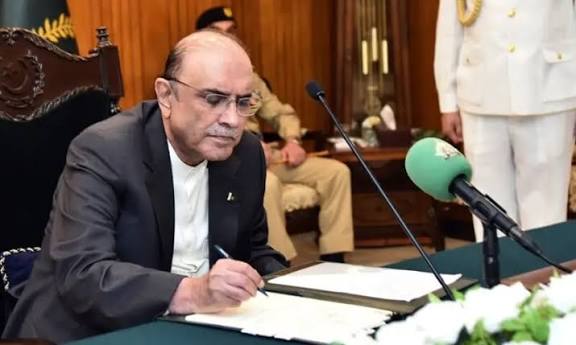
ISLAMABAD: President Asif Ali Zardari has approved the appointment of additional judges to five of the country’s high courts, ending a weeks-long standoff with the government that had left senior judicial posts vacant and prompted a legal challenge in the Islamabad High Court.
President Zardari gave his assent on Tuesday to a batch of appointments and confirmations that had been sitting on his desk since late July, according to a statement from the Presidency. The delay had triggered a constitutional dispute between the president’s office and the government, and left several sitting judges without formal office after their terms lapsed.
The Presidency said Zardari had approved the appointment of additional judges to the Lahore High Court, the Sindh High Court, the Peshawar High Court, the Islamabad High Court and the Balochistan High Court. He also signed off on the confirmation of a number of additional judges at the Sindh and Lahore courts, elevating them to permanent judges.
The approvals bring to an end a dispute that had rumbled on for more than three weeks and had begun to disrupt the day-to-day running of Pakistan’s superior courts.
The Judicial Commission of Pakistan, the body responsible for nominating judges to the country’s senior judiciary, made its recommendations at meetings on 20 and 21 July. It proposed the appointment of 19 additional judges across the Lahore, Islamabad, Sindh and Balochistan courts, the confirmation of four additional judges at the Peshawar High Court, and a six-month extension for one additional judge at the Sindh court.
Under the constitution, those recommendations had to pass through the prime minister before reaching the president. Article 175-A requires the Judicial Commission’s advice to be forwarded to the prime minister, who then submits a summary to the president for approval. That summary was sent on, but then stalled indefinitely once it reached the Presidency.
Behind the delay lay a set of objections raised by the president’s legal team, who queried the fairness of the Judicial Commission’s proceedings. They noted that almost all of the nominees put forward by the Pakistan Peoples Party, Zardari’s own party, had been passed over, and raised concerns that some of the candidates recommended for appointment had criminal records.
The consequences of the impasse were not merely procedural. Four additional judges at the Peshawar High Court, whose confirmations had already been recommended by the commission, lost their positions when their terms expired on 4 August, because the formal notifications needed to keep them in post had never been issued. An additional judge at the Sindh High Court, who had already had his term extended once by six months, was forced to stand down when his tenure ran out on 29 July.
As the deadlock dragged on, the government began weighing whether it could sidestep the president altogether. Officials examined the possibility of invoking Article 48(1) of the constitution, which would have allowed the law ministry to issue the appointment notifications directly. The argument advanced was that the president was obliged to act on the summary within a fortnight of receiving it, and that this window had long since closed.
That option was ultimately shelved. Government figures later indicated that with the matter now before the courts, pushing ahead with notifications unilaterally was no longer viable. Instead, sources said, the government’s legal team had been working towards an out-of-court resolution with the Presidency’s own lawyers.
The Presidency, for its part, rejected the idea that Article 48(1) could be used to override the president’s role in judicial appointments. Its legal team argued that Article 175-A set out no fixed deadline for presidential action, and that the provision could not simply be bypassed. They pointed instead to Article 48(2) of the constitution, which allows the president to act at his own discretion on matters the constitution specifically entrusts to him, and which shields such decisions from being challenged on any ground.
Government sources took a different view, insisting that judicial appointments remained a matter governed squarely by the constitution, and that any dispute over how they should proceed had to be settled within its terms rather than through discretionary powers.
The row eventually reached the courts. A petition challenging the delay in presidential approval was lodged with the Islamabad High Court by advocate Luqman Zafar, who argued that the nominations cleared by the Judicial Commission in July had been forwarded to the president under Article 175A(8) but had simply been left unresolved.
At a hearing on Monday, Justice Arbab Muhammad Tahir pressed the government over what had happened to the summary, noting that more than eighteen days had passed since it was sent for approval. The court issued notices to both the president and the prime minister, via their respective secretaries, and ordered replies by Tuesday. In a written order, the judge directed the federal government and the law ministry to explain when the summary had reached the president and what, if anything, had been done with it since — and to address the wider constitutional question of what it means to leave advice on judicial appointments unresolved beyond the period the constitution allows.
A separate petition, filed by advocate Luqman Chaudhary through his counsel Zahid Chaudhry, had also asked the court to direct the president to approve the summary. The Islamabad High Court reserved its verdict on Monday on whether that petition could proceed.
Tuesday’s announcement appears to have overtaken both cases, at least for now, by delivering the approvals the petitioners had been seeking through the courts.
Copyright © 2021 Independent Pakistan | All rights reserved