By Staff Reporter
ISLAMABAD: The government lowered the retail price of petrol while raising the cost of high-speed diesel on Tuesday, the latest adjustment since authorities scrapped weekly fuel-price reviews in favor of daily ones — a shift officials have linked to the volatility gripping oil markets since the war between the US and Iran broke out in February.
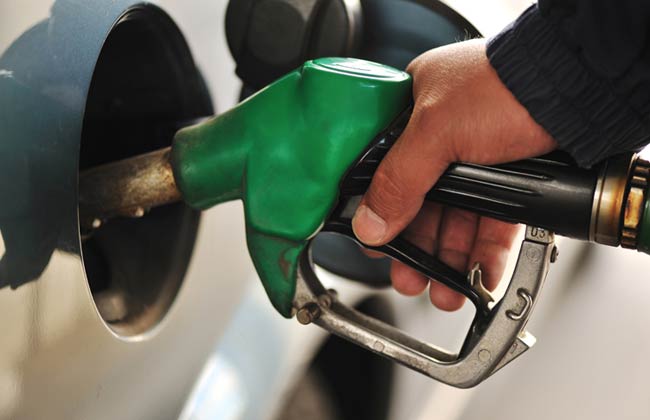
The Petroleum Division said petrol will fall by Rs1.70 a litre to Rs325.92, effective August 12, while high-speed diesel — the fuel underpinning Pakistan’s trucking fleet, farm machinery and a meaningful share of its power generation — will rise by Rs1.39 a litre to Rs382.25. The government’s tax take stayed largely intact: Rs114 a litre on petrol and Rs100 a litre on diesel.
A war that shut a fifth of the world’s oil route
The pricing shift traces back to February 28, when the US and Israel launched airstrikes on Iran, killing Supreme Leader Ali Khamenei and other senior officials in an operation that opened what is now called the 2026 Iran war. Iran responded by closing the Strait of Hormuz to US- and Israel-allied shipping and firing on vessels in the waterway — a corridor that normally carries close to a fifth of the world’s crude oil supply, according to the International Energy Agency, which has described the disruption as unprecedented in the history of oil markets.
Brent crude, trading in the low $70s before the war, spiked toward $118 to $120 a barrel in March as the closure took hold, though the exact peak varies by tracker. A Pakistan-brokered ceasefire on April 8 briefly allowed partial reopening before Iran restricted passage again on April 19, and prices have continued to whipsaw since: Brent traded near $83 in early July after a fresh flare-up, climbed toward $88 in early August, and was near $83 again this week amid on-again, off-again talks between Iran and Oman over a framework for reopening the strait. Iran has said it will not fully lift restrictions until Washington ends its naval blockade, lifts sanctions and agrees to compensation for war damage.
Pakistan among the most exposed
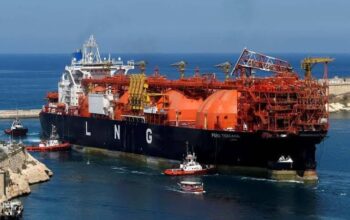
Analysts have flagged Pakistan as one of the countries most vulnerable to the fallout, largely because of its near-total dependence on Gulf gas rather than crude alone. Qatar and the United Arab Emirates supply roughly 99% of Pakistan’s liquefied natural gas imports, according to a Nomura note, a concentration that leaves the country with little room to substitute supply if flows are disrupted. Go Katayama, a principal insight analyst at commodities data firm Kpler, said Pakistan’s limited storage and procurement flexibility means a serious disruption would more likely trigger power-sector demand cuts than aggressive spot-market bidding.
It was against that backdrop that Petroleum Minister Ali Pervaiz Malik last month announced Pakistan would move to daily fuel-price reviews, citing swings in international crude tied to the renewed Iran-US conflict. The federal cabinet, with the prime minister’s approval, handed responsibility for setting those daily rates to the Oil and Gas Regulatory Authority, which calibrates prices against international benchmarks. The change replaces the weekly revision cycle Pakistan had used since early March, when the government also rolled out fuel-conservation measures anticipating supply disruptions from the conflict. In April, as prices climbed toward their domestic peak, the federal government added targeted subsidies to soften the impact on consumers.
Domestic pump prices have tracked that volatility, though on a lag and scale shaped by Pakistan’s own tax and subsidy settings rather than moving in lockstep with Brent. High-speed diesel peaked domestically at Rs520.35 a litre on April 3, up from Rs281 in the first days of March; petrol peaked at Rs458.41 on the same date. Tuesday’s prices sit well below both marks.
The move to daily reviews has drawn resistance from the All Pakistan Petroleum Dealers Association, which rejected the change and said it is considering a protest campaign, though it has not specified what form that might take.
Two fuels, two constituencies
The divergence in Tuesday’s pricing — petrol down, diesel up — lands differently across Pakistan’s economy. Petrol is consumed mainly in private cars, motorcycles and rickshaws, making it the fuel most directly tied to household budgets among Pakistan’s middle and lower-middle income groups. Diesel’s footprint is wider: it powers the freight trucks that move goods nationally, agricultural equipment, and a share of the country’s power plants and backup generators, so price swings there ripple into both transport costs and electricity generation.
Petrol and diesel remain Pakistan’s dominant petroleum products by volume and its largest source of fuel-linked government revenue, with combined monthly sales of roughly 700,000 to 800,000 tonnes. Kerosene, by comparison, sees monthly demand of about 10,000 tonnes.
Copyright © 2021 Independent Pakistan | All rights reserved