By Staff Reporter
QUETTA: At least 18 militants were killed in the restive Balochistan province on Wednesday after a car bomb they were assembling exploded prematurely, triggering a second blast and a manhunt in which security forces shot dead ten more terrorists as they tried to flee.
The military said the device, a vehicle-borne improvised explosive device intended for a future attack, detonated in the early hours of the morning in Surab district while militants from Fitna al-Hindustan were still preparing it. Eight of the attackers were killed instantly, with several more wounded, according to the Inter-Services Public Relations wing, the army’s media office.
The blast set off a second explosion among other explosives stored at the same site, killing three civilians who lived nearby, the ISPR said in a statement.
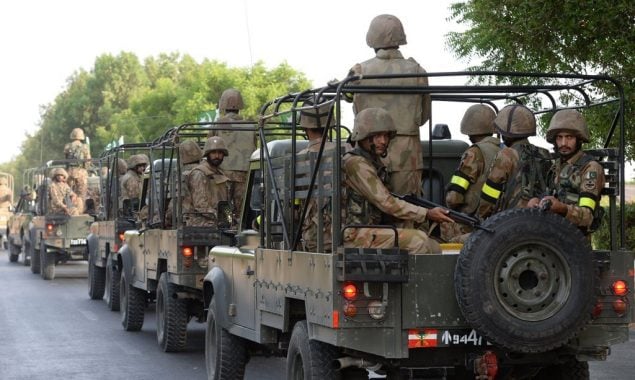
Troops and police from the Balochistan force were dispatched to the scene within hours and began a “comprehensive joint clearance operation” aimed at tracking down anyone connected to the plot. During the sweep, soldiers spotted a group of militants attempting to escape the area. A gun battle followed in which ten more fighters were killed, though two soldiers were wounded in the exchange.
“In total, 18 terrorists affiliated with Fitna al-Hindustan have been eliminated in these incidents so far,” the ISPR said, adding that searches were continuing in the district “to eliminate any remaining terrorists.”
Pakistan’s government formally designated separatist and militant groups operating in Balochistan as Fitna al-Hindustan last year, a label it uses to assert that India is bankrolling and directing the insurgency in the mineral-rich province.
The ISPR framed Wednesday’s operation as part of a broader campaign, known as Azm-e-Istehkam, that was signed off by the federal government’s National Action Plan committee. “The relentless counter-terrorism campaign … by security forces and law enforcement agencies of Pakistan will continue at full pace to wipe out the menace of foreign-sponsored and supported terrorism from the country,” the statement said.
Political reaction
Prime Minister Shehbaz Sharif and President Asif Ali Zardari both issued statements praising the security forces and police involved in the operation. The prime minister said he was grieved by the deaths of the civilians and described Fitna al-Hindustan fighters as “enemies of the peace and people of Balochistan,” vowing that the campaign against them would continue until the group was wiped out.
President Zardari wished the two wounded soldiers a swift recovery and offered condolences over the civilian deaths, saying operations against the militants and those who facilitate them “should continue” and that the country was determined to root out foreign-backed terrorism.
A province under growing pressure
Wednesday’s violence came a day after security forces said they had killed five suspected militants during an intelligence-led operation in Balochistan’s Panjgur district, and roughly a week after the army reported killing 15 fighters in a string of raids across Mastung, Bolan, Washuk, Awaran, Sibi, Khuzdar, Harnai and Nushki, part of what state broadcaster Pakistan TV described as Operation Raddul Fitna 3. Weapons and ammunition were recovered from the dead in those raids, according to the broadcaster, which said the strikes had “severely damaged” militant networks and restricted their movement.
The scale of violence in Balochistan has surged sharply this year. According to a monthly assessment published on 31 July by the Pakistan Institute for Conflict and Security Studies, the province’s overall death toll climbed 241 per cent in July compared with the previous month, rising from 109 fatalities in June to 372. Security personnel deaths jumped from six to 62, a rise of more than 900 per cent, while militant deaths rose from 75 to 238. Civilian deaths increased by 93 per cent, from 28 to 54, and 18 members of local peace committees were also killed during the month.
Separately, figures compiled by the Armed Conflict Location & Event Data project, a global monitoring group, show attacks across Pakistan have climbed sharply since 2022, from 658 that year to 2,425 in 2025, with strikes attributed to the Pakistani Taliban rising more than sevenfold over the same period.
Earlier this month, at least 30 people, including 27 police officers, were killed when militants identified by the state as Fitna al-Hindustan ambushed police in the Kach Mangi area of Ziarat district, setting off hours of gunfire and abducting several civilians and officers. The army, the paramilitary Frontier Corps and Balochistan Police launched a joint operation in response that the military says remains active.
On the final day of last year, militants killed 18 civilians, including women, children and labourers, in coordinated attacks in Balochistan’s Gwadar and Kharan districts.
Islamabad has long accused India of financing and directing separatist violence in Balochistan, and separately accuses the Afghan Taliban government of sheltering militants who carry out cross-border attacks into both Balochistan and Khyber Pakhtunkhwa province. Kabul rejects the claims and has urged Pakistan to address its internal security problems without implicating Afghanistan.
Militant groups active in the province, among them the Baloch Liberation Army, say the federal government and security establishment have denied local communities a fair share of Balochistan’s mineral wealth, fuelling decades of resentment. Islamabad rejects the accusation, pointing to infrastructure and livelihood schemes it says have been rolled out for residents. Last month the BLA carried out a series of coordinated attacks across the province, prompting the army, paramilitary forces and police to mount a joint anti-militancy campaign that continues to run alongside Wednesday’s operation in Surab.
Copyright © 2021 Independent Pakistan | All rights reserved