By Staff Reporter
ISLAMABAD: Pakistan is intensifying efforts to bring the United States and Iran back to the negotiating table, warning that unnamed actors are working to derail a peace process that has already delivered a ceasefire and a framework agreement, only for both to collapse in the past month.
The foreign office in Islamabad said on Wednesday that Pakistan would continue to “offset spoilers” obstructing dialogue between Washington and Tehran, as the country’s interior minister held talks with senior Iranian officials in Tehran in the latest sign of its determination to prevent the conflict from widening.
Pakistan has positioned itself as the leading mediator in the dispute since fighting broke out in February, when the US and Israel launched attacks on Iran. It brokered a ceasefire in April and hosted the first direct talks between the two adversaries later that month, work that produced the Islamabad Memorandum of Understanding — an interim framework giving Washington and Tehran 60 days to settle their differences.
That process fell apart last month when hostilities resumed after the US accused Iran of attacking commercial vessels in the Strait of Hormuz, one of the world’s most critical oil chokepoints.
“Pakistan is making all-out efforts to bring the two parties to the negotiating table, Islamabad and MOU, and pave the way for peace and stability in the region,” foreign office spokesperson Tahir Andrabi told reporters at a weekly briefing, declining to name any country or actor he considered a spoiler.
“Pakistan will continue to offset spoilers using direct and indirect channels and enable continuation of constructive dialogue to resolve all outstanding issues,” he added.
Message from Islamabad
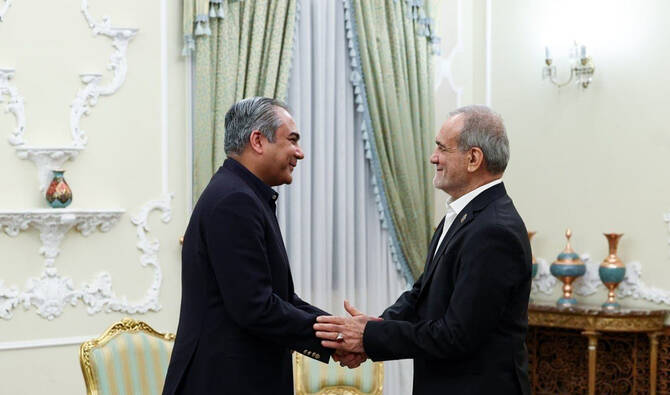
Interior Minister Mohsin Naqvi travelled to Tehran on Tuesday for talks with President Masoud Pezeshkian, Foreign Minister Abbas Araghchi and Petroleum Minister Mohsen Paknejad, carrying what Iranian state media described as a special message to the Iranian leadership from Prime Minister Shehbaz Sharif and Field Marshal Asim Munir, Pakistan’s army chief and Chief of Defence Forces.
The Islamic Republic News Agency reported that Naqvi briefed his hosts in detail on the newly signed Makkah Joint Defense Agreement between Pakistan, Saudi Arabia and Turkey, under which an attack on any one signatory would be treated as an attack on all three. The pact was signed on 7 August by Sharif, Saudi Crown Prince Mohammed bin Salman and Turkish President Recep Tayyip Erdogan.
Islamabad has repeatedly insisted the agreement is purely defensive and not aimed at any state; Turkey has offered the same assurance in relation to Iran.
IRNA said Naqvi was supporting Munir’s wider regional diplomacy, noting that the field marshal remains in direct contact with Gulf states, Iran and senior American officials. Pezeshkian, for his part, used the meeting to press for closer ties with Islamabad, telling Naqvi that Iran was “ready to further deepen its relations with Pakistan in all areas of interest to the two countries and to pave the way for the development of joint cooperation,” according to IRNA. Naqvi’s separate talks with Araghchi covered what the agency described only as key diplomatic issues and bilateral relations.
Andrabi told reporters in Islamabad that Naqvi’s visit centred on “bilateral relations, security, regional security and stability, and constructive engagement amongst the parties in the region.”
Shipping attacks cloud the picture
The renewed diplomacy comes against a backdrop of fresh violence at sea that has unsettled hopes of an early breakthrough. Four crew members were killed on Tuesday when Iran-backed Houthi rebels struck a small cargo vessel in the Bab el-Mandeb Strait — the first fatal attack on shipping by the group since the war began, according to Yemeni state media, which also reported that Houthi forces renewed ballistic missile strikes on the port of Mokha on Wednesday, a day after government forces said the port had already been hit by ten missiles and four drones.
Separately, US Central Command said a Navy MH-60 helicopter fired two Hellfire missiles to disable the steering gear of a Panama-flagged cargo ship that had ignored repeated warnings over violations of the American naval blockade on Iranian ports. Maritime sources told Reuters the vessel was struck off the coast of Pakistan as it sailed into the Gulf of Oman.
Tehran has warned it will keep the Strait of Hormuz closed unless Washington meets its conditions for ending the war. The waterway, which sits between Iran and Oman, handled roughly a fifth of the world’s oil and liquefied natural gas trade before the conflict began.
Brent crude, which has climbed steadily since February and peaked near $126 a barrel — about 75 per cent above pre-war levels — rose a further 35 cents to $89.26 on Wednesday, extending its gains to a sixth consecutive day amid the uncertainty.
Trump: “We will keep it”
President Donald Trump used a post on his Truth Social platform on Wednesday to declare that American forces would likely maintain their presence in the strait indefinitely. “The USA has total control over the Strait of Hormuz. I think we will keep it,” he wrote, describing the ongoing naval presence as a “wall of steel” against which “there is nothing Iran can do.”
Trump claimed Iran’s military had been “decimated and fleeing,” and painted a bleak picture of the country’s economy, citing “fake news and 300% inflation, and getting worse.” He added: “Iran is all talk and no action, the bully of the Middle East no longer.”
Speaking to reporters during a visit to Ohio on Tuesday, he struck a similar note, saying: “Iran is going fine, going just absolutely fine. We have a country that has been the bully of the Middle East for 50 years, really 51 if you think about it… and they’re no longer the bully of the Middle East.”
His comments followed a demand made on Monday that Iran pay compensation for people killed in what he called 50 years of wars, attacks and protests — the latest swing in a pattern that has seen the president alternate throughout the conflict between threats of further escalation and predictions that peace is close at hand.
Iran denies any progress — or any extension to talk about
A senior Iranian source told Reuters there had been no movement in efforts to revive the interim agreement reached in June, directly contradicting a report by Turkey’s Anadolu news agency — citing Pakistani government sources — that Tehran and Washington had agreed to extend the deal’s 60-day window.
“There is no talk of an extension because, from Iran’s perspective, there is no period that began and therefore nothing to extend,” the source said. “The United States violated the interim agreement 48 hours after it was reached and withdrew from it a few days later.”
The June accord had declared an “immediate and permanent termination of military operations on all fronts,” but collapsed within weeks. Trump declared it “over” on 7 July, and Iran’s foreign ministry followed a week later by calling it “suspended.” Washington maintains that Iran failed to honour its commitment to reopen the Strait of Hormuz; Tehran counters that the US reneged on promises to lift its blockade of Iranian ports and unfreeze Iranian assets abroad.
Under the original agreement, the 60-day window was meant to give both sides time to reach a final settlement curbing Iran’s nuclear programme in exchange for the lifting of American sanctions, with a ceasefire in Lebanon, free navigation through the Gulf and waivers allowing Iran to resume oil exports all regarded as preconditions for entering that phase of talks.
“One of the issues that is being discussed via mediators is the US returning to the interim agreement and defining a timeframe for implementing the commitments,” the Iranian source said. “There has been absolutely no progress on this issue.” Washington did not immediately respond to a request for comment.
The dispute over whether an extension is even on the table has coincided with sharpening rhetoric on both sides. Iran’s top security official, Mohsen Rezaei, reiterated on Tuesday that the Strait of Hormuz would stay closed until the US accepted Tehran’s terms, while Mohammad Reza Naqdi, a senior adviser to the Revolutionary Guard Corps commander, told PBS that the American military had proven “weaker than what we perceived.”
“Up until now, we are victorious. In the future, we will continue to be victorious,” Naqdi said. “We had never seen a real war to gain real experience to learn how to fight with America. In these five months, we have learned how.”
Separately, a spokesperson for Iran’s armed forces cautioned that renewed American aggression would put energy and internet infrastructure at risk worldwide. “In the event of renewed US aggression against Iran, energy transmission lines, power plants, all American and non-American systems, and even global internet-connected infrastructure are at risk,” he was quoted as saying by the state broadcaster IRIB.
A fragile note of optimism
Amid the escalation, Pakistan’s defence minister, Khawaja Asif, struck a more hopeful tone on Tuesday, telling Bloomberg News that Washington and Tehran were close to “some sort” of deal. “Things are shaping up again in favour of a peace arrangement or a deal,” he said. “The signals in the last two to three days are that we are close to some sort of an arrangement.” Qatar, which alongside Pakistan has served as a principal mediator, said separately that talks on managing access through the Strait of Hormuz had reached an advanced stage.
The conflict has killed thousands of people, mostly in Iran and Lebanon, since the US and Israel launched their initial attacks on 28 February. Iran has retaliated against American assets and infrastructure in Oman, Jordan, Kuwait, Israel, the United Arab Emirates and Saudi Arabia over the course of the war.
Copyright © 2021 Independent Pakistan | All rights reserved