By Staff Reporter
KARACHI: Investigators probing the murder of young Karachi businessman Mir Raza Ali have enlisted the National Cyber Crime Investigation Agency (NCCIA) in an attempt to unlock his digital footprint, as the case took several fresh turns this week, including the removal of the doctor who conducted the first post-mortem examination.
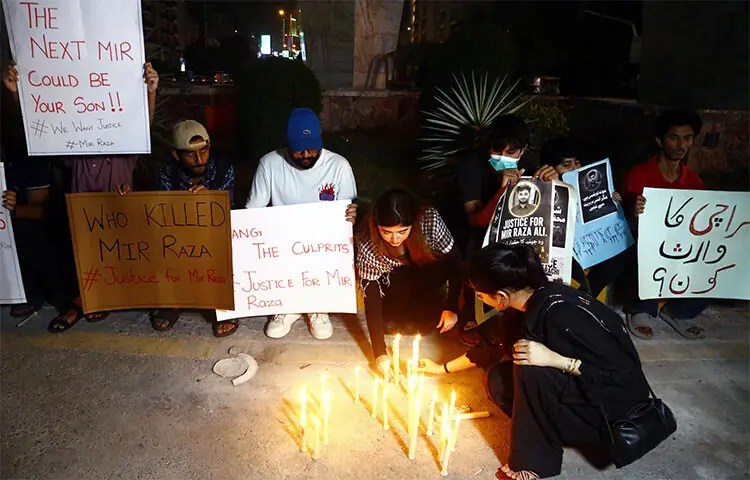
Raza, an IBA graduate and owner of the Wafflix eatery chain, went missing on 28 July. His bullet-riddled body was discovered the following day in bushes near the Shahi Qila Ground in Gulistan-i-Jauhar, in circumstances initially treated by police as a possible suicide.
Nearly two weeks on, that initial assessment has unravelled amid mounting scrutiny of the original investigation, a court-ordered exhumation, and pointed allegations from the family’s lawyer that the case was mishandled from the outset.
Digital trail under the microscope
A seven-member investigation team, headed by DIG Aamir Farooqi of the Crime & Investigation branch, is now examining geofencing data, digital evidence, the crime scene and witness statements in an effort to reconstruct Raza’s final movements.
Investigation SP Qais Khan has been assigned to handle digital currency records and other digital evidence, with the NCCIA brought in to help retrieve data from Raza’s WhatsApp account and other digital records that investigators believe could prove decisive.
Police have carried out geofencing around the crime scene to pull mobile phone data from towers belonging to three network operators covering the area, though officers say the analysis has been complicated by the number of days that have elapsed since Raza’s death. A search was also conducted within a 500-metre radius of where his body was found, and investigators have obtained partial data from his smartwatch, with efforts ongoing to retrieve its full contents.
Responsibilities within the team have been divided by discipline: SSP Ali Raza is overseeing crime scene evidence, DSP Hanif and Inspector Chaudhry Ghazanfar are handling forensic evidence and geofencing, and Investigation SP Anam Tajamul is managing medico-legal matters, including the second post-mortem, the exhumation and laboratory reports. The team is also drawing on technical support from the Citizens-Police Liaison Committee (CPLC).
Taxi driver’s account
Investigators have also taken a detailed statement from Ehsanullah, the ride-hailing driver who collected Raza from his home and dropped him in Gulistan-i-Jauhar on the afternoon of 28 July. According to his account, he received the ride request at 3.57pm and reached Raza’s location nine minutes later. He said Raza directed him along a route taking in Tariq Road, Bahadurabad, Stadium Road and Dalmia before arriving in Gulistan-i-Jauhar, and that the complete trip record remains available through the ride-hailing company.
MLO removed over autopsy concerns
In a significant development, Dr Usama Sheikh, the medico-legal officer at Jinnah Postgraduate Medical Centre who carried out the first post-mortem examination, has been removed from his post amid allegations of serious errors in his original report. He is due to appear before an inquiry committee to explain the shortcomings identified in that examination.
The first post-mortem had come under sustained criticism, not least over the initial absence of any firearm or spent cartridge at the scene. A .30-bore spent cartridge was later recovered near the body, though the weapon believed to have been used has still not been found.
Following concerns raised by Raza’s family and inconsistencies in the original medical findings, a court ordered his exhumation. A second post-mortem was carried out on 8 August by an eight-member medical board headed by Police Surgeon Dr Summaiya Syed, during which seventeen samples were collected for DNA and chemical analysis. That examination reportedly identified multiple ante-mortem injuries and possible signs of acid exposure, deepening questions over how Raza died.
In light of the new findings, Section 302 of the Pakistan Penal Code, which covers murder, was added to the First Information Report, which had originally cited Section 365 (abduction). Section 201, concerning the destruction or concealment of evidence, was subsequently added as well.
Police have since sealed a guest house near the site where Raza’s body was found and questioned around twenty people in connection with the case, including six members of staff at the guest house, as they examine the premises and the movements of those linked to it.
Raza’s family has voiced confidence in the new investigation team and has resisted calls for the immediate formation of a judicial commission, though they have asked for a CPLC representative to be included to provide technical assistance.
Lawyer alleges cover-up, points to new evidence
Civil rights lawyer Jibran Nasir, who is representing Raza’s family, said the fresh forensic findings had reinforced the family’s conviction that Raza was murdered, and argued the case had been wrongly characterised as a suicide from the beginning despite what he called obvious inconsistencies at the scene.
Nasir said the original post-mortem had never actually concluded that Raza took his own life, but had simply noted that the bullet appeared to have entered from the front. He argued that the absence of a firearm and cartridge casing at the scene, insufficient blood evidence at the site, damage to Raza’s body and the removal of fingerprints from both hands should have led investigators to treat the death as a probable homicide from the outset.
According to Nasir, the doctor who conducted the first examination has since issued a final opinion, following the receipt of chemical analysis results, concluding that the case was not a suicide and that the bullet had likely entered from the back, based on gunpowder residue found on the rear of Raza’s shirt. He said the examination had also detected traces of acid along with sedative or anaesthetic substances, which he described as further evidence pointing towards homicide.
Nasir said the findings of the first and second post-mortems should not be seen as contradictory, and accused senior police officials of continuing to downplay what he characterised as serious failings in the original investigation.
He also raised concerns over the handling of Raza’s smartwatch, his mobile phone and a DVR recovered from the guest house, saying gaps in the documentation and chain of custody for these devices could jeopardise evidence that may eventually be required in court. Nasir said he believed the conduct surrounding the case warranted scrutiny under Section 201 of the Penal Code.
He said the family had been in contact with the new investigation team led by DIG Farooqi, but that it remained too early to judge whether the team had made meaningful progress. Nasir said CCTV footage shared with the family appeared to show Raza for the last time at around 4.38am, while the revised medical assessment placed his death between 5pm and 7pm on 28 July, leaving roughly twelve hours of his movements unaccounted for.
He said the family was not pressing for any particular suspect or location to be pursued, and had instead given investigators information about Raza’s financial dealings, social contacts and movements, while cautioning against the production of a convenient suspect unsupported by evidence capable of withstanding scrutiny in court. Nasir said the circumstances raised the possibility that a more organised and powerful group could be involved, though he stressed this remained for investigators to establish.
He called on the Sindh government and police to allow the investigation to proceed without interference, saying the authorities faced a choice between establishing the facts and restoring public confidence, or continuing to face scrutiny over how the case has been handled.
Copyright © 2021 Independent Pakistan | All rights reserved