By Staff Reporter
ISLAMABAD: The prime minister has warned India that any interference with the country’s water supply will be treated as a red line, using the unveiling of a war memorial in Islamabad to deliver a pointed warning to Delhi over the fate of a decades-old water-sharing treaty.
PM Shehbaz Sharif told a ceremony marking the eve of Pakistan’s Independence Day that “every drop of water is our red line,” and that India would receive “a direct response” if it did not change course. The remarks were his most explicit yet on the Indus Waters Treaty, which India suspended unilaterally after last year’s brief but intense conflict between the two nuclear-armed neighbours.
“India must come to the right path, otherwise it will be given a direct response,” Sharif said, addressing the inauguration of the Yadgar-e-Fatah — or Victory Monument — in the capital on Thursday night. He insisted that Pakistan’s desire for peace should not be read as weakness, telling the gathered crowd: “With dignity and determination, we are resolute for peace.”
The monument, unveiled jointly with President Asif Ali Zardari, commemorates what Pakistan’s government calls “Marka-e-Haq” — the Battle of Truth — a four-day military confrontation with India last May that began after an attack on tourists in Indian-occupied Kashmir left 26 people dead. Delhi blamed Pakistan-backed militants for the assault, an accusation Islamabad has always rejected.
What followed was the most serious military escalation between the two countries in decades. India struck targets it said were linked to the Kashmir attack; Pakistan responded with force, and the fighting — which included air-to-air combat, drone strikes and cross-border shelling — continued for the better part of four days before a ceasefire was brokered on 10 May, credited by both Washington and Islamabad to intervention from the Trump administration. Pakistani officials maintain their forces downed eight Indian fighter jets during the exchange, including at least one French-made Rafale, along with a number of drones.
It was in the aftermath of that conflict that India suspended its participation in the Indus Waters Treaty, the 1960 World Bank-brokered agreement that has governed the sharing of the Indus river system between the two countries through decades of wars and diplomatic freezes. The treaty’s suspension has become one of the most sensitive unresolved threads of the post-war standoff, given how heavily Pakistani agriculture depends on the river system for irrigation.
Sharif’s warning on Thursday was his clearest signal yet that Islamabad regards the treaty’s status as a matter that could trigger renewed confrontation. “If anyone challenges Pakistan’s sovereignty and defence, they will receive an even stronger reply than in May 2025,” he told the crowd, adding that any future threat would be met with greater force than the response mounted last year.
A monument eight months in the making
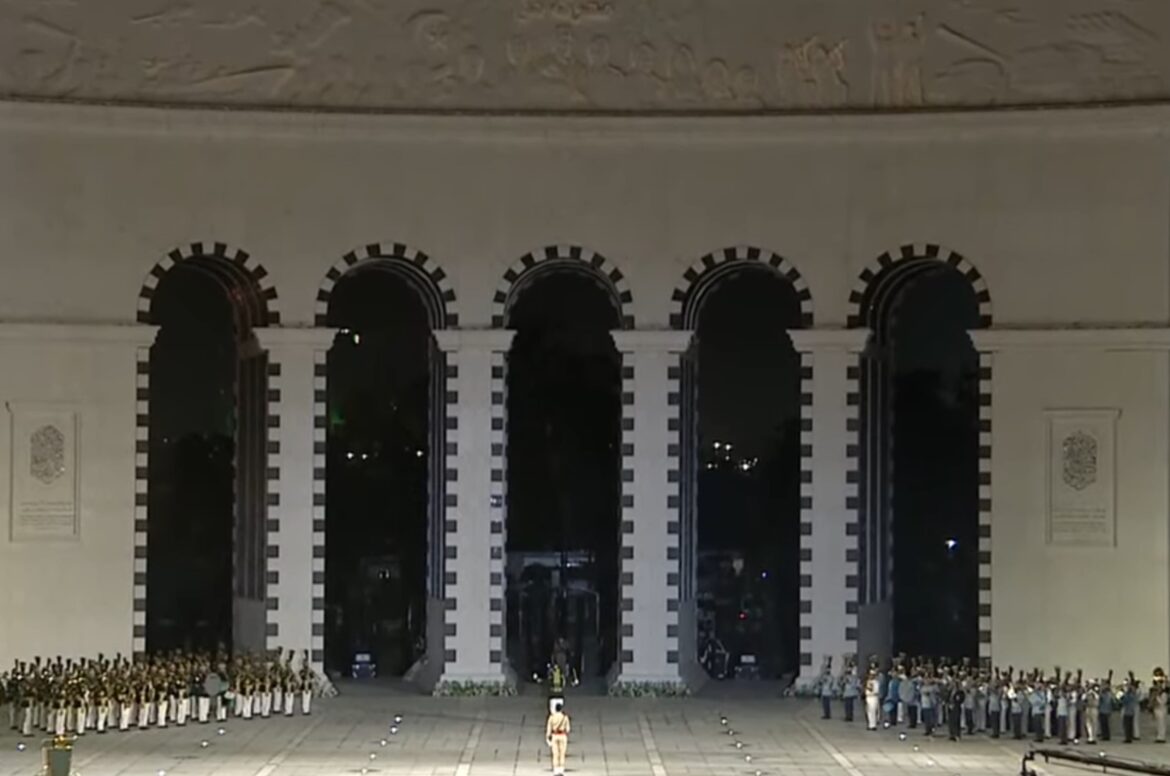
The ceremony itself was a heavily choreographed display of military and civilian unity, held on the eve of Pakistan’s 80th Independence Day. President Zardari and Sharif were joined by the country’s most senior military figures: Field Marshal Syed Asim Munir, the Chief of Defence Forces and Chief of Army Staff; Air Chief Marshal Zaheer Ahmad Babar Sidhu; and Admiral Naveed Ashraf, the naval chief. All stood as a military band played the national anthem.
Contingents from the armed forces, civil armed forces and police were drawn from all four provinces — Punjab, Sindh, Balochistan and Khyber Pakhtunkhwa — along with police units from Azad Jammu and Kashmir and Gilgit-Baltistan. The governors of Punjab and Khyber Pakhtunkhwa attended, as did Punjab’s chief minister, Maryam Nawaz, alongside the Chairman of the Senate, the Speaker of the National Assembly, federal ministers and a roster of foreign diplomats.
The monument itself — a marble structure completed in just eight months — was designed around five archways, intended to evoke both the five pillars of Islam and what officials describe as the five foundations of the Pakistani state: government, military, media, the public and the ideology underpinning the country’s founding. The design also nods to the three branches of the armed forces, and to newer domains of warfare, including cyber defence and space.
Sharif made a point of crediting Field Marshal Munir personally for the speed of construction. “Its completion in eight months would not have been possible if the field marshal hadn’t invested his deep interest,” he said, describing the monument as more than a structure of “blocks” — a tribute, he said, to those who died in last year’s fighting.
The inauguration included a light-and-sound display projected onto the monument’s façade, tracing Pakistan’s military history through to last year’s conflict, including footage said to show villagers and Punjab Rangers personnel firing on Indian drones together. The ceremony closed with a flypast by Pakistan Air Force jets, which released flares over the crowd as the aircraft passed overhead.
Water treaty and wider regional tensions
Beyond the confrontation with India, Sharif used the platform to set out a broader picture of Pakistan’s foreign policy, framing Islamabad as a stabilising force in a volatile region. He pointed to Pakistan’s role in mediating between the United States and Iran, and welcomed what he described as a ceasefire between Pakistan and India brokered by Donald Trump, expressing hope for deeper ties between Islamabad and Washington in the period ahead.
He also referenced the Makkah Joint Defence Agreement, noting that Turkey had since joined the pact, and described it as a marker of stability for the wider Middle East. Pakistan, he said, would continue backing the Palestinian cause and self-determination for the Palestinian people, while reiterating Islamabad’s long-standing position on Kashmir — a dispute that has driven three of the four wars fought between Pakistan and India since partition in 1947.
On Afghanistan, Sharif struck a more cautionary note, calling on the Afghan government to prevent its territory being used as a base for cross-border terrorism, without elaborating on specific incidents.
He closed his address on a domestic note, calling for national unity and pledging that his government would open up opportunities for Pakistan’s young population through investment in technology and human capital. “We are all heirs to Pakistan, and our differences should not turn into enmity,” he said.
Zardari: “We are not a small country to play with”
President Zardari, addressing the ceremony after the prime minister, framed last year’s conflict as a demonstration of Pakistani resolve rather than simply a military episode. “We are not a small country for you to play with,” he told the crowd, describing Pakistan as a “partner” within the international community rather than a state that could be pressured by its neighbours.
He drew a personal line back to Pakistan’s earlier conflicts with India, recalling that his own father had answered a call from the country’s founder, Muhammad Ali Jinnah, to fight in the 1948 war over Kashmir. “Most of Sindh, KP, other places, anybody who could carry an arm were there, and they fought against the Indian Army,” he said, adding that the resulting border arrangement — a reference to the Durand Line — had come at a cost still being reckoned with by subsequent generations.
The president also singled out members of Mr Sharif’s cabinet for praise, naming the deputy prime minister and foreign minister, Ishaq Dar, and the interior minister, Mohsin Naqvi, for what he called their “commendable” handling of the aftermath of the conflict. He was candid about the limits of governance, acknowledging that Pakistan, like any nation, carried its share of institutional weaknesses. “There is no nation in the world that can claim they have no weaknesses,” he said.
The events in Islamabad landed against a backdrop of continued uncertainty over the Indus Waters Treaty, whose suspension India has so far declined to reverse. For a country as reliant on the Indus system as Pakistan — where the river network underpins the bulk of the country’s irrigated agriculture — the treaty’s status is widely regarded in Islamabad as a matter of national survival rather than mere diplomatic leverage, which helps explain why Mr Sharif chose to frame the issue in such categorical terms on one of the most symbolically loaded nights in the political calendar.
Copyright © 2021 Independent Pakistan | All rights reserved