By Staff Reporter
KARACHI: The team investigating the murder of a 25-year-old Karachi dessert entrepreneur are examining a trail of drained bank accounts and deactivated social media profiles in the days before his death, as a dispute has broken out between his family and police over who has had access to a smartwatch that may hold crucial digital evidence.
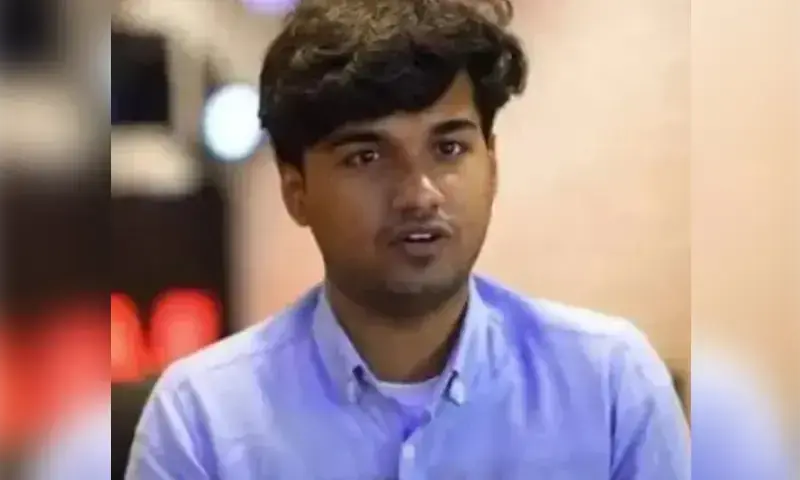
Mir Raza Ali, founder of the dessert chain Wafflix and a graduate of the Institute of Business Administration, disappeared from his home in the PECHS neighbourhood in the early hours of July 28, telling his mother he would be back within ten minutes. His body was found the next day dumped among nursery bushes near Shahi Qila Ground in Gulistan-e-Jauhar, close to the University of Karachi, bearing a gunshot wound.
What police initially treated as a possible suicide has, over the past fortnight, hardened into a murder investigation that has drawn in the provincial government, forensic agencies and a growing cast of detectives — driven at every turn by a family that refused to accept the original account of how their son died.
The turning point came earlier this month. Ali’s family had pressed for his exhumation after Karachi Police Surgeon Dr Summaiya Syed issued a memorandum on August 3 identifying fourteen separate deficiencies in the post-mortem carried out immediately after his death. A second examination found a gunshot entry wound on the upper right side of his back, an exit wound on the left side of his chest, a fractured rib, internal bleeding and other injuries sustained before death — findings that contradicted the original report and confirmed what his family had argued from the outset. On August 9, police amended the case to add a charge of murder under Section 302 of the Pakistan Penal Code, alongside the existing abduction charge and a further charge under Section 201 relating to the destruction of evidence. The case now runs under FIR No. 795/2026, filed at Ferozabad police station.
In the days since, the investigation has moved into a more granular phase, with detectives now working through the financial and digital record of Ali’s final days alongside the physical evidence gathered at the scene.
A financial trail cut short
Investigators have since widened their inquiry well beyond the crime scene itself, requesting forensic data from the National Cyber Crime Investigation Agency on Ali’s smartwatch, WhatsApp account and other social media profiles, while separately examining transactions across three of his bank accounts.
That financial picture, as it has emerged, shows a young business owner whose accounts were being steadily emptied in the run-up to his death. Bank records show one account fell to a zero balance on July 24, four days before he disappeared; a second account was drained on July 28 itself, the day he vanished. Investigators say Ali transferred a small sum from that second account into a third, and separately sent money to his parents, before leaving the house that night — a third account left holding just Rs720 by the time the transactions were complete.
At around 2:48pm during the investigation, Ali’s smartwatch is reported to have registered notifications showing that his social media accounts had been deactivated, apparently set to remain dormant until August 27 — two days before he had been due to marry.
The smartwatch itself has become a point of contention between the family and police. Jibran Nasir, the lawyer representing Ali’s relatives, has said the device remained in the possession of the previous investigation team’s leader for several days before finally being handed to the Cyber Crime Investigation Agency this week, and has raised concerns that it may have been tampered with in the interim. The family has asked instead that the smartwatch be sent to the Punjab Forensic Science Agency in Lahore for independent analysis, a request police have yet to grant.
Separately, a local media report citing investigation documents has said Ali had borrowed more than Rs50 million — roughly $180,000 — from ten individuals in the period before his death, with their names passed to the investigation team. His father has said the family cannot yet say what bearing, if any, the debts had on his killing.
‘Nothing unusual’ on the day he died
Speaking to local media, Ali’s father, Mir Hussain, rejected any suggestion that his son had shown signs of distress before he disappeared.
“He was very normal. He told his sister, ‘I am going out and will be back,'” Hussain said. “He also told his mother that he would be back in 10 minutes.”
Investigators have also recovered traces of acid on the shirt Ali was wearing, and a weapon holster from the scene where his body was found, though police have not said whether either is connected to his death. His family says it is still trying to establish whether he had been threatened or extorted in the weeks beforehand.
“Nothing is confirmed, nor does his partner know about anything,” Hussain said.
He described his son as an optimist who had built Wafflix from a single shop into a four-branch operation across Karachi, with hopes of expanding into other cities.
“Like Karachi has four branches, he wanted to open branches in every city,” Hussain said. “It was his dream that could not come true.”
Asked what punishment the family wanted for whoever is found responsible, Hussain did not equivocate.
“Exemplary punishment. Exemplary. That can be seen by the young generation as well as those who make them commit such things,” he said. “Hanging. Exemplary hanging.”
He said grief had left the family unable to sleep since his son’s death, which came weeks before Ali had been due to marry on August 29.
“We cannot close our eyes at night,” he said. “Be that his mother, his sister or myself.”
How the new investigation team took shape
The five-member team now running the case, led by Deputy Inspector General of Police Amir Farooqi, was constituted the same day the murder charge was added. Its formation came with a brief detour: the Sindh government moved on August 9 to establish a judicial commission, headed by a Sindh High Court judge, to oversee the investigation independently of the police, a step announced by provincial Home Minister Ziaul Hassan Lanjar after he and Karachi’s mayor, Barrister Murtaza Wahab, visited the family to offer condolences.
That plan was shelved within a day. Hussain wrote to the Sindh High Court’s chief justice objecting to the proposed commission, telling authorities the family had confidence in the newly formed police team and wanted it, rather than a judicial body, to carry out the inquiry. Lanjar confirmed on August 10 that the commission had been deferred “for the time being” at the family’s request, while insisting the provincial government remained committed to a transparent investigation.
Nasir, the family’s lawyer, said the decision to add a murder charge amounted to an acknowledgement that the case was “one of murder rather than suicide,” and was sharply critical of the original investigation team, whose credibility he said had been damaged by its early insistence on the suicide theory.
The team has since held at least two lengthy meetings at Ferozabad police station, each running close to four hours. Investigators have questioned the original investigating officer, reviewed statements from twenty-one people detained in connection with the case, and examined CCTV footage and a DVR that had reportedly remained in the custody of a local station house officer since the discovery of Ali’s body.
The team has also taken statements from officers who were among the first to reach the crime scene, from constables up to the rank of deputy superintendent, along with two former station house officers and personnel from the Madadgar emergency response service. Investigators have separately visited the site where Ali’s body was found and the spot nearby where he is said to have discarded his mobile phone, questioning gardeners working at an adjoining nursery.
Farooqi has declined to discuss the substance of the investigation while it remains active.
“The investigation is still underway,” he said. “Details will be shared with the media later.”
Business partner granted bail
Separately, a childhood friend and business partner of Ali’s has been granted interim pre-arrest bail in connection with the case. Muhammad Ahmed Bhardey, who ran Wafflix’s branch at Five Star Chowrangi while Ali managed the Bahadurabad outlet, applied to the Additional District and Sessions Court in East Karachi after alleging he was being harassed by police despite cooperating with the investigation.
His lawyer, Khalid Mumtaz, told the court his client had appeared for questioning whenever summoned and was willing to continue cooperating. The court granted bail against a surety of Rs100,000 and ordered Ahmed and the investigating officer to appear again on August 15, when the bail will either be confirmed or revoked.
A provincial government spokesperson, Nadir Gabol, said Sindh had treated Ali’s death “very seriously” and had instructed the new investigation team to work “professionally, transparently, and without haste.” A spokesperson for the Sindh police inspector-general declined to comment on the case, saying he was not authorised to speak to the media.
For Hussain, the investigation remains, above all, a search for a motive.
“He was a rising star, a rising businessman,” he said. “Who felt threatened by him? This is what we want to know.”
Copyright © 2021 Independent Pakistan | All rights reserved