By Staff Reporter
KARACHI: Pakistan’s fractious debate over redrawing its provincial map erupted again on Sunday, after the Muttahida Qaumi Movement-Pakistan announced it would lead a “grand national dialogue” on creating new provinces — a proposal that has already split the government’s own coalition and reignited historic tensions over the future of Sindh.
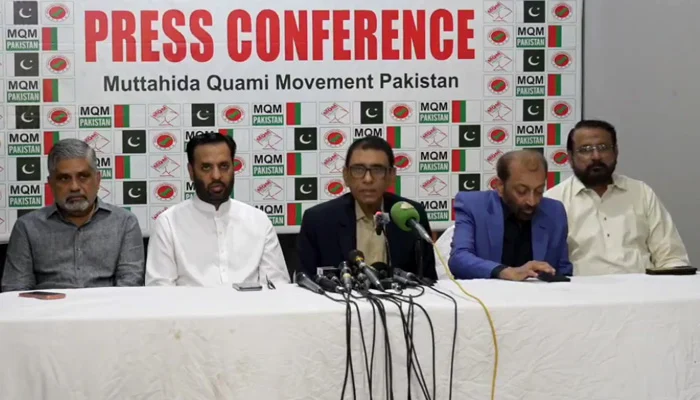
Addressing reporters in Karachi, MQM-P chairman Khalid Maqbool Siddiqui said Pakistan’s four provinces, carved out largely along linguistic lines decades ago, no longer reflect the realities of a country whose population has grown roughly tenfold since independence. He put the figure at around 25 to 30 million in 1947, compared with close to 250 million today. “More divisions have been created across the country than the rate of population growth, but provinces have not been created,” he told the press conference, flanked by senior party figures Farooq Sattar and Mustafa Kamal, the federal health minister.
It is not a new argument for the MQM-P, which has pressed the case for smaller, more accountable administrative units for the better part of four decades. But Sunday’s press conference marked a deliberate escalation: rather than simply repeating a long-standing demand, Siddiqui framed it as the organising principle of the party’s future political strategy, alongside a renewed push to enforce Article 140-A of the constitution, the local-government provision introduced under the 18th Amendment in 2010.
“There is a need for a major national dialogue, and we are going to initiate it,” Siddiqui said, adding that the party intended to approach every political force in the country — not only in Sindh — to build consensus around the idea. He was careful to note that the case, in his view, is strongest in Sindh, but insisted the demand was national in scope. “Wherever there is support for new provinces, we will stand with that voice,” he said.
Siddiqui’s remarks follow a proposal last month from interior minister Mohsin Naqvi, who told the Pakistan Economic Summit in Islamabad that the country’s governance structure had “collapsed” and that new administrative units were the only viable path forward. The following day, the military’s spokesperson lent the idea further weight, telling political parties that the country’s security and stability depended on adapting governance to modern demands and a growing population — a rare public intervention that has kept the issue alive in Islamabad’s power corridors ever since.
Local media reported that serious discussions on the most workable approach were already under way, and the government may be a precursor to a proposed 28th constitutional amendment — though they cautioned the idea remained at an early stage and that building consensus among major parties, several of which oppose it outright, would be “a major challenge.”
The Sindh question
Nowhere is that challenge more apparent than in Sindh, where the MQM-P’s ambitions collide directly with the Pakistan Peoples Party, which governs the province and sits alongside MQM-P in the coalition government at the centre.
Siddiqui was at pains to frame the party’s proposal as administrative rather than territorial. Recalling the migration of his community to Sindh after Partition, he said the MQM-P held “immense respect” for the Sindhi community that had received them, and suggested — in a striking aside — that a “thanksgiving day” might one day be observed in that spirit. He also revisited the disputed history of land ownership in the province, saying that much of Sindh’s territory had belonged to Hindus who left for India after Partition, and that migrants had effectively moved into homes and land vacated by that departure rather than displacing Sindhis directly.
Kamal was more pointed on the practical case. He argued Karachi and Hyderabad together account for around 43 percent of Sindh’s population — 38 percent and five percent respectively, by his figures, based on census data the MQM-P disputes as an undercount — yet wield no meaningful influence over who governs the province. “Even if a single vote from Karachi and Hyderabad did not go to the existing provincial government, we could not change our chief minister,” he said. He pointed to chronic failures in water supply, sewage and waste management, and cited Rs22 trillion in federal transfers to Sindh over 18 years as evidence that the province’s problems were not primarily about a shortage of money. “This is not a division. It is an administrative arrangement,” he said, adding that new units would not shift so much as “an inch” of territory between provinces.
Sattar, for his part, argued the stakes extended beyond Karachi’s grievances to the stability of the state itself. “If the status quo is not ended, rebellions will emerge in different parts of the country,” he warned, cautioning that people who grow alienated from the constitution and the law risk becoming alienated from Pakistan altogether. He put Karachi’s contribution at around 60 per cent of national tax revenue and 90 per cent of Sindh’s, with 55 per cent of the country’s exports originating in the city — figures he used to argue that its political marginalisation carried disproportionate consequences. He proposed that existing divisions such as Larkana, Sukkur and Mirpur Khas could form the basis of new administrative units, each with its own elected leadership, and reserved some of his sharpest language for Sindh’s entrenched political class: “The real enemy of Sindh is the feudal lord, the landlord and those who practise hereditary politics.”
A fraught legal history
Much of Sunday’s press conference centred on Article 140-A, which obliges provinces to devolve political, administrative and financial authority to elected local governments — a provision Siddiqui said the MQM-P had championed as part of its support for the 18th Amendment, and one he said remained unfulfilled fifteen years on.
The party has already tested that argument in court. Siddiqui said the MQM-P previously petitioned the Supreme Court over the lack of implementation, securing a ruling he described as applicable nationwide but subsequently ignored, and confirmed the party would now instruct lawyers to return to the court to seek contempt proceedings over what he called the “desecration” of that ruling. He also pointed to a constitutional amendment bill the party has already tabled in the National Assembly, which has not been rejected outright but remains stalled before a parliamentary standing committee.
Asked to justify a demand that critics regularly cast as unpatriotic, Siddiqui turned to the constitution itself. “If this demand is such a big danger, then remove it from the constitution. Why is this demand in the constitution?” he asked, noting that provisions for creating new provinces already exist in law. He argued, however, that provincial governments could never be relied upon to relinquish their own territory or authority voluntarily. “Who would willingly allow the division of their property?” he said.
A coalition at odds with itself
The proposal has exposed real strain within the ruling coalition. While Istehkam-e-Pakistan Party president Abdul Aleem Khan backed the idea and renewed calls for South Punjab and Bahawalpur provinces, and PTI chairman Barrister Gohar Ali Khan endorsed the principle — provided it proceeds through proper constitutional process, including the required two-thirds majority in the relevant assemblies — senior figures within the government itself have kept their distance.
Defence minister Khawaja Asif and the prime minister’s adviser on political affairs, Rana Sanaullah, have both declined to endorse the plan. Sanaullah went further, telling a private news channel that the government had formulated no actual plan on new provinces, and questioned whether genuine public appetite for the idea existed at all beyond long-standing calls for a separate Hazara province. He noted that competing proposals ranged as high as 20 or more new provinces, and suggested Kamal’s push was really a Karachi-specific concern rather than a broader national movement.
Naqvi himself sought to walk back the more incendiary reading of his original remarks, saying that he remained part of the government and had no intention of issuing what he called a “charge sheet” against it. He said his description of a “collapsed” governance structure referred to institutional erosion accumulated over eight decades, rather than a verdict on the current administration.
PPP hits back
The sharpest response came from within Sindh itself. PPP leader Qadir Mandokhail, in a statement issued through the party’s official X account, said the PPP supported the principle of new provinces elsewhere in the country but would not accept any move against the integrity of Sindh. “No political party can target the unity of Sindh for its own interests,” he said, adding that Sindh was “not just a line on a map” that could be redrawn on a whim. In pointed language, he suggested that if MQM-P leaders did not wish to live alongside the people of Karachi, “we can build them houses on the Sindh-Balochistan border” — and dismissed the party’s councillor-free standing in local government as proof it lacked a genuine public mandate.
Sindh information minister Nasir Hussain Shah went further still, dismissing the press conference as a symptom of the MQM-P’s political isolation rather than a serious policy proposal. He suggested Siddiqui was showing signs of “severe mental stress,” adding acidly that “its treatment is only available with the federal health minister” — a reference to Kamal’s cabinet portfolio. Turning to Sattar, Shah predicted further fragmentation within the MQM-P itself, declaring that “the ‘M’ will separate from the Muttahida, while the remaining ‘F’ will keep spinning like a ribbon.” His message on the underlying demand was unambiguous: “Sindh will not be divided, but I certainly see the Muttahida being divided.”
Copyright © 2021 Independent Pakistan | All rights reserved