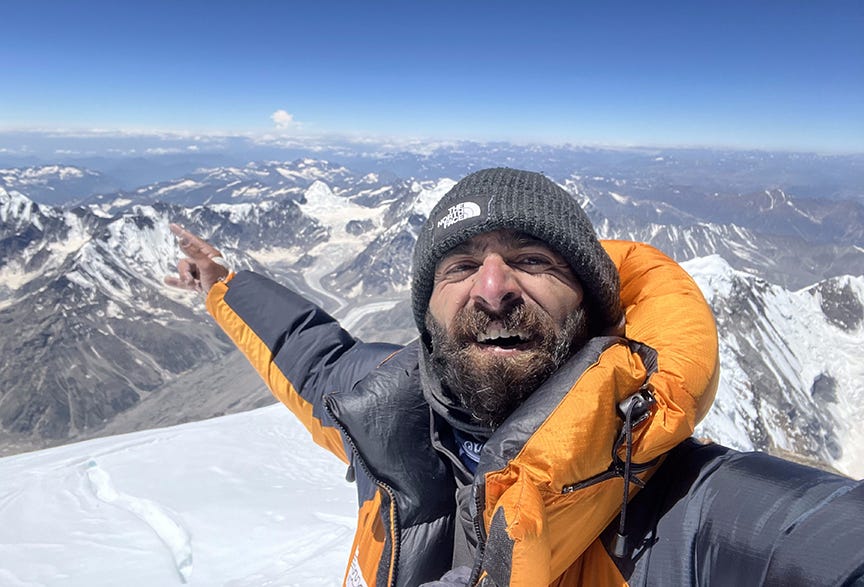
By Staff Reporter
HUNZA: The body of Pakistani mountaineer Sohail Sakhi was laid to rest on Sunday in his home village of Aliabad, in the Hunza district of Gilgit-Baltistan, following funeral prayers attended by hundreds of mourners, more than a fortnight after he was killed in an avalanche on one of the world’s highest peaks.
Sakhi, 30, was one of ten climbers caught in the disaster that struck Broad Peak on 30 July, when a wall of snow swept through the expedition team as they moved between camps on the 8,051-metre mountain in Pakistan’s Karakoram range. His body was recovered from the mountain on 13 August and carried down to base camp, more than two weeks after he vanished into the snow.
The expedition had been led by the British-Nepali mountaineer Nirmal Purja, one of the best-known names in high-altitude climbing, whose own body was found on 2 August and flown home to Nepal. Of the ten climbers swept up in the avalanche, eight bodies have now been recovered. Search teams are continuing to look for the American climber Sarah Mallory Geis and Nepal’s Nawang Thindu Sherpa, both of whom remain missing.
Sakhi’s remains were flown by Pakistan Army helicopter from Broad Peak base camp to Skardu on Saturday, before being driven onward to Nasirabad and finally to Aliabad early on Sunday morning. Funeral prayers were held at Aliabad College Ground, where mourners gathered alongside Naiknam Karim, Gilgit-Baltistan’s minister for tourism and culture, and officials from the district administration.
Addressing those gathered, Karim described Sakhi’s death as a loss that extended far beyond his home valley. “We have gathered here to say goodbye to a brave mountaineer of the land,” he said, calling the loss one that would be felt across both Gilgit-Baltistan and Pakistan as a whole.
The minister said Sakhi had built a formidable reputation in the mountaineering world in a comparatively short career, telling mourners that the climber had “loved mountains” and had made his name known well beyond the valley where he grew up. He offered condolences to Sakhi’s family before mourners moved to bury him in the family’s ancestral graveyard in Aliabad.
Sakhi had built his reputation as one of Pakistan’s most capable high-altitude climbers, regularly leading rope-fixing teams on major expeditions — the demanding and dangerous work of securing lines up a mountain’s most technical sections so that other climbers can follow. He was also known within Pakistan’s small mountaineering community for volunteering repeatedly in rescue operations, often putting himself at risk to help others descend safely from the mountains he had spent his life climbing.
Sajid Hussain, assistant director at Gilgit-Baltistan’s tourism department, said the provincial government would pay three million rupees to Sakhi’s family under an insurance scheme set up for local porters, climbers and mountain guides, in comments reported by the newspaper Dawn.
The Broad Peak avalanche has been described as one of the deadliest single incidents to strike Pakistan’s mountaineering industry in recent memory, claiming climbers from Pakistan, Nepal, the United States and beyond in a single catastrophic event. The scale of the loss, and the prominence of Purja among those killed, drew international attention to the disaster and to the risks faced by the guides and support staff who make Pakistan’s 8,000-metre peaks accessible to foreign climbers each summer.
For Gilgit-Baltistan, and for Hunza in particular, Sakhi’s death carries a weight that goes beyond a single tragedy on a distant mountain. The valley has long supplied the guides, porters and high-altitude workers who underpin Pakistan’s mountaineering economy, and his loss was felt as a blow to a community whose livelihoods, and often whose lives, are tied to the peaks that surround them.
Copyright © 2021 Independent Pakistan | All rights reserved