By Staff Reporter
ISLAMABAD: An Emirati political analyst and former aide to the UAE president has triggered a wave of anger after mocking Pakistan’s poverty and illiteracy rates in an attempt to question the country’s standing as a defender of Saudi Arabia — a post that has instead exposed the contradictions in his own position, and the depth of an unfolding rift between the UAE and its Gulf neighbours.
Abdulkhaleq Abdulla, who has previously advised President Mohammed bin Zayed, wrote on X on Friday that it was “one of the paradoxes of time” that a country where a quarter of the population lives in poverty and a third cannot read or write should be positioning itself, in his words, opportunistically to defend a state ranked among the world’s twenty largest economies.
Writing in Arabic, Abdulla pointed to Pakistan’s roughly $400 billion national income and its nuclear arsenal, arguing that a country which had endured decades of what he described as corrupt military rule, chronic internal unrest and wars with its neighbours was now leaning on some 170 nuclear warheads as its sole real qualification for the role.
The remarks were widely read as a response to the Strategic Mutual Defence Agreement Pakistan and Saudi Arabia signed on 17 September 2025, under which an attack on either is treated as an attack on both, since expanded into the broader Mecca Joint Defence Agreement that also draws in Turkey.
Abdulla’s post has since been viewed more than a million times, and the backlash was immediate. Pakistan is home to one of the largest expatriate communities in the UAE — close to 1.6 million people — whose remittances remain a significant source of income for the Pakistani economy, a fact several critics raised directly. One user wrote that comparing poverty levels and the size of an economy with a state’s political standing was misleading: Pakistan, they argued, was a sovereign state entitled to pursue its own alliances regardless of its wealth, and reducing its credentials to nuclear weapons ignored its demographic weight, its geopolitical significance and an economy that has passed $400 billion.
The criticism quickly moved beyond the economics. Several commentators pointed out that Abdulla’s mockery of Pakistan’s defence credentials sat awkwardly next to the UAE’s own security arrangements, which rely heavily on American military bases and hardware on Emirati soil — the very kind of outside backing Abdulla was using to question Pakistan’s legitimacy as a defender of anyone. Others resurfaced older posts to accuse him of straightforward inconsistency, including a 2015 comment in which he had urged Gulf and Saudi diplomacy to push harder to secure Pakistan’s own participation in the Saudi-led military campaign in Yemen, and a separate post in which he had condemned Gulf commentators who called for normalisation with Israel — a call that sits uneasily beside the UAE’s status as the first Gulf state to formally recognise Israel.
This was not Abdulla’s first intervention on the Mecca pact. When the agreement was signed on 7 August, he had already struck a sceptical note, writing that while he congratulated those behind it, strengthening cooperation among Gulf states mattered far more than investing in wider regional arrangements involving countries whose ability to confront what he called the Iranian-Israeli threat was not taken seriously. Any successful alliance, he argued, needed a clearly identified common enemy — and he questioned who, exactly, this one was supposed to be against.
That post drew a sharp rebuke from Saudi Arabia’s Prince Abdulrahman bin Musaid, who defended the pact as a matter of national sovereignty and asked why Emirati academic circles seemed uniquely troubled by Riyadh’s strategic choices. What, he asked, was the problem with an alliance, a treaty, an agreement, under any name — and how could it possibly conflict with unifying the Gulf, when any state had the right to make whatever agreements it judged served its own interests?
Fahad al-Arabi al-Harthi, chairman of the Asbar Centre for Studies and Research, made a similar case, insisting the Mecca agreement was not an alliance aimed at any particular target, since it was not built around identifying a common enemy but around building collective capacity for deterrence and protecting regional stability against any threat, from any direction. Other Saudi commentators were blunter, with one asking whether the UAE had bothered to inform its Gulf neighbours before establishing its own ties with Israel under the 2020 Abraham Accords.
As the exchange escalated, Abdulla pushed his argument further still, posting a message widely read as a rejection of pan-Islamic and trilateral solidarity in favour of pure national self-interest. Anyone who placed sect above homeland, he wrote, or Arab or Islamic nationhood above homeland, would never find safety; belonging and loyalty, he said, were owed to the homeland alone, with no partner.
That drew a pointed response from Abdulaziz al-Tuwaijri, a former head of the Islamic World Educational, Scientific and Cultural Organisation, the Rabat-based cultural and educational arm of the Organisation of Islamic Cooperation. Anyone who betrayed others and collaborated with what he called the Zionists, al-Tuwaijri wrote, would never find security — adding elsewhere that the Mecca agreement appeared to have left Abdulla dizzy. In a further post, he asked why the UAE’s own defence treaty with India and its extensive cooperation with Israel were treated as unremarkable while a Saudi-led pact with Turkey and Pakistan was being picked apart, closing with an Arabic proverb suggesting that those who have lost their sense of shame are, in every sense that matters, already dead.
The episode sits inside a wider and increasingly public rift between Abu Dhabi and Riyadh. The UAE was the first Gulf state to formally recognise Israel; Saudi Arabia has so far resisted American pressure to follow. Relations between the two have been further strained by Abu Dhabi’s backing of separatist groups in southern Yemen, and analysts see the Mecca pact partly as a counterweight to the UAE’s military cooperation with Israel — a relationship that remains deeply unpopular across much of the Arab world outside Israeli and American circles.
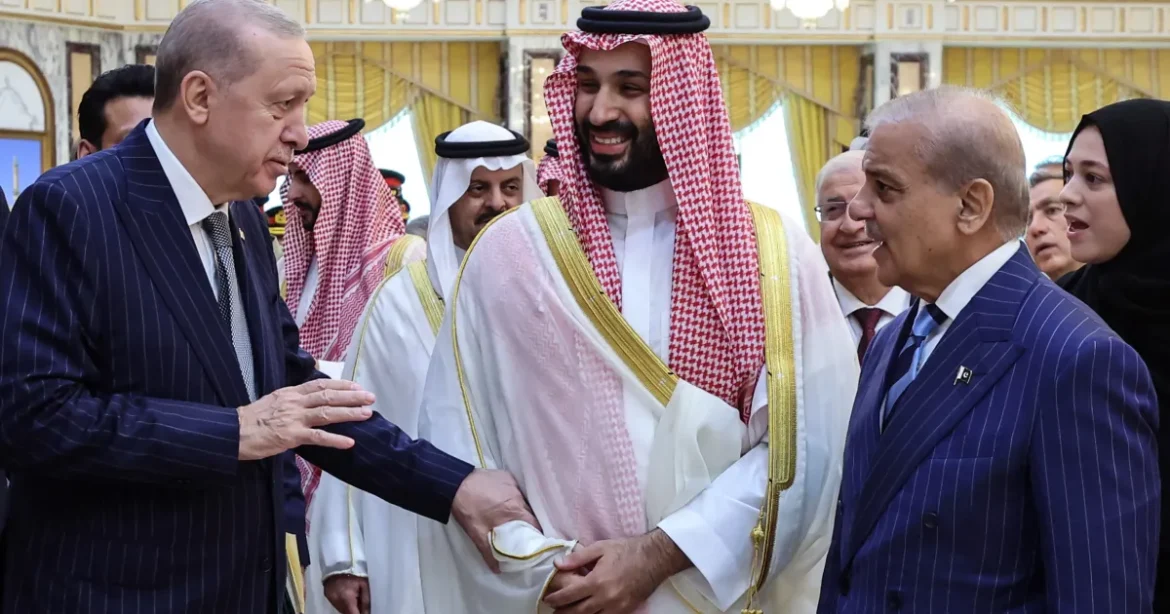
Theodore Singer, a former US intelligence officer, told Arab media that while the UAE-Israel relationship may deliver more immediate, tangible gains for both sides, the Mecca pact could ultimately carry broader resonance precisely because it is not purely transactional. The contrast was thrown into sharp relief in May, when Israeli prime minister Benjamin Netanyahu said he had visited the UAE at the height of the war with Iran — a claim Abu Dhabi moved quickly to deny. The Mecca pact, by comparison, was marked with considerable public fanfare, with Saudi Crown Prince Mohammed bin Salman, Pakistani prime minister Shehbaz Sharif and Turkish president Recep Tayyip Erdogan photographed attending Friday prayers together in Mecca. Some analysts argue that this open, public codification gives the pact room to grow in ways the more discreet UAE-Israel relationship cannot.
The Abu Dhabi-Riyadh rivalry is also playing out in the debate over who was left out of the new pact altogether. Saudi Arabia is understood to have opposed Egypt’s inclusion, amid growing unease in Riyadh over what officials there see as Cairo’s deepening alignment with the UAE. Egypt supplied air defence systems and fighter jets to Abu Dhabi following Iranian strikes, and President Abdel Fattah el-Sisi visited Mohammed bin Zayed more than once during that period — gestures not matched in Egypt’s dealings with Saudi Arabia.
Riyadh regards a number of Emirati policies as running counter to Egyptian interests, including the UAE’s role in the breakaway territory of Somaliland, its close strategic relationship with Israel, its support for Ethiopia in the dispute over the Grand Ethiopian Renaissance Dam, and its backing for the Rapid Support Forces paramilitary group in Sudan. Arab media earlier reported that Egypt has been reluctant to choose between the emerging bloc of Turkey, Saudi Arabia and Pakistan on one side, and Israel, the UAE and India on the other. Cairo maintains its own defence treaty with Abu Dhabi and deployed Rafale fighter jets in response to Iranian strikes on the UAE in May — a move that has only deepened Saudi doubts about Egypt’s reliability as a partner.
Copyright © 2021 Independent Pakistan | All rights reserved