By Staff Reporter
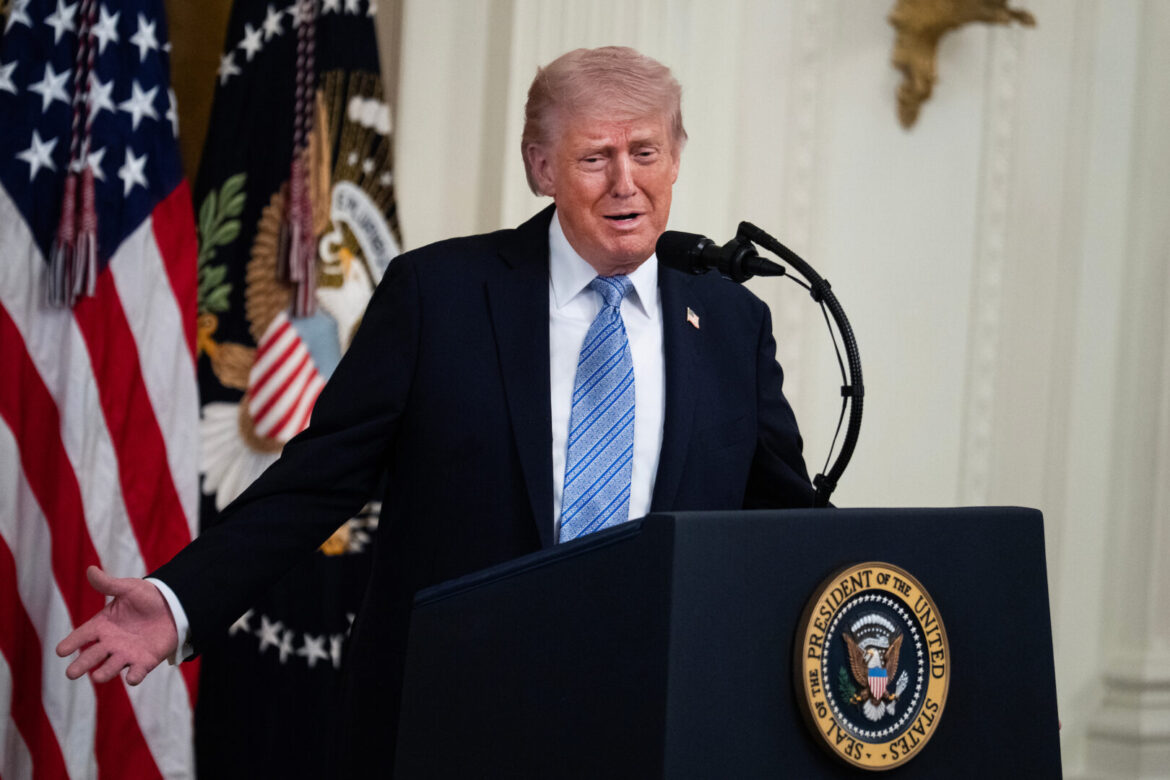
ISLAMABAD: US President Donald Trump has praised the trilateral defence agreement between Saudi Arabia, Turkey and Pakistan, describing it as a “big, bold, important first step” for a region he said was “finally” learning to defend itself — remarks that arrive as Gulf states quietly accelerate their search for security guarantees beyond Washington.
Writing on his Truth Social platform on Sunday, the US president said he was “very happy” that the three countries had “recently, and finally” signed what is known as the Mecca Joint Defence Agreement. “It shows how the Middle East is coming together, and how Countries will finally be able to defend themselves in a more meaningful way,” he wrote, adding: “Congratulations to the Great Leadership of the three Nations mentioned.”
The agreement was signed on 7 August at a ceremony in Mecca, where Saudi Crown Prince Mohammed bin Salman hosted Turkish president Recep Tayyip Erdogan and Pakistani prime minister Shehbaz Sharif for what the three governments called the Mecca Al-Mukarramah Summit for Joint Defence. Under its terms, an attack on any one of the three signatories will be treated as an attack on all — language that has drawn inevitable, if imperfect, comparisons to Nato’s Article 5.
The pact comes amid an ongoing US-Iran war that has drawn violence across the wider region, including a wave of attacks by Iran-aligned Houthi rebels in Yemen. Turkey’s defence ministry said last week that the three countries would establish joint political and military mechanisms under the agreement, and that defence-industry cooperation between them would deepen in the months ahead.
Pakistani officials have been at pains to frame the pact as defensive rather than provocative. Both Sharif and his deputy prime minister and foreign minister, Ishaq Dar, have stressed that the agreement is not directed at any particular adversary, with Dar going further to describe it as “open to any country in the region” prepared to sign up to its underlying principles.
Turkish foreign minister Hakan Fidan said in the days after the signing that he expected Egypt to join “in the next stage”, telling the Anadolu news agency that only “a few technical issues” remained. Cairo has since indicated it is at least weighing the prospect: Egyptian foreign minister Badr Abdelatty said his government maintains close bilateral ties with all three signatories and has been kept informed of the pact since its inception, though he noted Egypt’s constitution requires a thorough legal review of any international defence commitment before Cairo can formally sign on.
Erdogan, for his part, made clear he sees the three-way pact as a foundation rather than a finished structure. “Our vision for it is not limited to the three countries,” he told the London-based newspaper Asharq Al-Awsat. “Rather we aspire for it to grow, and perhaps appropriate conditions will emerge one day for all countries of the region to gather under its umbrella.”
Kuwait, Bahrain and Somalia have already welcomed the agreement publicly. More strikingly, Iran’s own response has been notably measured rather than hostile, with Tehran emphasising its preference for “security mechanisms based on cooperation between regional countries” — a marked change in tone from a government that might once have viewed such an alliance with suspicion.
A hedge against an unreliable patron
Diplomats and analysts see the pact as something more significant than a one-off show of solidarity. It marks an acceleration of a longer-running effort by Gulf states to diversify their security arrangements away from near-total dependence on the United States — a dependence that, in the eyes of several regional governments, has proved unreliable at critical moments. That push for diversification predates the current Iran conflict, but has taken on new urgency since a US-Israeli strike on Iran in February and the subsequent closure of the Strait of Hormuz, one of the world’s most consequential shipping chokepoints.
Riyadh had already signalled its intent to widen its security net days before the Mecca signing, announcing a 14-nation maritime coalition, led by Saudi Arabia, to protect shipping in the Red Sea. That coalition draws in Turkey and Pakistan alongside Egypt, Bangladesh, Kuwait, Bahrain, Qatar, Jordan, Sudan, Djibouti, Somalia, Yemen and the Comoros.
Quite how far the new defence pact will reshape events on the ground remains an open question. It is unlikely, in the short term, to alter the trajectory of Saudi Arabia’s escalating confrontation with Yemen’s Houthi movement, nor is it expected to have any bearing on other regional flashpoints, from the long-standing rivalry between Pakistan and India to tensions between Turkey and Israel. What it does do, by virtue of Pakistan’s inclusion, is lend renewed weight to the idea of a “Greater Middle East” that extends into South Asia — and in doing so, it chips away, at least symbolically, at Israel’s unofficial status as the region’s sole nuclear-armed power.
For each of the three signatories, the pact serves a distinct purpose. It offers a framework through which Saudi Arabia, Turkey and Pakistan can draw on each other’s financial muscle, technological expertise and industrial capacity — not least in strengthening their respective defence industries — while allowing each government to sidestep confrontations it would rather avoid.
Publicly, officials from all three countries insist the agreement is not aimed at any single state, and point instead to Israel, rather than Iran or the Houthis, as the region’s principal source of instability. Privately, the calculus looks rather different — particularly in Riyadh. The pact fits neatly within a more assertive Saudi posture that has emerged in recent months, one explicitly designed to shift the balance of power against Tehran.
Copyright © 2021 Independent Pakistan | All rights reserved