

By Staff Reporter
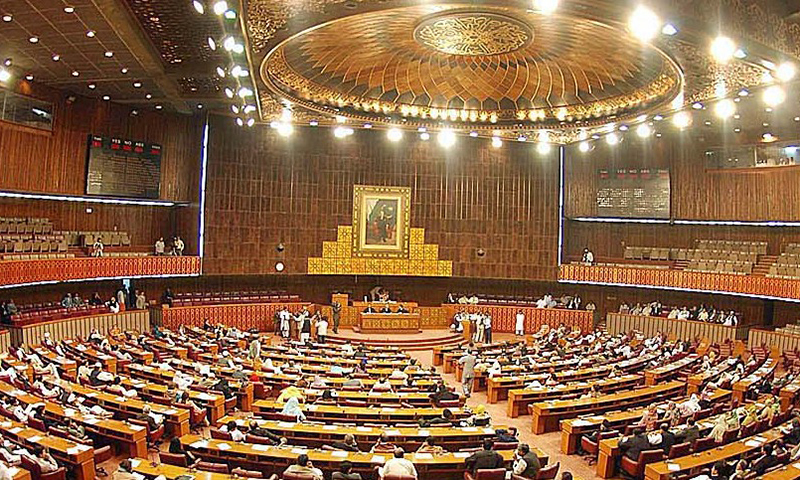
ISLAMABAD: Pakistan’s parliament pushed through sweeping changes to the country’s military command structure on Thursday, passing legislation that formally hands the newly created post of Chief of Defence Forces sweeping powers over the armed services, hours after the bills cleared the federal cabinet and over strong objections from opposition lawmakers in both houses.
The National Assembly and the Senate each approved the Defence Forces Act 2026 and the National Command Authority (Amendment) Bill 2026 by majority vote, capping months of restructuring that followed last year’s 27th Constitutional Amendment. That amendment scrapped the post of Chairman of the Joint Chiefs of Staff Committee and created the office of Chief of Defence Forces in its place — a role currently held by Field Marshal Asim Munir alongside his existing position as Chief of Army Staff.
The legislation was rushed through with unusual haste. Both bills were cleared by the cabinet, chaired by Prime Minister Shehbaz Sharif, only that morning, then added to the National Assembly’s agenda as supplementary business rather than through the normal order of the day. That timetable became the flashpoint of the day’s proceedings, drawing sharp criticism even from lawmakers who ultimately voted for the bills.
Government allies air their frustration
Bilawal Bhutto-Zardari, chairman of the Pakistan Peoples Party, used his time on the floor of the National Assembly to make clear that his party’s support for the legislation should not be read as approval of how it had been handled. The PPP is a coalition partner of the ruling Pakistan Muslim League-Nawaz, and Bilawal said the government had failed to consult its allies before bringing the bills forward.
“I personally apologise for what is happening to you,” he told the prime minister, extending the remark to both the ruling coalition’s allies and the opposition. He went on to question why legislation he considered uncontroversial in substance had been handled in a way that invited controversy. PPP lawmakers went on to back both bills when the vote was called.
The opposition was considerably less accommodating. Lawmakers walked out of the National Assembly chamber before the vote, having earlier objected that they had not been given adequate time — or in some cases, copies of the bills themselves — to examine what they were being asked to approve. Prime Minister Sharif was in the chamber for the session and, on arriving, crossed to the opposition benches to shake hands with opposition leader Mahmood Khan Achakzai and Pakistan Tehreek-e-Insaf figures including party chairman Barrister Gohar, Asad Qaiser and Aamir Dogar. The walkout followed shortly after, with PTI lawmakers leaving in protest after Gohar was denied an opportunity to address the House.
The sitting had already been disrupted once earlier in the day. Speaker Ayaz Sadiq suspended proceedings for fifteen minutes during question hour after ministers and parliamentary secretaries failed to appear to answer questions, singling out the Ministry of Inter-Provincial Coordination for particular criticism after neither the minister nor any of his staff turned up. “If you are not going to take parliamentary business seriously, then there is no point in holding the question hour,” the Speaker told the House, before summoning the ministry’s secretary and warning that a privilege motion would follow against the minister and the officials concerned if the lapse was repeated.
The National Assembly session was adjourned until eleven o’clock on Friday morning.
A rowdier reception in the Senate
The bills fared no more smoothly in the upper house. Defence Minister Khawaja Asif, who had introduced both pieces of legislation in the National Assembly, presented them again in the Senate, where they passed unanimously — but not before Pakistan Tehreek-e-Insaf senators made plain their unhappiness with the process.
Opposition Leader Allama Raja Nasir Abbas pressed the government on why the bills needed to be rushed through as they were. “What is the emergency? Is this how legislation is carried out?” he asked, telling the House he had only just received a copy of the bill and appealing to the Senate chairman to allow members proper time to study it. He then announced that the opposition intended to protest and boycott the sitting, and PTI senators duly walked out.
The objection to process had already surfaced earlier in the sitting. Jamiat Ulema-e-Islam Fazl senator Aliya Kamran complained that opposition members had not been given copies of the legislation — a complaint that drew a pointed retort from Law Minister Azam Nazeer Tarar, who told lawmakers to make better use of the tablets on which the bills had, he said, already been made available.
Tarar was equally unmoved by the wider objections. He argued that parliamentary rules permitted the government to bring forward supplementary legislation and questioned what further scrutiny critics believed was warranted. “Tell me, what mathematical formula is there that we need to sit down and discuss?” he said, pointing to the coordination shown by the three armed services during what he described as Marka-e-Haq — the military operation the government credits with securing Pakistan’s recent victory — as evidence the new command arrangements were already working. He added that the National Assembly had already read the bill “word by word” before passing it.
Not every party followed PTI out of the chamber. During the Senate proceedings, the chairman and the law minister intervened to head off a separate walkout by the Awami National Party, keeping the sitting intact for the vote that followed.
What the new law actually does
The Defence Forces Act 2026 gives statutory effect to the restructuring set in motion by last year’s constitutional amendment. It establishes a new Defence Forces Headquarters, which will serve as the headquarters of the armed forces as a whole, under the command of the Chief of Defence Forces. Under the Act, the CDF becomes the prime minister’s principal military adviser on national security, defence and all matters concerning the armed forces, and holds operational command and control of the forces — answerable to the federal government for how that command is exercised.
The legislation sets out broad powers for the office, describing its remit as covering multi-domain integration, operational cohesion, and coordination and oversight of any matter with joint, tri-service or strategic implications for the armed forces and the country’s security. It also gives the CDF authority over personnel matters across the services — the power to retire, discharge, accept or reject the resignation of service members, or to relax age and service limits — though that authority does not extend to officers appointed under Article 243 of the Constitution. The federal government retains the ability to prescribe further powers and functions for the office beyond those set out in the Act itself.
Implementation is left largely in the hands of the government and the CDF jointly, who are empowered to issue instructions and amend rules and regulations as needed to give the Act effect. Where difficulties or inconsistencies arise in applying the law, the president is given the power to resolve them by order.
The Act takes retrospective effect from 13 November 2025. The accompanying National Command Authority (Amendment) Bill 2026, which strips references to the now-abolished Chairman of the Joint Chiefs of Staff Committee from the 2010 Act and replaces them with references to the Chief of Army Staff and Chief of Defence Forces, takes retrospective effect from 27 November — the date the old post was formally abolished. The National Command Authority itself is the top-tier body, chaired by the prime minister, with oversight of Pakistan’s nuclear security arrangements.
The wider restructuring
Thursday’s votes are the latest step in a reorganisation of Pakistan’s higher defence architecture that began with the passage of the 27th Constitutional Amendment in November last year. That amendment rewrote Article 243 of the Constitution, abolishing the Chairman of the Joint Chiefs of Staff Committee and creating the office of Chief of Defence Forces in its place, with the army chief empowered to hold the position concurrently with his existing role. Field Marshal Asim Munir became the first officer to hold the post in December, shortly after the constitutional changes took legal effect.
The amendment also created a second new office, the Commander of the National Strategic Command, a four-star position responsible for the operational integration of Pakistan’s strategic forces. Lieutenant General Syed Aamer Raza, then chief of the general staff of the Pakistan Army, was promoted to four-star rank and appointed to the post by the prime minister on 24 July, on the recommendation of the army chief and the Chief of Defence Forces. Under the framework, the Commander of the National Strategic Command serves a three-year term, renewable once, with appointments, reappointments and extensions placed beyond challenge in any court; the ordinary retirement age and service-tenure rules that apply elsewhere in the Army Act do not apply to the post.
The restructuring has already been reflected in amendments to the service laws governing the Navy and Air Force, both of which have had references to the old Joint Chiefs of Staff Committee structure stripped out, with the Navy legislation also revising the terminology and command arrangements around the Chief of Naval Staff.