By Staff Reporter
ISLAMABAD: The prime minister has pledged to deepen ties with Syria “across the board”, as the country welcomed a Syrian foreign minister for the first time in almost two decades, in a visit that comes amid escalating tension in the Middle East following an Israeli strike on a Syrian airbase.
Asaad Hassan al-Shaibani touched down in Islamabad in the early hours of Thursday morning at the invitation of Pakistan’s deputy prime minister and foreign minister, Ishaq Dar, embarking on a two-day trip billed by officials as a turning point in relations between the two countries.
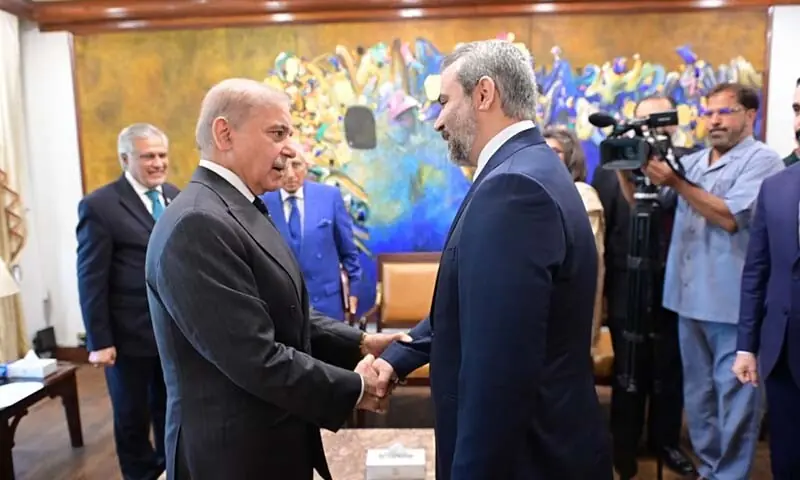
He was met on arrival by an additional secretary at the Ministry of Foreign Affairs, with pictures of the reception shared on social media by the Foreign Office, before heading into a full programme of talks that included a private meeting with Mr Dar and a sit-down with prime minister Shehbaz Sharif.
The visit marks the first by a Syrian foreign minister to Pakistan since Walid al-Mouallem made the journey in May 2007, and the first since the collapse of Bashar al-Assad’s government in December 2024 ushered in a new administration in Damascus under president Ahmed al-Sharaa.
Speaking after his meeting with al-Shaibani, Sharif said the two countries needed to move beyond warm words and turn what he called their “historic and multifaceted ties” into concrete cooperation spanning politics, defence, trade, investment, education and the development of human resources, according to a statement issued by his office.
The prime minister singled out air travel as one practical area ripe for progress, telling his Syrian counterpart that restoring direct flights between the two countries would boost people-to-people contact and ease the journey for the large numbers of Pakistani pilgrims who travel to Syria each year on religious visits.
On the thornier question of regional politics, Sharif reaffirmed Pakistan’s backing for Syria’s “unity, sovereignty and territorial integrity” and went further, pledging that Islamabad would stand firmly behind Damascus’s position on the Golan Heights — the plateau seized by Israel from Syria during the 1967 war and effectively annexed in 1981, in a move never recognised by the bulk of the international community. Israel has since expanded its military footprint in the area in the wake of Assad’s fall.
For his part, al-Shaibani passed on greetings from president al-Sharaa and updated the prime minister on the transition under way in Damascus, along with the reconstruction effort now gathering pace across the country. He thanked Pakistan for what he described as its unwavering support for Syria and said his government was eager to breathe new life into the relationship, including by setting up early institutional channels for cooperation between the two states.
Sharif responded by inviting president al-Sharaa to pay an official visit to Pakistan at a date convenient to both sides.
The meeting was also attended by Dar, special assistant to the prime minister Tariq Fatemi, and foreign secretary Amna Baloch.
Talks overshadowed by Israeli strike
The Syrian minister’s visit unfolded against a tense regional backdrop, coming a day after Pakistan issued a sharp condemnation of an Israeli air raid on a Syrian military airbase.
Syria’s state broadcaster, Ekhbariya, cited a military source in reporting that Israeli warplanes had struck the runway and storage facilities at the Abu al-Duhur base near Aleppo in the country’s northwest, in a wave of eight strikes. A separate military source, along with a civilian living close to the base, said no casualties had resulted from the attack.
Pakistan’s Foreign Office did not hold back in its response, branding the raid “provocative” and warning that such actions amounted to a “flagrant violation of international law” with the potential to “further undermine regional peace and stability”. The statement went on to express Islamabad’s “unwavering solidarity with the brotherly people of Syria” and reiterated support for the country’s sovereignty, territorial integrity, peace and prosperity.
That backdrop featured heavily in al-Shaibani’s earlier meeting with Dar, where the pair first held a restricted, one-on-one session before broadening out into delegation-level talks. Both rounds saw the ministers reaffirm what officials on both sides describe as “brotherly ties” and explore ways to widen cooperation across areas of shared interest, alongside what the Foreign Office called “in-depth” discussions on the wider region.
Dar used the talks to restate Pakistan’s support for Syria’s sovereignty, unity and territorial integrity, while the two ministers ranged across a broad sweep of regional and international issues — among them Palestine, the Golan Heights, Afghanistan, the situation in South Asia, and the wider turmoil across the Middle East.
al-Shaibani, in turn, welcomed the recently signed Makkah Joint Defence Agreement — a pact involving Pakistan, Saudi Arabia and Türkiye — and praised Islamabad’s part in fostering regional stability, pointing in particular to Pakistan’s efforts to ease tensions between the United States and Iran. Both ministers closed the talks by reaffirming their commitment to continued engagement in pursuit of peace, stability and prosperity in the region and beyond.
Visit comes amid wider Middle East turmoil
The trip to Islamabad forms part of a broader push by Syria’s transitional government to rebuild diplomatic bridges regionally and internationally following Assad’s ouster, and lands at a moment of renewed volatility across the Middle East.
Pakistan has positioned itself as an intermediary in the standoff between Washington and Tehran, a conflict that first erupted in February when Israel and the United States launched joint strikes against Iran. Islamabad has since shuttled messages and proposals between the two capitals, work that officials say helped secure a ceasefire in April and an interim peace agreement in June.
That fragile calm did not hold. Tensions flared again in July when the US struck Iran once more, accusing Tehran of breaching the agreement by targeting commercial shipping in the Strait of Hormuz — an allegation Iran has rejected, responding instead with strikes on American military bases across the Gulf.
The friction has continued to build in the days since. Iran’s armed forces warned Gulf states on Wednesday against lending support to US military operations, while president Donald Trump used the same day to announce a fresh campaign aimed at squeezing Iran’s economy, threatening penalties against any country found to be assisting or trading with Tehran.
Officials in Islamabad had signalled ahead of the visit that it would go beyond ceremony, with the Foreign Office noting in advance that the two sides intended to hold in-depth discussions spanning the full breadth of the bilateral relationship, alongside an exchange of views on developments across the region and beyond. The visit, running from 19 to 20 August, is intended, officials said, to mark a significant step in strengthening ties between the two countries going forward.
Copyright © 2021 Independent Pakistan | All rights reserved