By Staff Reporter
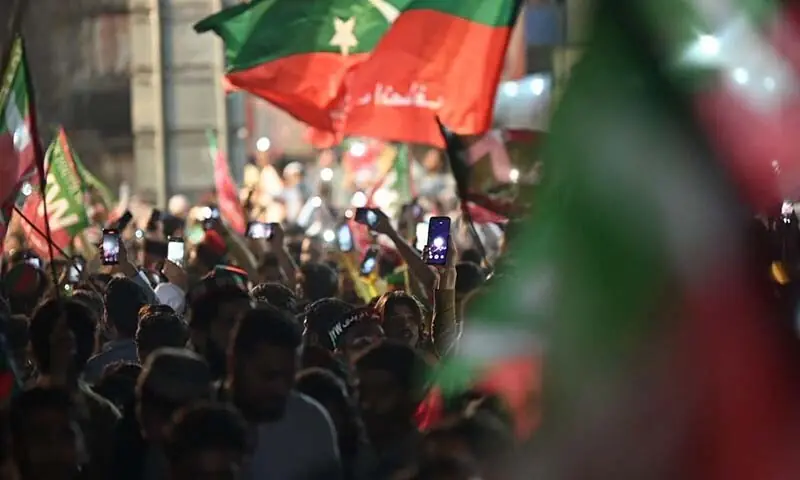
ISLAMABAD: The government and the main opposition party traded accusations on Friday as supporters of jailed former prime minister Imran Khan continued their march towards the capital, intensifying a political standoff that has raised the prospect of federal intervention in the country’s north-west.
The confrontation pits Prime Minister Shehbaz Sharif’s government against Khan’s Pakistan Tehreek-e-Insaf, which governs Khyber Pakhtunkhwa, the province bordering Afghanistan. A resurgence of militant violence there has sharpened disagreements over counterterrorism policy, adding another fault line to an already bitter political dispute.
The march, led by provincial Chief Minister Sohail Afridi, reached Peshawar on Thursday, its fifth day. Afridi vowed there would be “no turning back” once the convoy reached Swabi. The protest began Oct. 4 after talks with the government collapsed. Its route has changed repeatedly, and the party has yet to say when or how it plans to enter Islamabad.
In the capital, parliamentary secretary for information Danyal Chaudhry accused the PTI of mobilising supporters through hostility towards the federal government and state institutions while failing to confront militancy in the province. Asked about reports of renewed efforts to mediate, he dismissed the prospect of negotiations.
“So what more can we negotiate with those who gather people on the basis of hatred?” he said.
The PTI rejects suggestions that it is soft on militants. It argues that counterterrorism policy in Khyber Pakhtunkhwa must be shaped through consultation with the provincial government rather than imposed by Islamabad.
Addressing supporters at Bakshi Bridge in Peshawar on Friday, Afridi said the party would announce its “final plan” in Swabi, adding that it would leave its opponents “sleepless”. He insisted public enthusiasm for the march had not waned. Borrowing from cricket, he told the crowd: “We have played a Test match; now we have to play One-Day, T20 and T10.”
Earlier in the week, in Khyber district, Afridi vowed not to allow another military operation in the province. He has maintained that the march will remain peaceful and within constitutional bounds.
Faisal Karim Kundi, the provincial governor and the federal government’s representative in Peshawar, took a more confrontational approach. At a news conference, he challenged the marchers to “reach Swabi tomorrow and cross it”, claiming that whenever the convoy turned towards the district, “their legs start shaking”. He likened the protest to a “Lucky Irani Circus” and accused senior PTI leaders of staying in Islamabad drawing rooms or going into hiding.
Kundi also called on Afridi and his cabinet to resign on “ethical grounds”. Responding to PTI allegations that provincial ministers and lawmakers had been abducted, he said the chief minister, as head of the provincial executive, should explain who was responsible.
“My province is burning,” Kundi said, citing recent militant attacks.
Federal officials have discussed imposing governor’s rule or declaring an emergency that would allow Islamabad to assume certain functions of the provincial administration. No decision has been announced. Kundi said the choice rested with the president and prime minister and that he would submit a report on the province’s situation if asked.
Article 234 of Pakistan’s constitution allows the president to issue a proclamation if satisfied that a provincial government cannot function in accordance with constitutional provisions. Such a proclamation requires parliamentary approval.
Bilawal Bhutto-Zardari, whose Pakistan Peoples Party supports the governing coalition, said in Karachi that the federal government and “the entire system” had been prepared a week earlier to impose an emergency in Khyber Pakhtunkhwa. His party considered governor’s rule a legitimate constitutional option, he said, but one that should be treated as a “legal atom bomb” and used only as a last resort.
Bilawal accused the PTI of pursuing “extremist politics”, saying it was fighting the government, judiciary, parliament and the establishment simultaneously.
“When this is your politics, then your workers will also be disappointed,” he said.
He criticised the PTI for staying away from parliamentary proceedings and expressed hope that it would participate in a newly agreed committee on electoral reforms.
Bilawal also invoked his family’s political history. His father, President Asif Ali Zardari, held the “record” for the longest time in jail, he said. If the PTI continued its confrontational course, Khan could surpass that record and remain imprisoned, Bilawal added.
“It is Pakistan’s history; if someone is in jail today, it does not mean they remain there tomorrow,” he said.
The PTI has rejected the prospect of federal rule. Its chairman, Gohar Ali Khan, said earlier this week that governor’s rule or an emergency would not resolve the crisis. He thanked the Jamiat Ulema-e-Islam-Fazl, the Awami National Party and Jamaat-e-Islami for opposing either measure. The party’s provincial president, Junaid Akbar, has urged workers to assemble outside Governor House if federal rule is imposed.
In Lahore, PTI secretary general Salman Akram Raja said the party would not sign an agreement that compromised its principles or participate in any action that caused the deaths of innocent people. He alleged that several party workers had been abducted in Peshawar the previous day and predicted a large turnout from Punjab.
The political divide remains wide. Weekend talks broke down over access to Khan and counterterrorism policy in Khyber Pakhtunkhwa. The PTI says meaningful negotiations are impossible without Khan’s involvement, while the government accuses the party of frustrating previous efforts to reach an agreement. Interior Minister Mohsin Naqvi has said the two sides made substantial progress before talks reached an impasse.
One possible route out of the deadlock has emerged through Maulana Fazlur Rehman, the cleric who leads the JUI-F. PTI provincial information secretary Shaukat Yousafzai said Fazlur Rehman was trying to broker a settlement.
“We have full trust in him,” Yousafzai said, adding that there had been no direct contact between the government and the PTI. Neither side has announced a breakthrough.
Khan, who served as prime minister from 2018 until losing a parliamentary no-confidence vote in April 2022, has been imprisoned since August 2023. He faces multiple criminal cases and is serving a sentence in a corruption case that he says is politically motivated. A PTI march on Islamabad in November 2024 ended in clashes between demonstrators and security forces, with both sides continuing to dispute the circumstances and number of casualties.
Under the PTI’s announced schedule, the convoy is due to reach Charsadda on Friday, Mardan on Saturday and Swabi on Oct. 11. The party will decide its next move after reaching Swabi.
Copyright © 2021 Independent Pakistan | All rights reserved