By Staff Reporter
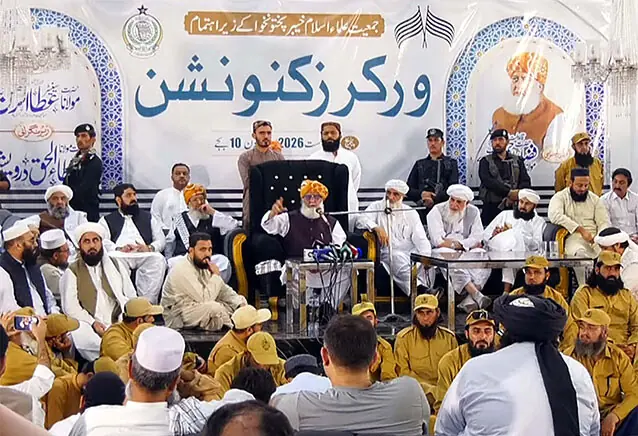
PESHAWAR: Maulana Fazlur Rehman, the head of Jamiat Ulema-e-Islam-Fazl, used a party workers’ convention here Sunday to deliver a pointed critique of Pakistan’s fractured opposition, arguing that its failure to coordinate a unified response allowed the government to push through sweeping new military command legislation with almost no scrutiny.
Addressing the gathering, organised by JUI-F’s Khyber Pakhtunkhwa chapter, Rehman said the burden of the legislative defeat rested largely with Mahmood Khan Achakzai, the leader of the opposition in the National Assembly, whom he faulted for not bringing the opposition’s parties together to mount an effective challenge.
“The recent legislation was passed in great haste, without any debate, and even opposition members did not examine it in detail,” Rehman told the convention.
His remarks centered on two measures — the Defence Forces Act, 2026, and the National Command Authority (Amendment) Bill, 2026 — which the National Assembly and Senate passed on Aug. 20 by majority vote. The bills formalise a restructuring of the country’s military command that followed last November’s 27th Constitutional Amendment, which abolished the office of the Chairman of the Joint Chiefs of Staff Committee and created the position of Chief of Defence Forces. Field Marshal Asim Munir, who serves simultaneously as Chief of Army Staff, was named the country’s first Chief of Defence Forces.
Opposition lawmakers walked out of the National Assembly as the bills came up for a vote, after Pakistan Tehreek-e-Insaf chairman Barrister Gohar Ali Khan was denied the floor to address the House. The Senate took up the legislation the same day; the defence forces bill passed there by majority vote, and the National Command Authority measure passed unanimously.
It was that swift passage — the Senate action came and went within half an hour, according to Rehman — that drew his sharpest criticism Sunday. He said opposition lawmakers had treated the walkout itself as a form of protest, without grasping the consequences of what they were allowing to pass in their absence.
“They have done a big damage, and we do not even know what has happened,” he said.
Rehman said he had since met with Achakzai to discuss a joint parliamentary strategy and had urged him to keep closer watch over legislation moving through the House. He argued that assembling a unified opposition bloc was specifically the opposition leader’s responsibility — and one that had gone unmet.
“It was the opposition leader’s job to unite all the parties sitting on opposition benches, and it was lacking there,” he said, adding that a strong, coordinated opposition was essential to forcing the government to listen.
The JUI-F chief was careful to frame his objection as institutional rather than a challenge to the military itself. He said his party supported Pakistan maintaining a strong defence capability but rejected any expansion of the military’s role in politics.
His central concern, he said, was the concentration of authority the new laws vest in a single office. Under the legislation, he said, administrative powers over the armed forces that once belonged to the prime minister — including the authority to dismiss personnel, extend service terms, and accept or reject resignations — now rest with one individual. He said those powers, along with the National Command Authority changes, extend that authority across the army, air force and navy alike, and that the new laws carry an overriding effect over any other legislation that conflicts with them.
“The powers that should have been vested in parliament were concentrated within a person,” he said, adding that the federal government had effectively surrendered its own authority and left itself able to enact further legislation without bringing parliament into the process at all.
Rehman also invoked an earlier parliamentary dispute over religious law to underscore his objection to the new legislation’s overriding-effect clause. He recalled that when JUI-F had previously pressed to have the Quran and Sunnah recognised as the supreme law of the land, a former chief justice of Pakistan had ruled that all clauses of the Constitution carried equal weight and that no single clause could take precedence over another. He argued that the standard had not been applied here, saying the new laws were built explicitly to give the military establishment power that overrides conflicting statutes.
He added that under parliamentary rules, if 40 percent of lawmakers demand that a matter be referred to the Council of Islamic Ideology, it must be sent there — noting that the 26th Amendment had been referred to the council by majority vote and, in his telling, still awaits action.
New provinces called a revenue tactic
Turning to a separate and increasingly contentious issue, Rehman also criticised renewed government discussion of carving new provinces out of the existing four, calling the timing reckless given the security crises already underway in Khyber Pakhtunkhwa and Balochistan.
“The house is on fire, and you are talking about dividing it,” he said, telling the convention that neither the political climate nor the necessary groundwork existed for redrawing provincial boundaries — and alleging that the push was originating from a powerful state institution rather than from elected government.
He argued the proposal was less about administration than about money and minerals. Provinces’ shares of federal revenue were expanded under the 18th Amendment through the National Finance Commission Award, he said, and that allocation could not simply be walked back. Creating new provinces, in his reading, offered a route to renegotiate the NFC formula and, at the same time, gain greater access to mineral resources within provincial boundaries — resources he said belong to the people of those provinces.
Rehman pointed to his party’s earlier opposition to merging Pakistan’s former tribal areas into Khyber Pakhtunkhwa as evidence that his scepticism of top-down administrative restructuring had been vindicated by events since.
Police authority eroding, Rehman says
The convention also became a forum for Fazl to lay out, in granular terms, what he described as a breakdown in civilian policing authority across two provinces.
In Bannu and Lakki Marwat, he said, district police officers are no longer being heeded, and orders from the provincial inspector general of police are going unimplemented. He said the chain of command within the police service in those districts has effectively broken down, with constables forming their own informal peace committees, operating without uniforms, and establishing checkpoints along provincial highways on their own initiative. He said the security of the deputy inspector general’s office in Bannu had, in effect, been placed under the control of a constable.
He described a similar collapse in Balochistan, dismissing suggestions that the province’s security could be managed by any single police officer and urging officials to examine what has actually happened to police stations and personnel there. He said major roads, including the Karachi-Quetta highway, have become unsafe, with travelers stopped for hours at makeshift checkpoints. He also referenced recent attacks in the province, including one near Quetta Cantonment in which he said civilians were killed, as further evidence that government authority continues to erode.
Rehman closed by warning against governance through force rather than consent, saying a state that relies on coercion alone will alienate the public it is meant to serve. Order and justice, he said, cannot be sustained through oppression — a principle he argued applies as much to how Islamabad handles the provinces as to how it handles the new concentration of military authority he spent much of his address condemning.
Copyright © 2021 Independent Pakistan | All rights reserved