By Staff Reporter
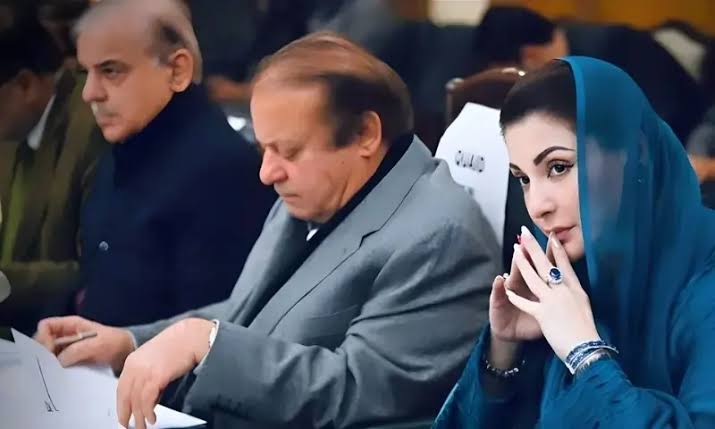
MUZAFFARABAD: Nawaz Sharif summoned the senior ranks of his party to Muzaffarabad on Sunday, opening a meeting that was ostensibly about naming the next prime minister of Azad Kashmir but that drifted, inevitably, into weightier terrain: the health of his political rival, the temper of the Supreme Court, and the durability of his brother’s government in Islamabad.
The session, convened by the Pakistan Muslim League-Nawaz president, came a day before six candidates were set to contest five seats reserved for women in the Azad Jammu and Kashmir Legislative Assembly — the last major hurdle before the region’s new government takes shape. But if the agenda began with logistics, it did not stay there for long.
Two names dominated the discussion of who might lead the incoming AJK administration: Shah Ghulam Qadir, the party’s AJK president, and Tariq Farooq. Party sources said Sunday that one of the two men is likely to be put forward as PML-N’s nominee for the territory’s top office, though no formal decision had been announced. The meeting also touched on the party’s broader political strategy in the region, building on what officials described as a series of earlier consultations aimed at consolidating PML-N’s position there.
It was, however, the parts of the conversation that ranged beyond Kashmir that gave the meeting its edge. Attendees discussed the country’s overall political climate, the condition of Pakistan Tehreek-e-Insaf founder Imran Khan, and a string of recent Supreme Court rulings that have unsettled Islamabad in recent days.
A parallel resolution, and a familiar slogan
Separately, PML-N’s parliamentary party in AJK met to lock down its strategy for Monday’s election to seven reserved seats in the territory’s Legislative Assembly. Shah Ghulam Qadir chaired that session as well; also on hand were Tariq Fazal Chaudhry, the federal minister for parliamentary affairs, and Senator Anusha Rahman.
The parliamentary party emerged with a resolution reaffirming confidence in Nawaz Sharif, in Prime Minister Shehbaz Sharif, and in Punjab Chief Minister Maryam Nawaz. It pledged continued work toward AJK’s development, the primacy of the Constitution, and what it called the restoration of merit and justice — language the resolution tied explicitly to the elder Sharif’s political vision. The document also renewed the party’s commitment to Kashmir’s accession to Pakistan, invoking the long-running slogan “Kashmir Banega Pakistan.”
The resolution went further, extending explicit support to the Pakistan armed forces under the command of Field Marshal Syed Asim Munir for what it described as operations against internal and external threats, and expressing satisfaction with what it characterised as Pakistan’s standing on the international stage. On more local matters, the parliamentary party said an incoming AJK government would prioritize law and order, restart development projects that have stalled, and draft policies aimed at public welfare. It also praised the region’s chief election commissioner and administration for their conduct of the vote.
The resolution’s language on the broader Kashmir dispute was pointed. It expressed alarm over conditions in Indian-administered Jammu and Kashmir, calling on the international community to take note of what it termed war crimes committed there, and repeated the party’s longstanding position that India’s 2019 revocation of the territory’s special status violated United Nations and Security Council resolutions. The resolution accused New Delhi of misrepresenting the situation to the international community, praised what it called the Kashmiri people’s “unprecedented sacrifices” in pursuit of self-determination, and thanked the Pakistani government and public for their political, moral and diplomatic backing. It also rejected recent remarks on Kashmir attributed to the American ambassador to India, and repeated the party’s call for the dispute to be settled under UN resolutions.
Six candidates, five seats
The immediate business at hand, though, is Monday’s vote. According to the final candidate list released Sunday by the Election Commission, six candidates are competing for the five seats set aside for women in the AJK Legislative Assembly: PML-N’s Riffat Abid, Sehrish Qamar, Maryam Idrees and Maryam Zaman — the latter also known as Maryam Kashmiri — running against the Pakistan Peoples Party’s Farzana Yaqoob and Zobia Khurshid Raja.
The field narrowed from seven after PPP candidate Shaheen Kosar Dar withdrew her nomination on the deadline set by the election schedule, according to Election Commission spokesman Raja Muhammad Shakeel.
Two other reserved seats are also in play Monday. For the seat set aside for Ulema and Mashaikh — religious scholars and spiritual leaders — PPP’s Hafiz Tariq Mahmood will face PML-N’s Mohammad Mazhar Saeed. And for the seat reserved for technocrats and professionals, PML-N’s Barrister Syed Iftikhar Gillani will run against PPP’s Sahibzada Zulfiqar Ali.
A fourth reserved seat, for state subjects residing abroad, will not be contested at all: PML-N’s Chaudhry Abdul Rehman Arain was the only candidate to file papers, and was declared elected unopposed.
Polling for the women’s, Ulema and Mashaikh, and technocrats’ seats runs from 10 a.m. to 1 p.m. Monday at the Assembly Hall in Muzaffarabad. The stakes for the timeline are immediate: the incoming Legislative Assembly’s inaugural session has already been called for 2 p.m. the same day, meaning newly elected members are expected to be sworn in within hours of the results being announced. That oath will be administered by outgoing Speaker Chaudhry Latif Akbar, who lost his own bid for reelection.
A warning at Jati Umrah
The Kashmir maneuvering unfolded against a tense backdrop in Islamabad, where Nawaz Sharif reportedly warned his brother that Pakistan cannot withstand another constitutional or political crisis. The remarks were said to have come during the Sharif family’s weekly meeting at Jati Umrah on Sunday — a gathering that, according to media reports, took on unusual weight given the current state of affairs: contempt of court proceedings pending against the prime minister, and a deepening controversy over how the government has handled Imran Khan’s medical care while in custody.
According to those reports, Nawaz Sharif pressed Shehbaz Sharif on why Khan had been taken to the Pakistan Institute of Medical Sciences rather than Shifa International Hospital, as the Supreme Court had directed in its Aug. 18 order. The prime minister is said to have explained the circumstances behind that decision to his elder brother. The two also reportedly discussed how the government might respond to a contempt petition PTI has filed with the Supreme Court, accusing the administration of failing to comply with the court’s directive.
Nawaz Sharif, who has served three separate terms as prime minister, was quoted as telling his brother that the country could not afford another constitutional standoff. Maryam Nawaz also attended the family meeting, according to the reports.
The timing underscores how precarious the moment has become for the government. What began as a court order concerning one man’s medical treatment has, in the space of days, hardened into a broader institutional confrontation. PTI has accused the administration of defying the Supreme Court’s Aug. 18 directive by sending Khan to Pims instead of Shifa International, and has named Prime Minister Shehbaz Sharif, Law Minister Azam Nazeer Tarar and Information Minister Attaullah Tarar, among others, as respondents in its contempt petition.
The episode carries particular resonance in Pakistan, where clashes between elected governments and the judiciary have a long and often bruising history. Former Prime Minister Yousuf Raza Gilani of the Pakistan Peoples Party was removed from office by the Supreme Court in a contempt case. Nawaz Sharif himself was ousted during his third term as prime minister following a separate Supreme Court ruling — a precedent that gives his reported caution on the subject added weight.
The brothers also reportedly used the Jati Umrah meeting to discuss the shape of an emerging opposition alliance, as well as political developments in AJK, including possible candidates for the territory’s premiership and speakership.
One senior PML-N leader, speaking on condition of anonymity, said the government has reason for caution — pointing specifically to the composition of the Supreme Court bench that issued the Aug. 18 order and to the nature of its directions. “There are matters that are making our government a bit uneasy,” the leader said.
PML-N Information Secretary Marriyum Aurangzeb did not respond to a message seeking comment on the reported meeting. Another senior party figure, Javed Latif, pushed back on any suggestion that the government’s position was under serious threat, arguing that opposition parties routinely intensify their pressure once a government passes the midpoint of its term, as they begin positioning for the next general election. On the Aug. 18 order itself, Latif said he believed the government should not have needed a court directive to ensure Khan received proper medical treatment in the first place — but that once the order was issued, it should have been carried out fully. He placed blame for the ensuing controversy on PTI, which he accused of attempting to politicise the matter.
Copyright © 2021 Independent Pakistan | All rights reserved