By Staff Reporter
KARACHI: Pakistan plans to raise as much as $2 billion through Eurobonds this fiscal year, extending a return to international capital markets that began with a $750 million issuance in April, while pursuing a $10 billion currency swap facility with the US to bolster investor confidence in the South Asian economy.
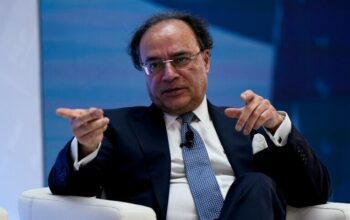
Finance Minister Muhammad Aurangzeb said the country is “looking at $1 billion to $2 billion” in Eurobond issuance during the fiscal year ending June 2027, with the exact timing hinging on market pricing and maturity terms. The plan forms part of a broader push by Islamabad to diversify away from its historical reliance on bilateral and multilateral lenders as it works to rebuild foreign-exchange reserves and stabilise public finances under a $7 billion International Monetary Fund program.
The finance ministry appointed a consortium of banks last month to a three-year mandate covering Eurobond sales, with separate bank groups tapped for Islamic sukuk and rupee-denominated, dollar-settled debt.
Central to Pakistan’s market-access strategy is a proposed $10 billion currency swap line from Washington, which Aurangzeb described as a mechanism to reassure private investors rather than a conventional loan. He said the request — formally known as an Exchange Stabilisation Support Facility — is designed to strengthen foreign-exchange stability and send what he called a “confidence signal” to holders of Pakistani debt.
“It’s a combination of engagement with the US primarily to focus on trade and investment flows, and to help signalling with respect to international capital markets,” Aurangzeb said.
The minister said Washington has offered “constructive engagement” on the swap proposal and that Pakistan expects a response within the next couple of months. Negotiations remain ongoing, with no agreement finalised.
Aurangzeb pointed to what he called a “very important role” for the Export-Import Bank of the United States and the US International Development Finance Corporation, saying both institutions have demonstrated risk appetite for Pakistani assets. He said the Ex-Im Bank could help finance Boeing aircraft purchases by the recently privatised Pakistan International Airlines and support American firms working on refinery upgrades in Pakistan, while the DFC could pursue equity stakes in domestic conglomerates.
Pakistan is separately preparing to issue $750 million in renminbi-denominated panda bonds, tapping Chinese capital markets in a move Aurangzeb called “very, very significant” given the depth of China’s onshore debt market. He said Pakistan isn’t currently seeking additional bilateral financing from Beijing, characterising the deepening US relationship as complementary rather than a strategic tradeoff.
“It’s not an and-or discussion,” he said of the choice between Washington and Beijing.
China remains Pakistan’s largest external creditor by a wide margin, holding 23% of the country’s $129.7 billion in outstanding foreign debt, according to World Bank data.
The pivot toward market-based financing follows a period of macroeconomic stabilisation under the IMF program approved in 2024. Inflation has eased, reserves have recovered, and fiscal deficits have narrowed, though growth remains subdued. The government estimates gross domestic product expanded 3.7% in the fiscal year that ended in June, even as the trade deficit widened to a four-year high of $39.5 billion and exports fell.
Aurangzeb said the government is wary of repeating past cycles of consumption-driven growth that strained the current account.
“If you look at our last episode where we put the foot on the pedal by pumping liquidity, going for consumption-led growth… we get into trouble very quickly because we are an import-dependent economy,” he said. “So we’re keeping a very close eye on that… on more export-led growth.”
Pakistan’s path back to international debt markets has been aided by a string of sovereign upgrades. S&P Global Ratings raised the country’s rating to B last month, five levels below investment grade, while Fitch Ratings holds it one notch lower at B-minus with a stable outlook.
“At this point we are working with the rating agencies to get back to B-plus over the next 12 months or so,” Aurangzeb said. “But our aim is to at least look at double-B and work back from there. And there is no reason why we cannot get there.”
Copyright © 2021 Independent Pakistan | All rights reserved