By Staff Reporter
ISLAMABAD: The Foreign Office on Thursday pushed back hard against reports that the country’s top military officer travelled to Iran last week on behalf of US President Donald Trump, insisting that Field Marshal Asim Munir went to Tehran as a mediator acting for Pakistan, not as an emissary of the United States.
Munir made a one-day visit to the Iranian capital on Monday, Aug. 24, accompanied by Interior Minister Mohsin Naqvi. The trip came at a delicate moment in the monthslong standoff between Washington and Tehran, and it quickly drew attention after Reuters reported that Trump had spoken by phone with Munir the week before his departure. Citing three Pakistani sources, the news agency said one of them described the call as a direct request from the White House: that Pakistan use its influence to help bring Iran back to the negotiating table.
That reporting fueled speculation that Munir, who has cultivated a personal rapport with Trump since the two met in Washington last year, had effectively become a go-between working American interests in Tehran.
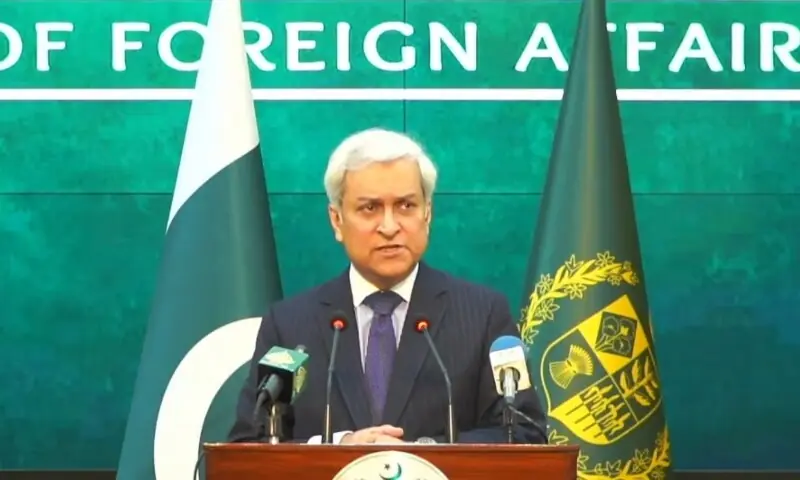
Foreign Office spokesman Tahir Andrabi moved to shut that framing down.
“I will also highlight that claims by certain quarters that the COAS and CDF visited Iran as envoy of President Trump or the US are misleading and factually incorrect,” Andrabi told reporters at his ministry’s weekly briefing in Islamabad, using the acronyms for chief of army staff and chief of defence forces. “His visit was undertaken purely in the context and backdrop of Pakistan’s role as a mediator.”
Andrabi said the talks in Tehran centred on “regional de-escalation, breaking the military stalemate and exploring a negotiated settlement to restore peace and stability,” and that Munir’s visit reflected Islamabad’s “sincere and constructive role in bridging the difference between Washington and Tehran.” He added that Iranian officials had expressed appreciation for Pakistan’s de-escalation efforts.
“Pakistan remains engaged alongside our brotherly countries in sincere and concerted efforts towards resolving the crises in the Middle East and Gulf and with respect to the standoff between the US and Iran,” Andrabi said, adding that the government would keep pursuing “diplomatic engagement and support all sincere efforts aimed at reviving the peace talks and achieving a comprehensive, just and lasting resolution of the conflict.”
During the visit, Munir and Naqvi met with members of Iran’s leadership, including President Masoud Pezeshkian. Naqvi told reporters on Tuesday that the meeting with Pezeshkian had made “significant progress” and ended on a “highly positive note.” He said the discussions touched on the broader US-Iran conflict, wider tensions across the Middle East, and the steps both sides would need to take to revive the Islamabad Memorandum of Understanding — the agreement Pakistan brokered between Washington and Tehran in June — with the goal of reaching a comprehensive settlement. Pakistan’s military said separately that the talks also addressed preventing further escalation, reopening the Strait of Hormuz to shipping, and bringing the conflict to what it called an “expedited” end.
Andrabi said Pakistan’s diplomatic push has not been limited to the military channel. He noted that Deputy Prime Minister and Foreign Minister Ishaq Dar has stayed in contact with regional counterparts on the crisis, including three phone calls over the past two weeks with Turkish Foreign Minister Hakan Fidan.
A fragile agreement, and a new push to save it
The Islamabad memorandum, signed by the United States and Iran in mid-June with Pakistan serving as broker, called for the reopening of the Strait of Hormuz and left it to Tehran and Muscat to work out, in consultation with Gulf states and under international law, how the waterway’s future administration and maritime services would be managed. The agreement was meant to be a bridge to broader talks aimed at ending the war for good. Instead, it collapsed within weeks, and the fighting between Iran and the United States resumed.
Diplomatic activity around the strait has picked up again in recent days. Omani Foreign Minister Badr Albusaidi travelled to Tehran on Tuesday to discuss a framework agreement that would create a temporary corridor for commercial shipping through the strait, along with a separate project to clear naval mines from its waters. No breakthrough has emerged, and the fundamental disagreements between Washington and Tehran remain unresolved, but the renewed diplomatic traffic has put both the political and technical dimensions of the dispute back in the spotlight.
Iran’s position, according to Andrabi’s characterisation, has not softened. Tehran continues to view the Islamabad memorandum as the correct framework for a settlement, he said, but is waiting for the United States to demonstrate through concrete steps — not just statements — that it intends to honor its side of the bargain.
Pakistan presses Kabul for action on militant sanctuaries
Andrabi also addressed recent remarks from Afghanistan’s interior minister, Sirajuddin Haqqani, who has floated a dedicated security mechanism to address disputes between the two countries. Pakistan is open to talks, Andrabi said, but sceptical that a new framework alone would change much.
“We remain open to state-level dialogue,” he said. “However, the sustainability of any mechanism will depend on tangible actions rather than mere assurances.”
He said any dialogue would need to be grounded in a basic commitment from Kabul: that Afghan territory not be used to stage attacks against Pakistan.
“Kabul must honour its international commitments, including those under the Doha framework, and ensure that Afghan soil is not used by hostile proxies, particularly the Tehreek-i-Taliban Pakistan and the Baloch Liberation Army, against Pakistan,” Andrabi said. He added that Islamabad remains ready for “institutional coordination provided it results in tangible and verifiable counterterrorism measures and effective border management.”
The complaint is a familiar one. Pakistani officials have spent the past several years pressing the Taliban government in Kabul to shut down militant sanctuaries operating from Afghan soil, arguing they serve as staging grounds for attacks inside Pakistan. Those appeals, officials say, have largely gone unanswered.
Foreign Office disputes Indian account of Kirana Hills strike
Andrabi used part of Thursday’s briefing to reject a separate claim, made recently by India’s former defence chief, Anil Chauhan, that an Indian Harop drone had accidentally struck the Kirana Hills area near Sargodha during last year’s conflict between the two countries after running low on fuel.
“We categorically reject the self-contradictory and retrospective claims made by the former Indian chief of defence staff regarding Kirana Hills,” Andrabi said. He argued that Pakistan’s air defences had performed effectively throughout the May 2025 conflict and that the country’s response, carried out under what Pakistan calls Operation Bunyanum Marsoos, showed its capacity to inflict costs on India across the fighting. No strategic assets or sensitive sites in Pakistan were compromised, he said.
“Attempts to retrospectively recast these events through selective narrative or dramatised production cannot alter the verifiable operational record of May 2025,” Andrabi said, adding that history “is established by facts and evidence, not by Bollywood-style retrospective claims.” He was more pointed still in closing: “These post-facto punches, if I may call them, 16-18 months after the war, would be better directed at their faces.”
Bangladesh’s interest in joining Makkah pact called premature
Asked about reports that Bangladesh has expressed interest in joining the Makkah Joint Defence Agreement — the mutual security pact linking Pakistan, Saudi Arabia and Turkiye — Andrabi described the arrangement as “an evolving security architecture” that “remains open to countries who share their commitments to collective obligations and common security interests.”
The agreement, signed Aug. 7, is designed to strengthen deterrence among its three members by treating an attack on any one signatory as an attack on all of them. Andrabi called it “a defensive framework aimed at safeguarding peace and promoting regional stability,” and said any formal request from another country to join would be weighed jointly with Saudi Arabia and Turkiye. For now, he said, the pact’s implementation remains in its early stages.
Copyright © 2021 Independent Pakistan | All rights reserved