By Staff Reporter
ISLAMABAD: An international arbitration court ruled on Monday that India cannot unilaterally suspend a six-decade-old treaty governing the sharing of water from the Indus River system, delivering a sharp rebuke to New Delhi and ordering it to curtail construction on a hydroelectric project in the disputed Kashmir region.
The Permanent Court of Arbitration, based in The Hague, found that the Indus Waters Treaty remains fully binding on both India and Pakistan, rejecting the legal grounds India had cited when it placed the 1960 agreement in abeyance last year. The decision, issued unanimously by a five-member panel, represents one of the most consequential rulings yet in a dispute that has simmered for years and briefly erupted into military conflict.
The treaty, brokered by the World Bank in 1960, divides the rivers of the Indus basin between the two nuclear-armed neighbours. India controls the eastern rivers — the Ravi, the Beas and the Sutlej — while Pakistan holds primary rights to the western rivers: the Indus, the Jhelum and the Chenab. For 65 years, the arrangement survived wars, border skirmishes and diplomatic ruptures, earning a reputation as one of the more durable transboundary water agreements anywhere in the world.
That endurance was tested last April, when India announced it was suspending its participation in the treaty, a move Pakistan immediately labeled an “act of war.” The following month, the two countries engaged in a brief but intense military confrontation. That four-day confrontation, in May 2025, was triggered by an attack on tourists in Indian-occupied Kashmir, which New Delhi linked to Pakistan without producing public evidence. Islamabad rejected the accusation and called for an independent inquiry. Both sides launched strikes against the other before Washington helped broker a ceasefire on 10 May, pulling the two nuclear powers back from the brink of a wider war.
Pakistan argued from the outset that the treaty contained no mechanism allowing either side to unilaterally step away, and that India’s decision violated the 1969 Vienna Convention on the Law of Treaties, the international framework governing how agreements between nations can be modified or terminated. The arbitration court agreed.
“In a unanimous decision, the court found that none of these grounds could justify suspension or termination of the treaty,” the panel said in a written statement accompanying its ruling, referring to the various justifications India had offered publicly.
The court said the treaty “remains fully in force” and that India “must observe its obligations” under it, including provisions governing how it designs and operates hydroelectric plants along the western rivers.
A dispute over dams
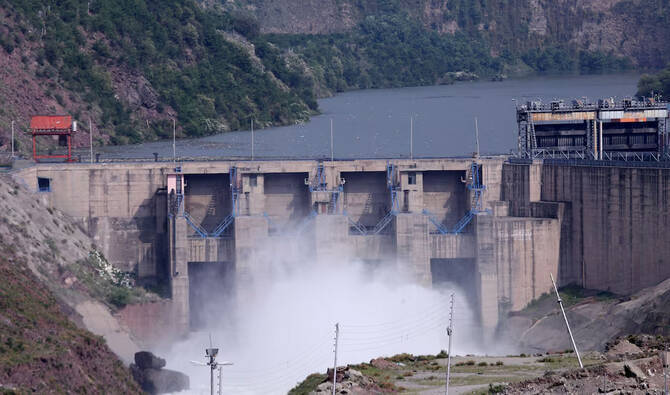
At the center of the case is India’s Ratle Hydro-Electric Plant, one of several run-of-river projects New Delhi has built or is building on the western rivers — construction permitted under the treaty, but subject to design restrictions intended to prevent India from controlling the flow of water into Pakistan. Pakistan had also raised concerns about India’s Kishenganga plant, though the court’s interim order Monday focused specifically on Ratle.
The panel ordered India to halt concrete work on the Ratle dam wall and its power intake structure above specified levels, a restriction that will remain in place until 90 days after a separate, ongoing review is completed. That review is being conducted by a neutral expert appointed by the World Bank, who is expected to issue a final determination by July 2027 on whether the Ratle and Kishenganga projects comply with the treaty’s technical requirements. The court also required India to continue reporting on the Ratle construction schedule, though it declined to grant two other measures Pakistan had requested.
The arbitration panel was chaired by Sean D. Murphy, a professor and international law scholar based in the United States. The other four members were Wouter Buytaert of Belgium, Jeffrey P. Minear of the United States, Awn Shawkat Al-Khasawneh, a Jordanian judge, and Donald Blackmore of Australia.
India rejects the ruling outright
India’s Ministry of Foreign Affairs said in a statement that it “categorically” rejects the court’s findings and does not recognize its authority to weigh in on the matter at all.
“This so-called Court of Arbitration has no jurisdiction whatsoever to pronounce on India’s sovereign decisions,” the ministry said, adding that India’s original decision to hold the treaty in abeyance remains in effect regardless of the ruling.
India did not participate in the proceedings, submitting no written or oral arguments in its own defence. The court noted it nonetheless attempted to account for India’s position by examining public statements from Indian officials and communications New Delhi had sent to Pakistan and to the World Bank-appointed neutral expert.
Pakistan’s response was notably more measured. The country’s information ministry said Islamabad had “taken note” of the ruling and welcomed the court’s conclusion that India remains bound by the treaty. Officials said the government would review the full text of the award once published and consider how it might help restore normal engagement between the two countries under the treaty’s framework.
The legal reasoning
In its ruling, the court methodically dismantled each justification India had offered for suspending the treaty, working through the narrow set of circumstances under which international law permits a country to unilaterally exit an agreement: a material breach by the other party, a fundamental change in circumstances since the treaty was signed, or the outbreak of armed conflict.
On the question of breach, India had suggested Pakistan violated the “cooperative spirit” of the treaty by declining to negotiate modifications to it. The court found no such obligation exists in the treaty’s text, and noted that its review of correspondence between the two governments showed Pakistan had, in fact, been willing to discuss potential changes.
India had also pointed to what it described as cross-border terrorism originating from Pakistan as grounds for suspending the agreement. The court found the treaty does not address terrorism or the use of force at all, and said it saw no evidence that alleged terrorist activity had actually prevented India from building hydroelectric projects on the western rivers — noting, to the contrary, that India has continued constructing such plants in recent years. Even accepting India’s terrorism allegations as true, the court said, they would not amount to a material breach of the treaty by Pakistan.
The panel also rejected the idea that changed circumstances justified India’s move, considering five arguments New Delhi had raised: shifting demographics, its growing need for clean energy, advances in dam technology, an escalation in cross-border terrorist attacks, and the effects of climate change. In each case, the court found the legal threshold for invoking “fundamental change of circumstances” had not been met.
As for armed conflict, the court noted the treaty was designed to remain operational even during wartime — and that no state of armed conflict exists between the two countries at present, despite last May’s brief clash. The panel additionally considered and rejected the argument that India’s actions could be justified as a lawful countermeasure against a prior violation by Pakistan.
The court underscored that suspending or terminating the treaty would carry serious consequences, potentially affecting India’s obligations to protect fundamental human rights, cutting off the treaty’s dispute-resolution mechanisms, and preventing any return to normal operations under the agreement.
A long road to The Hague
Monday’s ruling caps a legal process that has unfolded over nearly a decade. Pakistan first initiated arbitration proceedings concerning the western rivers in August 2016. Months later, the World Bank paused the process of appointing both the court’s chairman and a neutral expert — a pause that lasted until 2022, when the process resumed and a neutral expert was named.
After India moved to suspend the treaty in April 2025, the arbitration court first addressed whether that decision affected its own authority to hear the case, issuing a supplemental ruling in June of that year affirming that India’s move could not limit the court’s jurisdiction, though it stopped short at that point of ruling on the treaty’s overall status.
Pakistan filed the application that led to Monday’s ruling on March 4, asking the court to determine the treaty’s status in light of India’s abeyance decision. The court said it invited India to participate but received no response. Pakistan was then directed to file a detailed written memorial, and the court held hearings at the Peace Palace in The Hague from April 26 to 28.
With India’s rejection of the ruling and no enforcement mechanism to compel compliance, the practical effect of Monday’s decision remains uncertain. But the ruling gives Pakistan a significant legal victory in a dispute that shows no sign of easing, and sets up a further reckoning in 2027, when the World Bank’s neutral expert is due to rule on whether India’s dam projects themselves comply with the treaty it has been ordered to uphold.
Copyright © 2021 Independent Pakistan | All rights reserved