By Staff Reporter
LAHORE: Pakistan’s interior minister said on Saturday that any effort to create new provinces or administrative units in the country must be driven by public demand rather than political calculation, reviving a debate that has strained relations among the government’s coalition partners and drawn sharp opposition from officials in Sindh province.
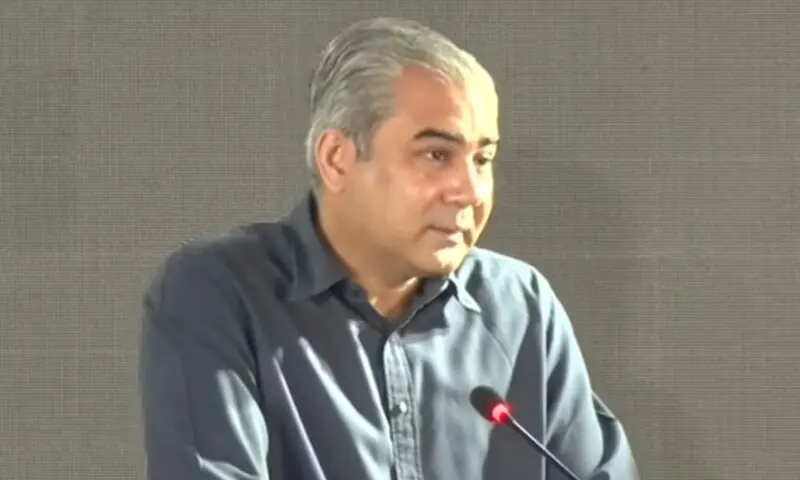
Speaking at the National Policy Dialogue here, Interior Minister Mohsin Naqvi said a broader overhaul of Pakistan’s governance system — a proposal he first floated in July — was not intended to dismantle the country’s political structure, but to correct what he described as decades of administrative failure.
“Reset does not mean breaking the system,” Naqvi told the gathering. “Under no circumstances does it mean breaking the system. It means that whatever is wrong should be changed.”
The minister’s remarks were the latest turn in a monthslong controversy that has exposed fault lines between Pakistan’s ruling coalition partners and reignited long-standing anxieties in Sindh, where any suggestion of redrawn provincial boundaries has historically met fierce resistance. Naqvi, who is widely seen as close to Pakistan’s military leadership, first drew criticism in July when he described the country’s governance system as “collapsed” and proposed smaller administrative units to bring government services closer to citizens.
That comment set off weeks of political maneuvering. The Pakistan Peoples Party, a key partner in the ruling coalition led by Prime Minister Shehbaz Sharif, referred the matter to its central decision-making body. Sindh’s chief minister rejected the idea outright. Lawyers in Lahore called it unconstitutional. And nationalist groups in Sindh demanded Naqvi’s resignation.
On Saturday, Naqvi sought to lower the temperature while standing by the substance of his proposal. He said any restructuring would have to proceed through “political consensus” and be grounded in “the will of our people,” and could not be dictated by a single leader, party or government.
“This would only happen if the people want it and consent to it,” he said.
The minister called for a public dialogue that would weigh the advantages and drawbacks of new administrative units before any plan moved forward. “Draft a thing and present it to the people, asking them whether they accept it or not,” he said, adding that questions about how many units to create and where to draw their boundaries should be examined for their financial and practical consequences by Parliament, outside experts and the public before any decision is made.
Naqvi said his earlier comments had been misread as an attack on the current government or a specific political party, when he had intended them as criticism of an administrative system that has been in place since Pakistan’s founding 79 years ago.
“Even today, four out of every 10 children are not receiving the education they need,” he said, citing what he called evidence of the system’s shortcomings. “Today, only 55 percent of the population has access to clean drinking water, and there are still two million cases pending in our courts.”
The dispute has taken on particular urgency in Sindh, where the provincial assembly passed a resolution on Thursday rejecting any proposal to divide the province or alter its boundaries. Sindh Chief Minister Murad Ali Shah has said any attempt to split the province would be unacceptable, and Nisar Khuhro, president of the Pakistan Peoples Party’s Sindh chapter, presided over a party meeting that branded the federal ministers’ comments “unconstitutional interference” in the province’s affairs. The meeting called on Sharif to rein in his ministers.
Naqvi, for his part, argued that Pakistan’s four provinces — Punjab, Sindh, Khyber Pakhtunkhwa and Balochistan — have grown too unwieldy to govern effectively as the country’s population has swelled past 240 million. He noted that Pakistan already permits the creation of smaller administrative tiers such as tehsils, divisions and districts, and questioned why similar flexibility should not extend to larger units.
“When it comes to power moving down to the grassroots level, everyone objects to it,” he said. “This objection needs to be removed.”
He rejected the notion that new administrative units would create costly additional layers of bureaucracy, arguing instead that decentralisation would reduce spending and bring government closer to the people it serves. He also said no proposed unit should be based on ethnic or linguistic lines, and sought to reassure residents that regional identities would not be erased.
“A Sindhi would remain Sindhi and a Punjabi would remain Punjabi,” Naqvi said. “No one will be asked to surrender their identity.”
Citing the constitution’s founder, he added: “Quaid-i-Azam had made it clear that we are all Pakistanis,” saying national identity took precedence over provincial affiliation.
The minister devoted a portion of his remarks to what he called the unresolved status of Islamabad, the federal capital, which he argued should be granted provincial status. Islamabad currently receives no share of the National Finance Commission Award, the mechanism through which federal tax revenue is distributed among the provinces.
“Islamabad is the only city that does not get a single rupee from the budget of Pakistan,” he said, describing himself as the “biggest supporter” of the proposal. “If a province is to be made, Islamabad is such a case that we should all say yes to it.”
He also raised concerns about the formula used to calculate the NFC Award, which weighs population heavily in determining how much funding each province receives — an approach he suggested could invite manipulation of census figures.
Naqvi said he did not intend to abandon the broader push for administrative reform despite the political backlash, and appealed to lawmakers to debate the issue on its merits rather than through what he called “emotional” rhetoric.
“Under no circumstances are we ready to accept that we have become so incapable that we cannot reset this system,” he said.
He pointed to New York City Mayor Zohran Mamdani as an example of local leadership that understood constituents’ needs directly, arguing that officials closer to the communities they serve are better positioned to address everyday problems.
Naqvi closed his remarks by reiterating that no plan should be finalized in advance of public input.
“We should not be fixed on anything in any way,” he said. “Neither should the maps be decided beforehand, nor should any formula be decided beforehand. The only thing that should be decided beforehand is Pakistan’s interest.”
Copyright © 2021 Independent Pakistan | All rights reserved