By Staff Reporter
QUETTA: Pakistan’s top military officer travelled on Saturday to Quetta, the provincial capital of Balochistan, delivering a message of solidarity to a region convulsed by one of the most violent stretches of insurgent activity it has seen in years — even as questions persisted about how many people have actually died in the government’s response.
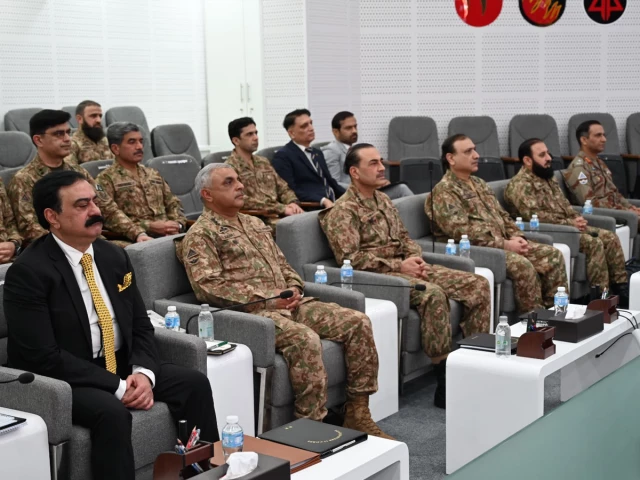
Field Marshal Asim Munir, who holds the dual titles of chief of army staff and chief of defence forces, met with senior commanders at Quetta Garrison and was briefed on the security situation across a province that has, for weeks, been the site of near-daily military operations, ambushes, and reprisal attacks. According to a statement from the Inter-Services Public Relations office, the military’s media and public affairs arm, Munir told commanders that “the peace, prosperity and well-being of the people of Balochistan” remained central to the state’s mission there.
Balochistan — the country’s largest province by land area but among its poorest and least populated — is the site of a long-running separatist insurgency, waves of enforced disappearances documented by human rights groups, and a military and intelligence footprint that journalists and independent observers say makes the region one of the hardest in South Asia to report from freely.
The visit came one day after the ISPR announced that security forces had killed 48 people in “high-tempo” operations across the districts of Mastung, Quetta, Kalat, and Sibi over a 72-hour period. The military said those killed were linked to groups it labels “Fitna-al-Hindustan” and “Fitna-al-Khawarij” — state-coined terms that translate roughly to “strife of India” and “strife of the Khawarij,” an epithet drawn from early Islamic history. Pakistani officials use the first term to describe Baloch separatist networks they allege are backed by India, and the second to refer to the outlawed Pakistani Taliban, known by its initials, TTP.
The pace and scale of violence in the province has been difficult to overstate this year. Just this past week, gunmen — the government says roughly 40 of them — struck the town of Bhag with rocket launchers, sniper rifles, and hand grenades in a coordinated assault on a police station, a bank, and the office of the assistant commissioner, according to Shahid Rind, the Balochistan chief minister’s aide for political and media affairs. Rind said on social media that the attackers failed to breach the police station or seize its weapons stockpile, though two officers were among five people wounded.
Days before that, in the early hours between Aug. 31 and Sept. 1, militants identified by the ISPR as belonging to the Pakistani Taliban assaulted a customs facility along the N-50 National Highway in Pishin district, near the Afghan border. The ensuing gun battle killed six members of Pakistan’s security and customs personnel, including two officers, the military said. Ten attackers were also killed, according to the ISPR account.
Taken together, the incidents reflect a documented surge in violence that predates Saturday’s visit and appears, by most measures, to be accelerating. The Pakistan Institute for Conflict and Security Studies, an independent research organization that tracks militant violence nationwide, recorded 89 attacks in Balochistan in August, a 7 percent increase from the 83 recorded in July. Separately, Armed Conflict Location & Event Data, a U.S.-based nonprofit that catalogs political violence globally, found that attacks across Pakistan as a whole nearly quadrupled between 2022 and 2025 — climbing from 658 to 2,425 — while attacks specifically attributed to the Pakistani Taliban rose more than sevenfold, from 118 to 838, over the same period.
Those figures track with a pattern that has troubled Western security analysts for several years: the steady collapse of a 2014-2015 lull in militancy that followed a major Pakistani military offensive, and the resurgence of both the Pakistani Taliban along the Afghan frontier and Baloch separatist groups, chief among them the Baloch Liberation Army, in the country’s southwest.
The insurgency in Balochistan has different roots and grievances than the Islamist violence associated with the Pakistani Taliban, though the government increasingly folds both into a single counterterrorism narrative. Baloch separatist groups, active in various forms since Pakistan’s founding, accuse the federal government and its security establishment of extracting the province’s natural gas and mineral wealth while leaving its population in poverty, and of using heavy-handed tactics — including what human rights organisations have documented as widespread enforced disappearances of suspected sympathisers — to suppress dissent.
Pakistani officials reject that characterisation. They point to billions of dollars in infrastructure spending under the China-Pakistan Economic Corridor, a signature project of Beijing’s Belt and Road Initiative that runs through Balochistan and terminates at the deep-water port of Gwadar, as evidence of the state’s commitment to the province’s development. Officials argue that militant attacks targeting labourers from other provinces and infrastructure projects tied to the corridor have themselves slowed the economic progress separatists say they are denied.
Prime Minister Shehbaz Sharif waded into that debate recently, stating that Pakistani forces have killed more than 1,188 militants in Balochistan since the start of the year.
During Saturday’s visit, Munir was received on arrival by the Quetta Corps commander and given a comprehensive briefing on operational readiness and ongoing security measures. He also discussed matters of “institutional coordination” and support for the province’s economic development. Munir praised the troops’ professionalism and their “selfless commitment,” and he called for tighter coordination between law enforcement agencies and other government bodies to “consolidate peace and maintain an environment conducive to sustained economic activity and development.” He also paid tribute to Pakistani security personnel killed in the province, a group that has grown considerably over the past several weeks alone.
Copyright © 2021 Independent Pakistan | All rights reserved