By Staff Reporter
ISLAMABAD: A Senate hearing into the death of a Gujranwala sanitation worker descended into open hostility on Wednesday, as two senators traded sharp words across the committee room while officials from Suthra Punjab faced sustained questioning over the circumstances of his death.
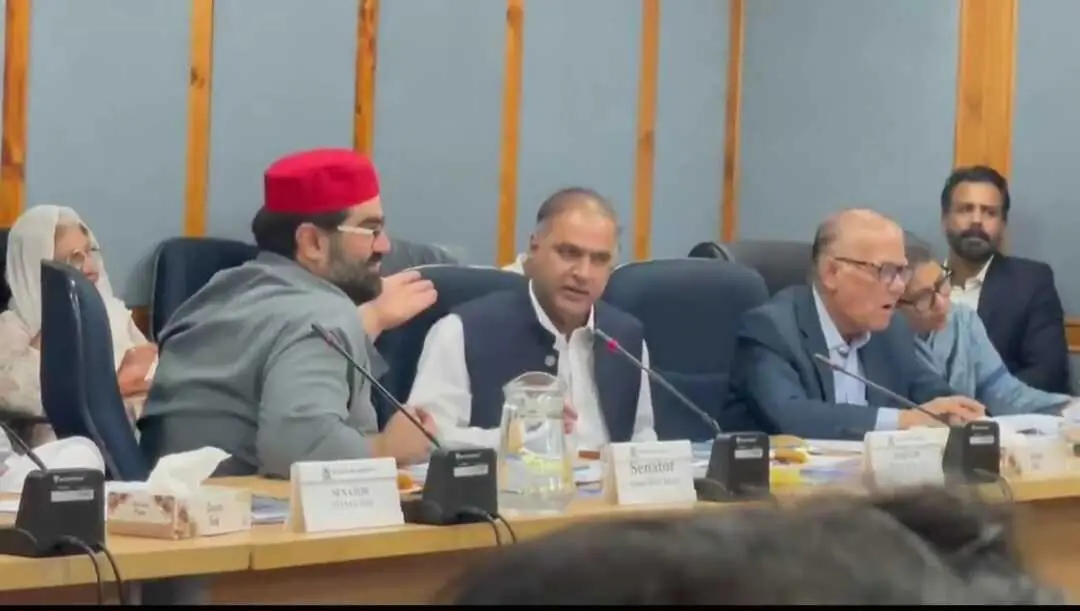
The exchange, between Pakistan Muslim League-Nawaz senator Abid Sher Ali and Awami National Party chief Aimal Wali Khan, unfolded during a session of the Senate Functional Committee on Human Rights, chaired by Senator Samina Mumtaz Zehri. The committee had convened to examine the death of an employee of the Gujranwala Waste Management Company, who is alleged to have taken his own life after being paid only half his salary and having his contract terminated.
As Khan bore down on officials with a series of pointed questions, Ali intervened to object to what he characterised as an overly aggressive line of interrogation. “Listen to them — you are conducting an inquiry and asking questions as if you are sitting in a police station,” he said.
The atmosphere sharpened further when another committee member proposed that the cameras recording the session be switched off. Ali brushed off the suggestion, insisting he had nothing to hide. He then turned back to Khan. “Speak properly,” he said. Khan was unmoved. “I am speaking properly — you speak properly too,” he replied. Senator Qurratulain Marri and other members of the committee stepped in to calm the exchange before it escalated further.
Beneath the public friction lay a case that has already drawn scrutiny over how Punjab’s waste management contractors treat their lowest-paid staff. Officials told the committee that the worker had been employed by the Gujranwala Waste Management Company between 2024 and 2025, and that his contract had lapsed on 31 May 2026. His death, they maintained, occurred only after that contract had expired — a detail that appeared calculated to place the incident outside the company’s direct responsibility.
That framing did not go unchallenged. Senator Musarrat Hussain asked officials directly whether any audio or video recording had been made of the worker before his death, before putting a starker question to them: “Did you kill him?”
Khan alleged that the worker had been receiving only half his entitled salary in the period before his death, and said the financial pressure this created had driven him to take his own life. “A common labourer was pushed to the point where he took his own life,” he told the committee.
The company’s chief executive, Abdul Razaque Ali Dogar, rejected the claim. He told the committee that bank records showed the worker had received his salary in full, and suggested separately that the worker had a history of performance issues — a characterisation that drew visible irritation from committee members.
Attention then turned to the structure of Suthra Punjab’s employment practices more broadly. Senator Qurratulain Marri questioned why the organisation was relying on third-party contractors to supply cleaning staff rather than hiring workers directly, a model that has drawn criticism in other Punjab waste management disputes for diluting accountability. She went further, highlighting an apparent legal inconsistency: the Suthra Punjab Act did not come into force until 2026, yet the incident under review took place in 2025. “How was recruitment done before the institution formally existed?” she asked. Khan repeated the question in his own words moments later, pressing officials on how hiring could have proceeded under a law that was not yet in effect.
The CEO told the committee that compensation had since been extended to the worker’s widow and children, including a residential plot secured with the assistance of a chamber of commerce, though he did not specify which chamber had been involved. Khan seized on the apparent contradiction — that a company maintaining the worker was not in its employ at the time of his death had nonetheless arranged compensation on the scale typically reserved for a serving employee. “If you give me a plot too, I will also be happy,” he said.
The session grew tenser still when officials appeared to suggest the worker’s death may have stemmed from personal circumstances unrelated to his employment. Khan rejected this characterisation outright, accusing officials of introducing an unsubstantiated claim into the record. “You casually made an allegation that there was a love affair involved in why he died,” he said.
The committee concluded the session by directing Suthra Punjab to submit copies of the legislation governing the organisation for both 2025 and 2026, and asked whether any grievance or redress mechanism existed for workers beyond one-off financial compensation.
Wednesday’s hearing followed weeks of mounting concern over the case. On 1 July, a Suthra Punjab worker set himself on fire in Gujranwala in protest at the non-payment of his full salary, and died of his injuries two days later. CCTV footage from the scene showed the employee leaving an office where he had gone to lodge a complaint against a contractor, before dousing himself in petrol in a corridor in front of colleagues. Other staff members rushed to help, throwing water on him in an attempt to extinguish the flames, the footage showed.
An official familiar with the case has said the contractor responsible had been illegally withholding a significant portion of workers’ monthly salaries of Rs21,000.
The Senate committee first raised concerns over the case on 17 July, when it demanded complete documentation — including employment contracts, salary registers, tax records and banking transactions — to establish whether any violations had occurred. It also instructed the relevant authorities to detail what compensation and insurance arrangements had been made for the deceased worker’s family.
Copyright © 2021 Independent Pakistan | All rights reserved