By Staff Reporter
ISLAMABAD: Pakistan’s defence minister has warned that a fresh wave of Houthi missile and drone strikes on Saudi Arabia could be enough to activate a fledgling trilateral defence pact between Islamabad, Riyadh and Ankara, as the Yemeni conflict edges closer to spilling across the kingdom’s southern border.
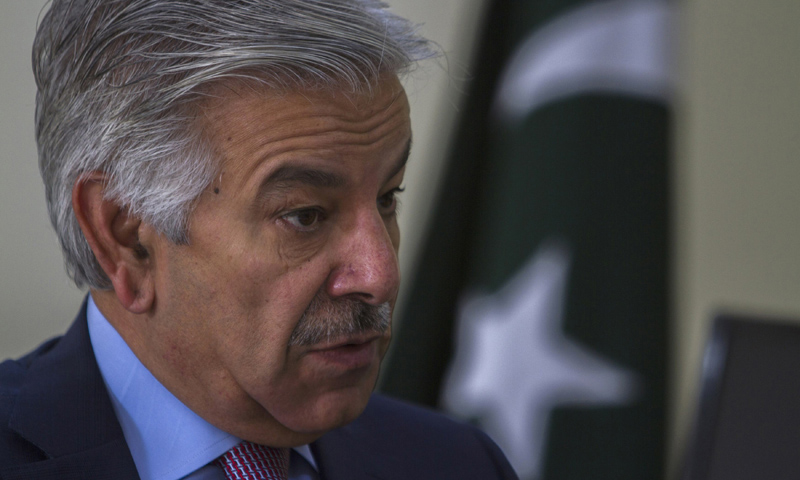
Khawaja Asif said there was “no ambiguity” that the Makkah Defence Alliance, signed by Pakistan, Saudi Arabia and Turkiye barely a month ago, would become operational if the fighting in Yemen crossed into Saudi territory, or if any of the three signatories came under unprovoked attack.
“This is a joint defence pact,” he told a private news channel. “And unprovoked aggression or spillover of whatever is happening in Yemen into Saudi Arabia, definitely, the pact will become operational; there should be no doubt in this.”
“We are bound by the terms and conditions of this pact and we will honour them in case there is a need,” he added.
The minister’s remarks came hours after Iran-aligned Houthi forces claimed a wave of strikes on four cities in southern Saudi Arabia — Abha, Khamis Mushait, Jazan and Najran — hitting Abha International Airport, the King Khalid air base and installations belonging to the state oil company Aramco. Saudi Arabia halted several energy facilities in its south as a result of the strikes. More than 70 people were injured, according to Pakistani officials, though early figures from the region put the toll at 73.
Saudi forces responded with strikes of their own on Taiz and Marib provinces in Yemen, as well as the Jubah district east of the rebel-held capital, Sanaa. The kingdom’s foreign ministry said it would “take all necessary measures to defend its sovereignty.”
A pact born of old ties
The Makkah Defence Alliance was signed on 7 August at the Makkah Al-Mukarramah Summit for Joint Defence, formalising a strategic relationship between the three Muslim-majority states that has developed over decades. Under its terms, an attack on any one signatory is to be treated as an attack on all three — a clause that has drawn comparisons to Nato’s Article 5, though defence analysts have cautioned that the pact was designed to codify existing military cooperation rather than establish a new offensive bloc.
Asif was careful to frame the agreement as defensive rather than escalatory. “If there is aggression against one member state, then all three member states will respond in kind,” he said, adding that Pakistan’s obligations would have applied even without the wider trilateral framework. “This is a trilateral pact — but even if it were bilateral, we would have responded.”
Pressed on whether Riyadh and Islamabad had been in direct contact since the attacks, Asif said he was not aware of any specific engagement, though he insisted Pakistan remained “bound to react under the pact because it is aimed at joint defence and collective help in case of aggression.”
He was equally keen to stress that activation of the pact would not necessarily mean a military response. Three nations with Pakistan, Saudi Arabia and Turkiye’s combined strength, he argued, did not need to answer aggression with aggression — the alliance’s real value lay in deterrence. “We don’t need to respond to a brick with a stone,” he said, arguing that the combined military capabilities of Pakistan, Saudi Arabia and Turkiye should themselves act as a deterrent.
“At their own peril”
The defence minister was notably measured in his language towards Iran, whose backing of the Houthis has long complicated the politics of any Pakistani response. He acknowledged that sympathy for Tehran ran deep across the Muslim world, Yemen included, but drew a sharp distinction between that sentiment and the Houthis’ actions.
“There is sympathy for Iran around the Muslim world. There is no doubt about that, but exploitation of a bilateral dispute by non-state actors, I believe they are doing it at their own peril,” he said, describing the Houthis explicitly as “non-state actors” whose actions did not reflect Yemen’s own government, which he noted had itself responded to the group’s attacks.
He appealed directly to the rebel movement to draw back. “The Houthis will realise that if they attempt to export their internal matters, then the clauses of this pact over confronting aggression will become operative,” he said. “They should keep this in mind.”
Asif drew on his own experience of the conflict, recalling a visit to Yemen in 2014, when he held the same post, as the war there first escalated. “At that time too, we helped Saudi Arabia,” he said, pointing to the “sanctity” of the kingdom’s territory and Pakistan’s long alliance with Riyadh as reasons the two countries had traditionally stood together “whenever there are testing times.”
Despite the tough language, Asif struck a hopeful note about the immediate crisis, saying he expected the situation to “come under control and die down.”
Sharif condemns “dastardly” attack
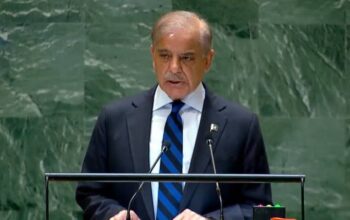
Prime Minister Shehbaz Sharif condemned the Houthi strikes within hours, describing them on social media as “dastardly attacks” that threatened “innocent lives as well as regional peace and security.” He pledged Pakistan’s “unwavering solidarity” with Riyadh.
“We reaffirm our steadfast support for the kingdom’s sovereignty, security and territorial integrity, and pray for the swift recovery of all those injured,” he wrote on X.
The Foreign Office followed with its own statement branding the attacks “reprehensible.”
Asif used the same interview to address Pakistan’s continuing efforts to mediate between Washington and Tehran, whose relations have remained tense since the United States and Israel struck Iranian targets in February. He said the process had reached “a stalemate” but rejected the suggestion that diplomacy had run its course.
“I will not abandon hope that the process has ended or that all doors have closed,” he said, pointing to ongoing “indirect engagement” between the two sides.
He acknowledged the difficulty of Pakistan’s position, caught between “brotherly relations” with states on opposing sides of Middle Eastern rivalries, and voiced hope that peace could ultimately prevail. But he reserved his sharpest criticism for Israel, accusing Benjamin Netanyahu’s government of prolonging regional conflict for its own benefit.
“Israel will want that the conflict should continue and Gulf countries should be drained,” he said, arguing that Israel bore few of the direct costs of the fighting because its funding “was coming from overseas.” “In fact, I believe they are profiting off of it.”
He said ordinary people in Gaza, the West Bank and Lebanon were paying the price for what he called Netanyahu’s “lust for power” — but pointed to a shift in international opinion as a source of hope. “In the world over, especially Europe, North America, New Zealand, Latin America, there is a sea change in the opinions of people, and people want to get rid of the Zionist lobby,” he said.
Copyright © 2021 Independent Pakistan | All rights reserved