By Staff Reporter
ISLAMABAD: Prime Minister Shehbaz Sharif telephoned Saudi Arabia’s crown prince on Sunday to condemn a string of attacks that battered the kingdom’s energy sector over the preceding week, as Riyadh grappled with both a missile and drone barrage from Yemen’s Houthi rebels and a still-unclaimed drone strike on one of its most important oil pipelines.
Sharif told Crown Prince Mohammed bin Salman that Pakistan stood in “complete solidarity” with Saudi Arabia, according to a statement from his office, and warned that the escalating violence threatened not just the region but the global economy.
“I reiterated Pakistan’s strongest condemnation of the recent Houthi attacks targeting civilian and economic infrastructure in the Kingdom, and conveyed our complete solidarity with the Saudi leadership and our Saudi brothers and sisters,” Sharif said in a social media post summarizing the call. “Such reckless actions threaten regional peace and stability, with serious consequences for the global economy and energy security.”
The call capped a difficult week for Saudi Arabia. On Sept. 8, the Iran-aligned Houthi movement launched a barrage of ballistic missiles and drones into the kingdom’s south, striking an Aramco refinery, a bulk fuel plant and facilities near an air base in the Jazan region, as well as the nearby cities of Abha, Khamis Mushait and Najran. Saudi authorities said the attacks injured 73 people, including women and children, and forced several energy facilities offline as fires burned at the sites. The Jazan refinery, which processes roughly 400,000 barrels of crude a day, is among the largest in the country. Houthi military spokesman Yahya Saree claimed responsibility, saying the group had fired dozens of missiles and drones in retaliation for Saudi airstrikes across Yemen days earlier.
Then, on Sept. 10 and 11, drones struck Saudi Arabia’s East-West Crude Oil Pipeline in the Riyadh and Medina regions, a 1,200-kilometer conduit that normally moves 4 million to 5 million barrels of crude a day from the kingdom’s Eastern Province to the Red Sea port of Yanbu. The pipeline has taken on outsized importance since March, when the closure of the Strait of Hormuz cut off Saudi Arabia’s usual export route, leaving the East-West line as its primary alternative. Saudi Arabia shut the pipeline down Friday as a precaution, halting the flow of oil it carries with no ready way to reroute the same volume elsewhere.
Saudi Arabia’s Foreign Ministry said the strikes came from “several drones originating from Iraq,” causing injuries and material damage, and issued its strongest condemnation. But the kingdom said it would hold off on retaliating, at Baghdad’s request, to give the Iraqi government a chance to act on its own. No group has claimed responsibility for the attack.
Iraq’s government confirmed the drones had been launched from its territory, tracing the origin to a location in Maysan province, along the border with Iran. Iraqi Prime Minister Ali al-Zaidi ordered an investigation and dismissed the military commander who had led operations in the province. An umbrella group representing Iran-backed militias in Iraq denied responsibility for the strike, while separately praising the Houthis for what it called their “ongoing battlefield victories” against Saudi forces. Regional officials have told the Associated Press that the Houthis and Iraqi militia groups may have coordinated their recent attacks on Saudi facilities, though that assessment has not been independently confirmed.
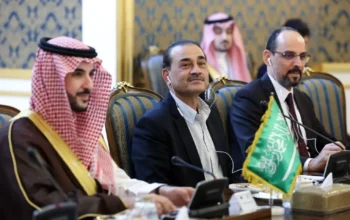
Against that backdrop, Sharif’s call with Mohammed bin Salman doubled as a reaffirmation of a security relationship that has deepened considerably over the past year. Sharif told the crown prince that he, Pakistan’s military chief, Field Marshal Syed Asim Munir, and Deputy Prime Minister and Foreign Minister Ishaq Dar would keep working to de-escalate the crisis, according to the PMO statement, and he praised the crown prince’s handling of the turmoil. He also passed along his regards to King Salman bin Abdulaziz Al Saud, the custodian of Islam’s two holiest sites. Mohammed bin Salman thanked Sharif for Pakistan’s continued support, and the two leaders agreed to stay in close touch and meet again soon, the statement said.
The relationship has been formalized in a pair of defense agreements. Pakistan and Saudi Arabia signed a bilateral pact, the Strategic Mutual Defense Agreement, in September 2025, committing each country to treat an attack on the other as an attack on itself. In early August of this year, Pakistan, Saudi Arabia and Turkey expanded that arrangement into a trilateral pact, extending the same mutual-defense commitment to all three countries amid what regional officials described as growing instability tied to the broader U.S.-Israeli conflict with Iran. It remains unclear whether or how Pakistan or Turkey would actually be drawn into any Saudi response to the recent attacks.
Pakistan’s defense minister, Khawaja Asif, warned the Houthis earlier in the week against using the wider U.S.-Iran war as cover to draw Saudi Arabia deeper into the conflict, saying they would do so “at their own peril,” and suggested that further escalation could activate the trilateral agreement.
“Unprovoked aggression or spillover of whatever is happening in Yemen into Saudi Arabia will definitely make this agreement operational,” Asif said.
Pakistan’s Foreign Office has since sought to dampen speculation that the warning meant Islamabad was preparing to join Saudi Arabia in military action against Houthi targets in Yemen, saying the trilateral pact was still being finalized and should not yet be read as close to activation.
The Houthis, who control the most populous areas of Yemen and much of the country’s north, have escalated their campaign against Saudi Arabia since declaring a naval blockade against the kingdom in July, striking vessels in the Red Sea in addition to onshore energy infrastructure.
Copyright © 2021 Independent Pakistan | All rights reserved