By Staff Reporter
LAHORE: The chief minister of Pakistan’s north-western province of Khyber Pakhtunkhwa has accused the authorities in Punjab of abducting him and abandoning him at the roadside, an allegation the Punjab government rejected on Monday night as a piece of political theatre.
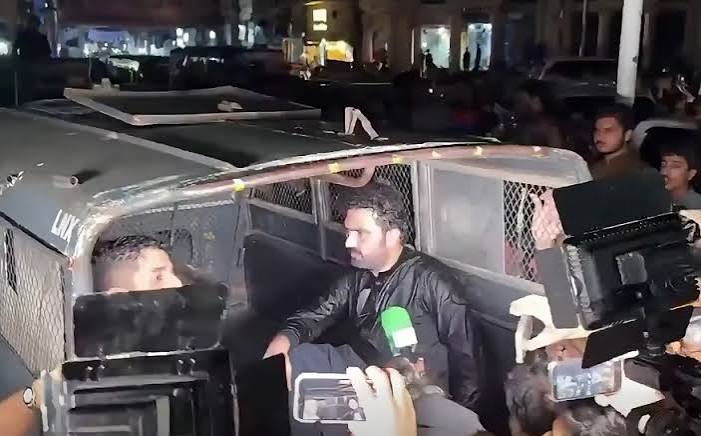
Sohail Afridi, the head of the Khyber Pakhtunkhwa administration for Imran Khan’s Pakistan Tehreek-e-Insaf (PTI), said police took him away in a vehicle in Lahore and then abruptly abandoned him once the officers involved came under pressure.
“We were abducted and, when they came under pressure from somewhere, they threw me by the roadside, left me without security and drove away,” he said.
Afridi went further, alleging that there had been a “conspiracy to abduct the chief minister of a province” and saying he had warned previously that “they want to divide the country” — an unusually blunt charge from a serving head of a provincial government against the administration of a neighbouring one.
The claim landed at the end of a day in which Pakistan’s most populous province had effectively been locked down against him. Entry and exit points to Lahore were sealed, police pickets were thrown up across the city, and more than a dozen PTI workers were arrested, among them the party’s Lahore president, Mian Akram Usman, and its vice-president, Naeemullah Taj.
Punjab’s information minister, Azma Bokhari, gave a very different account. She said Afridi had not been arrested at all and had climbed into the police vehicle of his own accord.
Footage circulated by Bokhari shows the chief minister walking towards the vehicle and getting in. He is then seen refusing to get out, with a voice off camera heard asking him to “please leave the vehicle”.
Speaking to a private television channel, Bokhari said the situation had escalated when PTI supporters surrounded the vehicle, and officers concluded they were under attack. “There were cameras shooting them, and there was a video from inside the dala,” she said, using the local term for a police pick-up truck. “The driver thought the vehicle was being attacked, so he drove away, but stopped a short while later and said people got off and sat on the footpath.”
She questioned why no passing motorist appeared to have noticed a provincial chief minister sitting on a Lahore pavement, and pointed out that there were no police officers at the spot where he was left, but that his own guards and a cameraman were. “This is a total drama because people did not come out from Lahore and Punjab,” she said.
Asked about Afridi’s claim that he had been released under pressure and left without a security detail, Bokhari was dismissive. “The only pressure in that scenario is his low blood pressure,” she said.
A third version came from within Afridi’s own government. A senior Khyber Pakhtunkhwa official travelling with him told the Dawn newspaper that the chief minister had got into the police van deliberately, in an attempt to secure the release of party workers picked up during the day. Some were let go, the official said, but others remained inside, and Afridi refused to get out while they were still being held. Police then drove the van some distance from the spot before removing him from it.
Afridi’s own official account on X added to the confusion. A post shortly before 9 pm said he “himself got on a Punjab Police van and reached a police station”. A post published minutes earlier had placed him with party workers at a protest on Lahore’s Mall Road.
The IP has not been able to independently verify the competing accounts of what happened.
‘An attack on the foundations of the federation’
Khyber Pakhtunkhwa’s information minister, Shafi Jan, backed his chief minister’s version, alleging that Punjab Police had tried to abduct him, had separated him from his security detail and had forced him into another vehicle before driving him to a remote area. He was left there without protection once “pressure mounted”, Jan said.
Jan accused the Punjab government of Maryam Nawaz of “police high-handedness” and said the treatment of an elected chief minister was unconstitutional and undemocratic. “The attempt to abduct Chief Minister Afridi will be considered an attack on the foundations of the federation,” he said.
He described the episode as a “dangerous attempt” to stir hatred and confrontation between the two provinces, and said the “humiliation” of the chief minister would not be tolerated.
PTI condemned what it called Afridi’s arrest as an “insult” to the mandate and the dignity of the people of Khyber Pakhtunkhwa. In a statement, the party warned that the incident, taken together with recent remarks by the Punjab chief minister, risked deepening “resentment, mistrust and division” between the provinces. It said it would not itself resort to “provincialism, ethnicity, hatred or division”, and insisted the mandate of voters in every province be respected. Supporters were urged to respond peacefully, with the party arguing that repression and political victimisation would only harden public anger.
Salman Akram Raja, PTI’s general secretary, wrote on X that the alleged abduction was an attack on the foundations of the federation and told the police to “come to their senses”.
A condolence visit that became a confrontation
Afridi had originally planned a broader tour of Punjab but changed course and travelled straight to Lahore to offer condolences to the family of a senior party worker who had died of burn injuries.
What followed was less a condolence call than a show of strength. He refused police protection outright, accusing the officers escorting him of obstructing party leaders and workers trying to reach him and calling them “shameless”. “I do not want security from a force that killed a man preparing for Eid-i-Miladun Nabi,” he said, referring to the dead worker.
He also answered Maryam Nawaz directly, after the Punjab chief minister said she felt threatened by the country’s other three provinces. “The fake chief minister says she feels threatened not by India but by the other three provinces of Pakistan,” Afridi said. “I announce today that I feel no threat from my brothers and sisters in Punjab.” He announced a nationwide street movement for 27 September, promising to rid the country of “fake rulers”.
His convoy was stopped at police blockades as it crossed into Punjab and again inside Lahore. Scuffles broke out between officers and party workers at several points. Elsewhere along the route, crowds of PTI supporters slowed the convoy to a crawl, with Afridi standing through the sunroof of his vehicle to wave and lead chants, and stopping to address workers at Do Moriya Pul on Circular Road.
The result was gridlock across the Walled City. Railway Station Road, Aik Moria Pul, Akbari Market Road, Delhi Gate, Wasanwala Bazaar and Shah Alam Market were all choked, and traffic police attempts to clear them failed. Earlier in the day, officers had shut markets around the dead worker’s home and along Gulberg, Ferozepur Road and The Mall.
The arrests were made under Section 144, the colonial-era provision banning public assembly that Punjab had imposed across the province before the visit.
Copyright © 2021 Independent Pakistan | All rights reserved