By Staff Reporter
ISLAMABAD: Pakistan’s military has moved to reassure allies and rivals alike that its new defence pact with Saudi Arabia and Turkiye carries no hidden ambitions, insisting the trilateral alliance exists purely to deter aggression rather than to project power across the region.
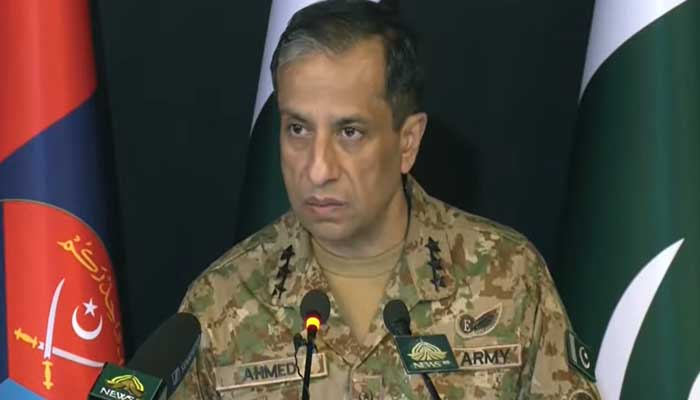
Lieutenant General Ahmed Sharif Chaudhry, director general of the Inter-Services Public Relations (ISPR), the military’s media wing, made the comments in an interview broadcast in the early hours of Wednesday on Al Arabiya English’s Global News Today, hosted by Tom Burges Watson. His remarks come at a delicate moment for the year-old alliance, with Saudi Arabia facing a fresh wave of missile and drone attacks from Yemen’s Houthi movement and Pakistan simultaneously attempting to broker peace between Washington and Tehran.
The Makkah Defence Alliance, signed on 7 August at Al-Safa Palace in the holy city, binds Pakistan, Saudi Arabia and Turkiye to treat an attack on any one member as an attack on all three. It was struck against a backdrop of regional upheaval, coming months into a war between the United States and Israel on one side and Iran on the other, a conflict that has since drawn in Gulf states and disrupted shipping through the Red Sea and the Strait of Hormuz.
Asked directly whether the pact amounted to more than a defensive arrangement, Lt Gen Chaudhry was unequivocal. “It is defensive. There’s nothing aggressive. There are no regional aspirations. It is collective deterrence,” he said, describing the agreement as the formalisation of “decades-old” ties between Islamabad and its two partners rather than the beginning of something new.
He was pressed repeatedly, however, on what the mutual defence clause would actually mean in practice — and on this, he declined to be drawn. Asked how Pakistan would respond were one of its partners attacked, the general said the mechanics of any collective response were, by their nature, not matters any state discloses in advance.
“What you’re asking is the how part — that how we are going to defend Pakistan against any aggression,” he said. “That is always part of the operational classification and security. It is for the three countries to decide, and it is for them to know and for them to actualise it.”
Since the pact was signed, Houthi forces have escalated missile and drone strikes on Saudi Arabia, including an attack on oil installations last week that left dozens injured, and have threatened shipping around the Bab-el-Mandeb Strait. On Tuesday evening, Saudi Arabia’s air defences shot down a drone launched by Houthi rebels south of Mecca in what the kingdom described as an attempt to breach the restricted airspace over Islam’s holiest city before pilgrims and residents were put at risk.
Pakistan’s own defence minister, Khawaja Asif, warned last week that the alliance could become operational should the conflict in Yemen spill over into Saudi territory — a possibility that has lent new urgency to a question Lt Gen Chaudhry was unwilling to answer in detail.
No competition with China, no exclusively Muslim bloc
Much of the interview was devoted to dispelling the notion that the new alliance might crowd out, or compete with, Pakistan’s other strategic partnerships — chief among them its relationship with China. Lt Gen Chaudhry rejected the suggestion outright, arguing that Beijing had long understood the depth of Pakistan’s ties to Riyadh and Ankara.
“We need to understand that the Pak-Saudi and the Pak-Turkiye relationship has not come out of the blue. The Chinese understand it. The world at large understands it,” he said. “Nobody has any problem with that. Everyone understands that this is defensive… And all the three countries that are part of it, they have a wonderful relationship with China.”
He was equally firm in pushing back on any characterisation of the pact as a specifically Islamic security bloc, despite its origins in the holy city of Makkah and its three Muslim-majority signatories. “It is not a club that is being made for only Muslim countries,” he said, adding that any decision to expand membership rested solely with the leadership of the three founding states.
That question of expansion has hung over the alliance since its inception. Turkiye floated the possibility of Egypt joining in the weeks after the signing, though Cairo has offered no confirmation. Pakistan’s Foreign Office, for its part, poured cold water on any imminent enlargement when its spokesperson, Sajjad Haider Khan, told a weekly briefing last week that expansion was “not on the cards” for now, with the three founding members first needing to consolidate the organisation’s structures before considering other states with comparable security concerns.
Deputy Prime Minister and Foreign Minister Ishaq Dar struck a more open tone in the immediate aftermath of the signing, describing the pact as “open to any country in the region” prepared to uphold its founding principles. At the alliance’s first ministerial meeting, held in Istanbul on 31 August, the three countries formally adopted the Makkah Defence Alliance name and agreed that Pakistan would head its secretariat, based in Saudi Arabia, for an initial three-year term.
Pakistan’s role as mediator between Washington and Tehran
The conversation also turned to Pakistan’s efforts to mediate the wider conflict between the United States and Iran, a role Islamabad has pursued since the war began in February with US-Israeli strikes on Iranian territory. Lt Gen Chaudhry rejected any suggestion that membership of the Makkah alliance complicated that effort or Pakistan’s standing with Tehran, framing the pact instead as separate from, and unrelated to, the country’s diplomatic outreach.
Asked why Pakistan had taken on the mediator’s role at all, he offered a brief but pointed answer: “For regional peace.” He went on to argue that Islamabad’s policy of engagement with states across the international spectrum gave it a “unique position” from which to act as what he called “an objective arbiter of peace and an honest broker of peace” — though he was careful not to be drawn on the substance or progress of any negotiations, arguing that neutrality demanded restraint from public comment.
Pressed on whether Pakistan would persist with mediation even if Washington and Tehran ultimately rejected its proposals, the general responded with a question of his own. “Is there any other way of resolving this conflict other than through mediation?” he said, adding that Pakistan remained “fully confident” in its ability to secure its own borders regardless of how the wider conflict developed, while acknowledging that a war of this scale inevitably carried risks that reached “the entire world at large.”
A warning to India, and the shadow of last year’s conflict
The interview also revisited the brief but intense military confrontation between Pakistan and India in May last year, with Lt Gen Chaudhry using the opportunity to deliver a pointed message to New Delhi. He described the prospect of war between two nuclear-armed neighbours as “a sheer, I would say, a sort of mad idea,” and argued that the conflict had exposed what he called a “strategic folly” on India’s part.
Asked whether he believed India had absorbed the lessons of that episode, the general was blunt, accusing New Delhi of a “hubristic mindset” and describing its military as “deeply politicised.” He went further, suggesting India had a tendency to externalise domestic problems — citing the treatment of religious minorities — while treating Kashmir, which he characterised as fundamentally an external dispute, as something to be managed through repression at home.
Despite the sharp language, Lt Gen Chaudhry insisted Pakistan remained open to restoring military-to-military dialogue with its neighbour, noting that contact between the two countries’ directors general of military operations had continued through and beyond last year’s clash. Any resumption of broader political dialogue, he said, would have to proceed on equal terms and could not serve as cover for what he described as continuing Indian-backed activity inside Pakistan.
Afghanistan and the campaign against militancy
Turning to Afghanistan, Lt Gen Chaudhry set out Pakistan’s position in stark terms, describing the country’s counter-terrorism campaign as “the only successful counter-terrorism campaign in the world” and invoking Pakistan’s right to self-defence under Article 51 of the UN Charter as justification for any cross-border action against militant groups operating from Afghan soil.
He disclosed that Pakistani forces had carried out 42,000 intelligence-based operations so far this year, resulting in the deaths of 2,100 militants, and rejected the characterisation of ongoing violence in Balochistan as an insurgency. “There’s just terrorism,” he said, noting that more than 32,000 of the year’s operations had taken place in the province, targeting what he described as proxy groups with no genuine connection to Baloch identity or grievances.
Copyright © 2021 Independent Pakistan | All rights reserved