By Staff Reporter
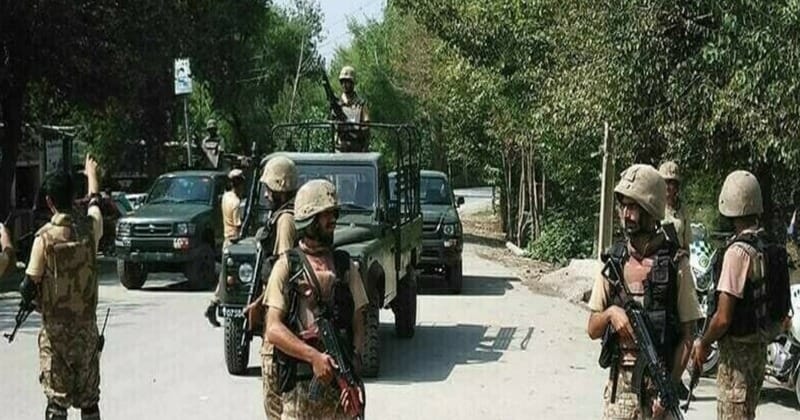
QUETTA: Security forces have killed 11 militants in a pair of operations in the restive southwestern province of Balochistan, state media reported on Saturday, the latest in a rapid succession of military actions as violence across the region intensifies.
Radio Pakistan, citing unnamed security sources, said five militants were killed in the Gowargo area of Panjgur district, while another six died in raids in the Aminabad and Siah Chang areas of neighbouring Chagai district. Large quantities of weapons and ammunition were recovered, along with what the broadcaster described as a significant cache of explosive material.
The operations were conducted under Operation Radd-ul-Fitna 3, the name given to the current phase of the military’s campaign in the province. Officials described those killed as members of “Fitna al-Hindustan”, the label the Pakistani state applies to Baloch separatist groups it accuses of acting on behalf of India.
Interior Minister Mohsin Naqvi praised the forces involved, according to the state-run Associated Press of Pakistan. He said the security forces had “once again thwarted the intentions of terrorists through effective action”, and that the operations reflected their commitment to safeguarding national security and their resolve to confront threats and maintain stability.
The announcement came a day after security forces said they had killed seven militants in two separate operations in Panjgur and Kachhi districts. On Thursday, a further seven were reported killed in an intelligence-based operation in the Badrang area of Awaran district.
Saturday’s raids form part of a relentless tempo of operations announced since the start of the month, as the authorities seek to contain a deteriorating security situation.
On the night of 31 August into 1 September, militants from the banned Tehreek-i-Taliban Pakistan (TTP) launched a coordinated assault on the Customs House at Ziarat Cross, on the N-50 National Highway in Pishin district. The military’s media wing, Inter-Services Public Relations (ISPR), said 10 attackers were killed in the ensuing exchange of fire. Six people died on the government side, among them two officers and a customs official, it said.
The state calls the TTP “Fitna al-Khawarij”. The ISPR described the assault as a manifestation of the nexus between terrorism and organised crime.
Hours earlier, on 31 August, 11 militants were killed in Chagai’s Nokcha area after they set up an illegal checkpoint on the N-40 Quetta-Taftan highway in what officials described as an extortion attempt against travellers. That brought the ISPR’s tally for that single night to 21 dead.
On 2 September, 12 militants were reported killed in an intelligence-based operation in Kalat district. Days later, troops said they had killed 11 more and recovered 2.9 tonnes of explosives in separate operations in Kharan and Washuk. On 4 September, the ISPR said 36 militants had been killed in what it called “high-tempo” operations across Mastung, Quetta, Kalat and Sibi, including the foiling of an attack on a police station in Sibi’s Bhag area.
The escalation has been mirrored in the data. The Pakistan Institute for Conflict and Security Studies (PICSS) recorded a 7 per cent rise in militant attacks in Balochistan, from 83 in July to 89 in August.
That followed a far starker deterioration over the summer. According to PICSS’s assessment released on 31 July, total deaths in Balochistan rose 241 per cent in July, from 109 in June to 372. Security personnel deaths climbed from six to 62. Militant fatalities rose from 75 to 238, while civilian deaths increased 93 per cent, from 28 to 54. Eighteen members of pro-government peace committees were also killed. The institute described July as the deadliest month of 2026 nationally.
Analysts have also pointed to a geographic shift. Al Jazeera reported that violence has surged since June in Balochistan’s Pashtun-majority districts, which had largely escaped the two-decade insurgency waged by Baloch nationalist rebels. The Pishin attack, claimed by the TTP, was cited as an example of that change. The Pashtun belt borders Afghanistan, and the TTP is separate from, though historically allied with, the Afghan Taliban.
Pakistan has seen a surge in militant violence since 2021, when the Taliban returned to power in Kabul, with Balochistan and Khyber Pakhtunkhwa its main hotspots. Islamabad accuses Kabul of sheltering TTP fighters, an allegation the Taliban government denies.
Balochistan, Pakistan’s largest province by area, is rich in minerals but its least developed. It has been the scene of some of the country’s most serious recent attacks, including the 2025 hijacking of the Jaffar Express train by Baloch Liberation Army militants, in which 38 of around 380 hostages were killed, according to available accounts.
Security officials said clearance activities were continuing in the affected areas of Panjgur and Chagai, and that operations under Radd-ul-Fitna 3 would continue.
Copyright © 2021 Independent Pakistan | All rights reserved