By Staff Reporter
ISLAMABAD: Pakistan has called on Yemen’s Houthi movement to halt attacks on merchant shipping in the Bab al-Mandab Strait, as the United Nations Security Council met for the second time in a week to discuss the growing threat to one of the world’s most important trade routes.
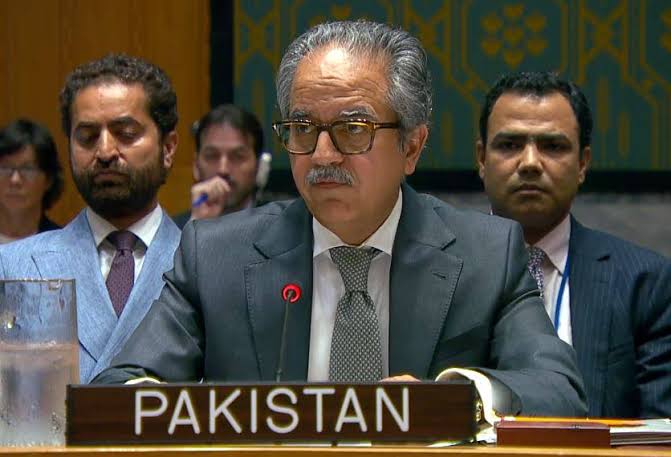
Speaking at a session convened by Bahrain in New York on Friday, Pakistan’s ambassador to the UN, Asim Iftikhar Ahmad, condemned what he called the group’s “nefarious designs” to weaponise the strait, and warned that its actions “could have dire consequences for maritime security, and regional peace and stability”.
“We call upon Houthi militia for immediate cessation of these provocative acts,” he said.
The meeting, held under the title “Safe Seas, Shared Security: Protecting Freedom of Navigation in an Evolving Security Environment”, came as the Security Council issued a separate statement demanding that the Houthis “immediately cease their military escalation” and condemning attacks on Saudi Arabia that have hit civilian and energy infrastructure and injured civilians, including women and children.
Council members also expressed solidarity with Riyadh and affirmed the kingdom’s “inherent right to self-defence under international law”.
The two-day-old crisis is the latest, and potentially the most dangerous, escalation in Yemen since a UN-brokered truce took hold in April 2022. It has unfolded against the backdrop of the war between the United States and Iran, and a prolonged disruption to shipping through the Strait of Hormuz.
Advance along the coast
The Houthis, who are backed by Iran, launched a rapid offensive against Yemen’s internationally recognised government earlier this month. They seized the port of Mocha on 10 September and pushed south the following day, taking the rest of the country’s Red Sea coast and Perim Island, which sits in the middle of the Bab al-Mandab Strait, according to analysis by the Foundation for Defense of Democracies. They also reportedly captured the Hanish Islands.
The strait links the Red Sea with the Gulf of Aden and carries around 12 per cent of global maritime trade.
Khaled Khiari, a UN assistant secretary general, told the Security Council on Wednesday that the situation around the strait had become “increasingly volatile”. He called for the restoration of navigational rights and freedoms in and around the Red Sea and Bab al-Mandab, in line with international law.
The Yemeni government has claimed to have recovered some territory near the strait, though the Houthi advance has been described by Reuters as one of Saudi Arabia’s most serious setbacks in Yemen in years.
Saudi Arabia under attack
Saudi Arabia’s representative, Abdulaziz Alwasil, told the council that the Houthi escalation threatened Yemen, regional security, international trade and global supply chains. He cited attacks on Abha, Khamis Mushait, Jazan and Najran, which he said had injured civilians, as well as renewed strikes on 14 September and continued targeting of commercial ships in the Red Sea.
He accused the Houthis and their allies of pursuing a policy of “choking the straits”, and said the group was holding the international community and global economy hostage.
“Saudi Arabia remains committed to de-escalation and peace while reserving its right to defend its territory and citizens,” Alwasil said.
The Houthis announced a maritime blockade of Saudi Arabia on 20 July and have since attacked the kingdom’s oil facilities and shipping. Riyadh closed a key pipeline on 10 September after attacks by Iran-backed militias in Iraq, according to the FDD, leaving it more reliant on exports through the Red Sea.
The Houthis have claimed that Saudi forces carried out 26 attacks on Houthi-held areas in a single 24-hour period, and around 300 over the past week, according to AFP. Saudi Arabia has not confirmed those figures. The Yemeni government said its forces killed 30 Houthi fighters and wounded more than 60 in clashes in the al-Waziiyah district on Friday.
Fears for shipping and civilians
Pakistan’s envoy said the Houthi attacks “seriously undermined maritime security” and threatened the development of countries in the region, “especially the Kingdom of Saudi Arabia”, which he said was facing “blatant and unprovoked aggression”.
He said Pakistan stood in “complete solidarity” with Saudi Arabia’s leadership, government and people, and reaffirmed its “unwavering support” for the kingdom’s sovereignty, territorial integrity, security and prosperity.
The Saudi-owned ENCELIA was attacked in the Red Sea in July, according to Saudi media. On 11 August, the Yemeni commercial vessel Tihamah came under repeated missile fire as it sailed through the strait. Pakistan’s foreign office said six sailors were killed, including three Pakistani nationals. Human Rights Watch has said at least three recent Houthi attacks on commercial vessels in the Red Sea and Gulf of Aden probably amounted to war crimes.
The human cost on land is also rising. The UN says at least 125,000 people have been displaced across Yemen since the start of September, and that 40 civilians have been killed or injured over the same period, more than half of them women and children.
Bahrain’s representative, Jamal Fares Alrowaei, said the escalation had worsened Yemen’s humanitarian crisis by forcing civilians from their homes. “It is high time for the Security Council to take a more decisive stance,” he said.
China’s representative, Sun Lei, said his country was concerned by the rapid escalation and opposed attacks on energy and civilian infrastructure. “Securing freedom of navigation requires ending armed conflict and achieving lasting peace,” he said, urging all parties to show restraint and return to negotiations.
The Security Council also demanded the unconditional release of detainees held by the Houthis, including 73 UN personnel and staff of non-governmental organisations, civil society groups and diplomatic missions. It called on states to meet their obligations under the targeted arms embargo, and backed the efforts of the UN special envoy, Hans Grundberg, to reach a negotiated, Yemeni-led political settlement.
Hormuz and Pakistan’s mediation
Asim placed the Red Sea crisis alongside the disruption in the Strait of Hormuz, which Iran has effectively closed to shipping since the war with the US began on 28 February. Roughly a third of globally traded crude oil, and a significant share of the fertiliser trade, passes through that waterway.
“The volatility at these maritime choke points has not only imperilled peace and stability but also skyrocketed energy prices and heightened fears of global food insecurity,” he said.
“It is our principled position that global shipping should not become a casualty of conflict and strife. Instead, it should remain a driver of global trade and economy.”
He called for “an immediate de-escalation of tensions, security of ships and crew members, and restoration of normal passage through the strait”.
Bahrain’s concept note for the meeting warned that attacks on merchant vessels, the laying of sea mines and interference with navigational rights could rapidly disrupt global energy flows, trade, food supply chains and humanitarian operations.
The ambassador reminded the council that Pakistan had acted as mediator between Iran and the US following the outbreak of hostilities, “culminating in a ceasefire and the Islamabad Memorandum of Understanding”.
That agreement, signed on 17 June, has since fallen apart. Donald Trump declared it “over” on 8 July after Iran attacked commercial ships in the strait and the US struck Iranian territory in response. Tehran says the strait will stay closed until Washington honours the memorandum, while Pakistan has been trying to revive direct talks.
Asim said Islamabad would keep working “for a negotiated settlement of all outstanding issues for an early return to normalcy at sea and land”.
Pakistan’s stance also carries a defence dimension. Islamabad signed a trilateral defence pact with Saudi Arabia and Turkey last month, under which an attack on any one of the three is to be treated as an attack on all. Pakistani officials have repeatedly said they would come to the kingdom’s aid if its sovereignty were threatened.
Copyright © 2021 Independent Pakistan | All rights reserved