By Staff Reporter
LAHORE: Talks between the government and the country’s largest Islamist party collapsed on Saturday, leaving the authorities facing a week of mass protest in and around the capital after Jamaat-e-Islami (JI) refused to call off a march against fuel taxes.
The fifth round of negotiations, held at the party’s headquarters in Mansoorah, Lahore, ended without agreement. Ministers asked the party to postpone its planned “Super Long March” on security grounds. JI’s leadership declined, saying it would proceed as scheduled from Karachi on Sunday.
Talks between the two sides began on 7 September. All five rounds have now failed to produce a deal.
The government was represented by Ahsan Iqbal, the federal planning minister, alongside Rana Sanaullah and the Punjab provincial minister Khawaja Salman Rafique. The JI delegation was led by its deputy emir, Liaquat Baloch, and included acting secretary general Nazir Ahmad Janjua, Umair Idrees, a special assistant to the party leader, Ziauddin Ansari, the party’s Lahore chief, and information secretary Shakeel Ahmad Tarrabi.
Baloch said the march would remain necessary for as long as the levy imposed on the public was in place. He said the government must take practical steps to address public demands, warning that otherwise the party would “definitely” go ahead with its protest and long march.
The government team told the party that “extraordinary relief” would soon be provided to the public. Ministers also said Islamabad was under pressure from the International Monetary Fund, whose delegation is expected in Pakistan shortly.
The dispute centres on the taxes and duties levied on fuel, which the government puts at Rs114 per litre on petrol and Rs100 per litre on diesel. JI has staged sit-ins in Lahore, Peshawar, Karachi and dozens of other locations since 16 August in protest.
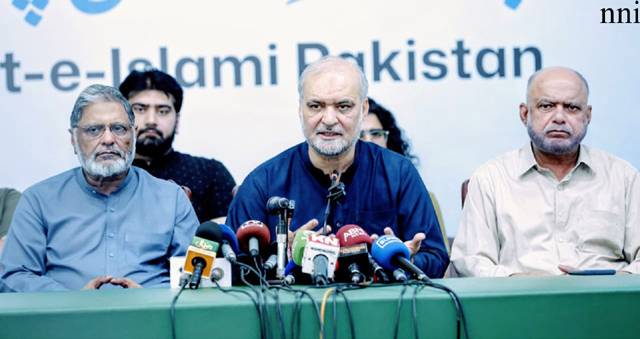
Earlier on Saturday, the party’s leader, Hafiz Naeemur Rehman, told a press conference in Mansoorah that there would be “no turning back”. “If the rulers cannot abolish the levy, we cannot call off our march,” he said.
Rehman said protest caravans from across the country would begin moving towards the capital on Sunday, following a public rally in Karachi on Saturday night. He promised the protest would be peaceful and warned the government against taking action against demonstrators.
The JI leader claimed that up to Rs107 per litre was being collected as petroleum levy on petrol, on top of other taxes. He said the party had already rejected the government’s fuel relief package as inadequate, and urged ministers to present a concrete proposal for abolishing the levy.
Under the current scheme, eligible motorcycles, rickshaws, Qingqi rickshaws and cars of up to 800cc are entitled to a subsidy of Rs100 per litre, subject to monthly limits. Mr Rehman said relief was “not a favour but a right” and accused the government of avoiding structural measures to cut the burden on consumers, arguing that fuel prices feed directly into the cost of essential goods.
He said the movement had entered its 35th day, with more than 25 sit-ins still under way and demonstrations held in 42 cities. The number of sit-ins was being reduced gradually, he said, as part of the party’s strategy for the Islamabad march.
“If the government does not listen to talks, it will have to listen to public pressure,” he said.
Rehman used the press conference to attack the government’s wider economic record. He called for lower interest rates, questioned the autonomy of the State Bank of Pakistan, and accused ministers of using the IMF as an excuse to withhold relief while continuing what he described as lavish official spending. He called on the Punjab chief minister, Maryam Nawaz, to sell her official aircraft, which he valued at Rs11bn.
He also alleged that powerful cartels were influencing government decisions on sugar and wheat imports and exports, leaving farmers underpaid, and criticised Rs1.8tn in capacity payments to independent power producers. The government has not been given a right of reply in this report; The Independent has contacted the relevant ministries for comment.
On Friday, Rehman claimed the party’s proposed fiscal reforms could save the national exchequer between Rs3tn and Rs4tn.
The government has sought to counter the rising cost of fuel with austerity measures of its own, cutting fuel provision for official vehicles by 50 per cent for three months, a step it attributed to the economic effects of renewed tensions in the Middle East.
Capital braces for disruption
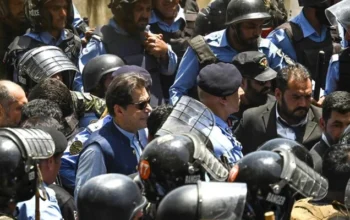
The confrontation comes as authorities in the twin cities of Islamabad and Rawalpindi prepare for what local reports describe as four separate protest and long-march calls in the space of a week, running from Sunday until 27 September. The Pakistan Tehreek-e-Insaf (PTI) party of the jailed former prime minister Imran Khan has called its own demonstration for 27 September.
Rehman said that peaceful protest was a constitutional right of every party, and that containers should not be placed to block the PTI’s demonstrations. He said JI supported the PTI’s right to protest, as the PTI had supported JI’s.
The government has the backing of a recent Islamabad High Court ruling against activities that curtail freedom of movement, and is determined to stop rallies from disrupting traffic and daily life in the capital.
Authorities in Rawalpindi have ordered the closure of all educational institutions, colleges and universities, along with hotels, motels, rest houses and inns, from next week. Markets and wholesale markets will shut, transport and goods terminals will close completely, and the Metro Bus and Green Electric Bus services will be suspended. Mobile internet and electricity supplies are to be cut during the marches, according to The Express Tribune.
All 1,500 cameras installed under the Safe City project in Rawalpindi have been activated, and drones will be used to monitor protesters. Large containers fitted with eight-inch spikes are being installed at entry points to the twin cities, including Faizabad, Chungi No 26, Rawat, Chakri, Adiala Road, Pirwadhai, Bharakahu and 17-Mile, with routes being sealed.
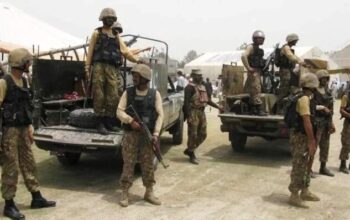
Emergency has been declared at hospitals in both cities, and leave for doctors, nurses and paramedical staff has been cancelled. Fresh contingents of Rangers and Punjab Constabulary have been brought in, and thousands of rubber bullets and tear-gas shells have been supplied to Rawalpindi and Islamabad police.
Police in Attock, on the route from Khyber Pakhtunkhwa, have been given heavy Rangers contingents, armoured vehicles, prison vans and heavy weapons, with personnel due to take up duty on Wednesday and Thursday. Officials said a separate march coming from Khyber Pakhtunkhwa would be stopped “at all costs”.
Under JI’s schedule, caravans from all six districts of Rawalpindi division will begin arriving at Liaquat Bagh in Rawalpindi from Sunday, with daily sit-ins continuing there until Mr Rehman arrives. The party leader is due to leave Karachi by train on Sunday and reach Rawalpindi on Tuesday. Party spokesmen have separately said the march will travel via Multan and Lahore, with participants expected to reach Islamabad on 23 and 24 September. Mr Rehman has said the party will not block roads.
Business and social life in Rawalpindi is expected to be at a standstill from Monday until 27 September. Traders’ and private school associations have condemned the repeated closures and road blockades.
The stand-off is the latest in a long line of marches on the Pakistani capital. Previous protests, including those led by Khan’s PTI in 2022 and 2024, have been met with shipping containers, mobile internet blackouts and mass arrests. Last year, a march by the Islamist Tehreek-e-Labbaik Pakistan party led to deadly clashes, with reports that at least 11 of its workers were killed.
Copyright © 2021 Independent Pakistan | All rights reserved