By Staff Reporter
ISLAMABAD: Pakistan has accused the Afghan Taliban of using the “pretence of dialogue” to shield militants, as it warned it had the “will and capability” to eliminate terrorist threats “wherever they are” following a suicide attack on a police mosque that killed at least 23 people.
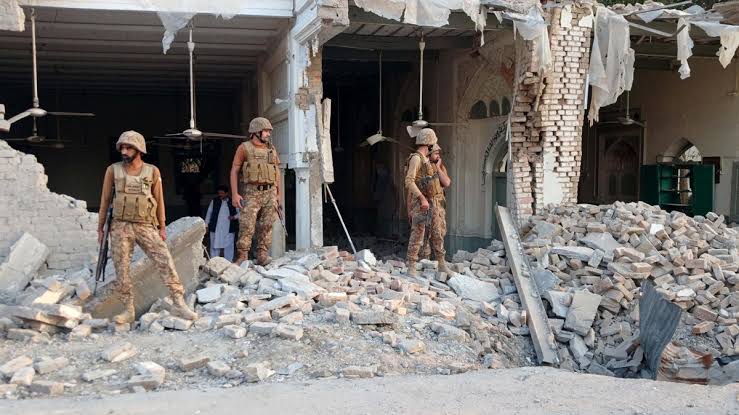
The statement from Pakistan’s information ministry on Saturday came a day after a vehicle packed with explosives was detonated near a mosque inside the Old Police Lines in Kohat, in Khyber Pakhtunkhwa province, as officers and civilians gathered for Friday prayers. Gunmen then stormed the compound in an assault that took security forces around 20 hours to bring to an end.
Islamabad said it had “consistently pursued dialogue and constructive engagement” with the Taliban, but “would not allow pretence of dialogue to shield those who threaten our people”.
The ministry was responding directly to remarks by the Taliban’s chief spokesperson, Zabihullah Mujahid, who told Al Arabiya English on Friday that Kabul wanted dialogue with Pakistan and stronger mechanisms for intelligence-sharing and cooperation. He also welcomed a larger Saudi role in mediating between the two countries, describing the kingdom as a friend of both and saying it could play a “positive role” in resolving their differences.
But Mujahid also cautioned Pakistan against carrying out military operations inside Afghanistan. “If Pakistan invokes Article 51 to violate the sanctity of Afghan territory, Afghanistan has the right to defend its country, and we will do so,” he said, warning of a “crushing response” to any violation of Afghan sovereignty.
He denied that Kabul allowed the Tehreek-e-Taliban Pakistan (TTP) to operate from Afghan territory or supported armed groups targeting other countries, and argued that Pakistan should address its security problems internally, saying unrest involving the TTP and Baloch groups predated the Taliban’s return to power in 2021.
Islamabad described that threat as “reprehensible” and said the Taliban leadership must “address the terrorist ecosystem thriving under their patronage instead of trying to deflect responsibility and malign Pakistan”. It added: “Such antics cannot obscure their counterterrorism obligations under the Doha Agreement or their responsibility to prevent Afghan territory from being used to threaten other countries.”
Attack on police compound
The ministry condemned the Kohat attack as “barbaric” and blamed “the vilest of Khwarij with roots in Afghanistan” – the term Pakistan’s authorities use for the banned TTP – saying it was a reminder that “terrorism has no religion and no justification”. “Those who perpetrate, facilitate or shelter such acts are the worst among humankind,” it said.
Officials said the attack began when a vehicle laden with explosives was detonated near the mosque. Attackers then entered the compound, which houses Special Branch and Counter-Terrorism Department (CTD) offices, and engaged police in a gunfight. A first information report lodged by police described a assault involving suicide bombing, gunfire and grenades.
The Old Police Lines is a densely built and highly sensitive area, surrounded by a cantonment police station, a traffic police station, the Special Branch and CTD offices, a bank, a police club, hotels and homes. Several nearby buildings were damaged in the blast.
Regional Police Officer Irfan Tariq said 23 people were killed, including 17 police personnel and six civilians, and that 130 others were injured. Early tallies were lower, and other outlets have reported different figures as the count rose through Saturday; some reports that put the toll at 31 appear to include the eight attackers killed.
Among the dead were Akbar Shinwari, the district’s traffic police chief, and Dr Israel Orakzai, head of the paediatric department at the district hospital, according to Pakistani media reports. The News correspondent Syed Yasir Shah was injured while covering the attack.
Rescue 1122 said more than 60 personnel and 24 ambulances and rescue vehicles took part in the emergency response, with reinforcements sent from Karak, Hangu and other districts. Seven critically injured people were transferred to Peshawar, five to Lady Reading Hospital and two to Hayatabad Medical Complex.
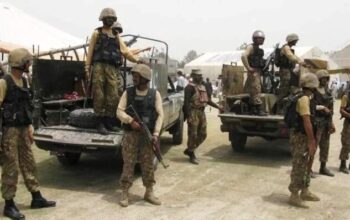
Police said the clearance operation, which involved Elite Force commandos, CTD teams and the army’s Special Service Group, was completed on Saturday. Officials initially reported seven militants killed; some later accounts put the number at eight.
Major General Shahid Amir Afsar, the general officer commanding 9 Division, said the militants had targeted worshippers at the mosque before taking shelter in a building inside the compound. “The timely and decisive action of the security forces had foiled the militants’ plan,” he said, according to officials. Zulfiqar Hamid, the provincial police chief, remained at the scene throughout and announced rewards for personnel who took part.
Funeral prayers were offered for the dead police officers, attended by senior police and military officials and relatives. Mr Shinwari was buried with full state honours in his home village of Hathian, in Takht Bhai, where thousands of mourners gathered. Elected members of the national and provincial assemblies from the constituency were absent, according to local reports.
Claim of responsibility
The Ittehadul Mujahideen Pakistan, led by the Afghanistan-based commander Hafiz Gul Bahadur, claimed responsibility, according to Pakistani media. The TTP, the main Pakistani Taliban group, was reported by Reuters to have denied involvement. The claim has not been independently verified.
Security sources have since said one of the two suicide bombers has been identified as an Afghan national, named in Pakistani media as Mutee-Ullah, or Matiullah in some reports. The identity of the second attacker is still being verified. Pakistani officials said the finding added to their concerns about the use of Afghan territory for attacks inside Pakistan. The Taliban have not commented on the reports.
Mujahid’s foreign ministry condemned the attack, describing assaults on places of worship as “unjustifiable and condemnable” and expressing sympathy for the victims’ families. Pakistan said it had noted the statement but regretted that it did not mention terrorism.
“Notwithstanding, condemnation must be matched by concrete action,” the ministry said, calling on the Taliban to take “credible, verifiable and sustained measures” to dismantle terrorist sanctuaries, disrupt recruitment and training networks, and prevent militant groups from planning and launching attacks against Pakistan.
Islamabad also said it had “repeatedly raised grave concerns” over the presence of what it called terrorist sanctuaries and recruitment and support infrastructure in Afghanistan, which it said posed “a direct threat to Pakistan’s security”.
“Pakistan has both the will and the capability to eliminate terrorist threats wherever they are, and will take all necessary measures, in accordance with international law, to protect its citizens, territory and sovereignty,” the statement said.
It warned that the continued presence of militant groups in Afghanistan would “aggravate instability, with serious regional and global repercussions”, and called on the international community to “push the Afghan Taliban regime to act decisively and verifiably” before the threat spread “across the region and beyond”.
A year of escalating tension
The exchange comes after a year in which relations between the neighbours have deteriorated sharply over the issue of the TTP, which Islamabad says operates from Afghan soil. Kabul denies this and has accused Pakistan of violating its sovereignty through cross-border strikes.
In October 2025, Pakistan carried out its first airstrike on Kabul after a militant attack that killed 11 military personnel in Khyber Pakhtunkhwa, triggering the deadliest clashes between the two countries since the Taliban returned to power. Qatar and Turkey helped broker a ceasefire, but talks in Istanbul failed to agree on Pakistan’s central demand that Kabul rein in the TTP.
Fighting resumed in February, when Pakistan’s defence minister declared the two countries were in “open war” after Pakistani air strikes hit Kabul and Kandahar. In March, Afghan officials said a Pakistani strike hit a drug rehabilitation centre in Kabul, killing hundreds of people; Pakistan said it had targeted military installations and accused Kabul of exaggerating the casualty figures. Mediators from Qatar, Saudi Arabia and Turkey then secured a pause in fighting for Eid, and China hosted talks in Urumqi in April.
The ceasefire has since come under strain, with both sides reporting cross-border attacks. Pakistan’s border with Afghanistan has been largely closed for months, and hundreds of thousands of Afghan refugees and migrants have been forcibly repatriated.
Pakistani officials say meaningful engagement with Kabul cannot resume until the Taliban take concrete and verifiable action against the TTP and other groups, including the Balochistan Liberation Army. Islamabad has said assurances alone are insufficient. It appears to be keeping diplomatic channels and limited institutional contacts open while refusing to resume substantive talks, with officials saying any change in policy would depend on developments on the ground.
The Kohat attack came a day after a roadside bomb in the same region killed six soldiers, according to Al Jazeera. It also struck the same complex that was hit by a suicide car bombing in 2010, an attack that killed around 20 people and was claimed by Lashkar-e-Jhangvi.
Copyright © 2021 Independent Pakistan | All rights reserved