By Staff Reporter
ISLAMABAD: Police have detained 278 members of Imran Khan’s Pakistan Tehreek-e-Insaf (PTI) party in Khyber Pakhtunkhwa since the federal government imposed emergency rule on Sunday, AFP reported on Monday.
Separately, police told reporters that at least eight PTI leaders are in protective custody, among them the chief minister, Sohail Afridi, the provincial assembly speaker, Babar Saleem Swati, and the PTI’s provincial president, Junaid Akbar. Officials gave no details of how long they would be held.
The PTI said on Sunday that Afridi had been arrested, within hours of the announcement from the presidency. An administrative official, also speaking anonymously to AFP, said he had been placed in protective custody at his official residence and later moved to another location, which the official declined to disclose.
PTI spokesperson Sheikh Waqas Akram said the arrest could not be viewed in isolation from the decision to impose emergency rule.
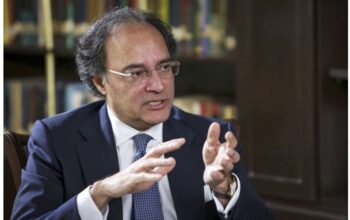
On Monday, deputy prime minister and foreign minister Ishaq Dar defended the move at a seminar in Islamabad. “It is not a political move; it is surely against the menace of terrorism,” he said, referring to the violence that has hit the province over the past decade and a half.
Dar asked whether the centre could keep sleeping and looking towards one another because the step might be deemed political. He said the federal government had a responsibility to act once it was totally determined that there was no other solution. He added that the government had no choice and would implement the measures in totality, and he expressed hope that residents would soon see peace restored and radicalisation end.
He said the ruling PML-N had paid a heavy political cost when the country was on the brink of default in 2022, taking unpopular structural measures that eventually saved it. He also recalled negotiating with the PTI in 2014, during its sit-in in Islamabad.
President Asif Ali Zardari approved both measures on Sunday on the advice of prime minister Shehbaz Sharif’s cabinet, which recommended them citing the PTI-led provincial government’s deliberate disengagement from the fight against terrorism. The emergency was declared under Article 232 of the constitution and governor’s rule under Article 234. It is the fourth time governor’s rule has been imposed in the province.
The governor, Faisal Karim Kundi, takes over the administration of the province, with an 11-member advisory council to assist him, according to law minister Azam Nazeer Tarar. The government said the PTI-led administration would remain inoperative until the security situation improves. An emergency has been declared in 12 districts, and the interior ministry authorised the deployment of army troops and assets in aid of civil power.
Khyber Pakhtunkhwa, which borders Afghanistan, has seen a surge in militant attacks in recent weeks that have killed dozens of security personnel, police and civilians. The federal government and the military accuse the PTI of failing to curb the militants. The party rejects the charge and says Islamabad has not provided the funding and equipment it needs. Talks between the two sides collapsed on 3 October.
Interior minister Mohsin Naqvi said Islamabad had tried to avoid an emergency and had told PTI leaders repeatedly it had “no issue” with a march on the capital. “Our issue was entirely terrorism-related, and we want to take you on-board on it,” he told reporters.
The PTI has rejected that account, describing the measures as undemocratic and a power grab by the federal government. Zulfikar Bukhari, an aide to Khan, called the move “more of a coup disguised as emergency” and said it was intended to stop the protest march. The party’s parliamentary committee, after a three-hour meeting, unanimously rejected the emergency and governor’s rule, and the party said it would challenge the decision in the courts, in the assemblies and in public. Mr Afridi had earlier said he would not accept the move, which he described as illegal.
The emergency came as Afridi led thousands of Khan’s supporters towards Islamabad to demand the release of the former cricketer. The marchers have also voiced anti-government grievances fuelled by harsh economic conditions. Mr Afridi had asked party lawmakers and supporters to gather in Swabi district by 14 October before setting off for the capital.
Khan has been in jail since August 2023 and faces scores of charges ranging from corruption to inciting violence, after widespread anti-establishment riots in May that year. He and his lawyers say the cases are politically motivated.
The PTI’s last large-scale protest, two years ago, ended in deadly clashes with security forces, and Khan’s 2023 arrest set off nationwide riots. The party has led Khyber Pakhtunkhwa since 2013, and the province is its stronghold.
Peshawar sealed off
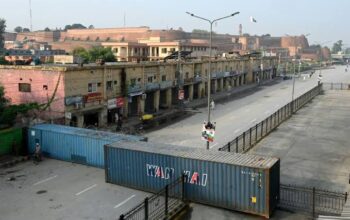
Peshawar woke on Sunday to find mobile signals gone. Local media reported that Bus Rapid Transit stations shut and shipping containers across GT Road at Firdous Chowk, where only pedestrians were let through. Containers also blocked the road to Khyber Road and the city’s red zone, as well as University Road at Tehkal, Arbab Road and parts of Stadium Chowk, with a heavy police presence throughout.
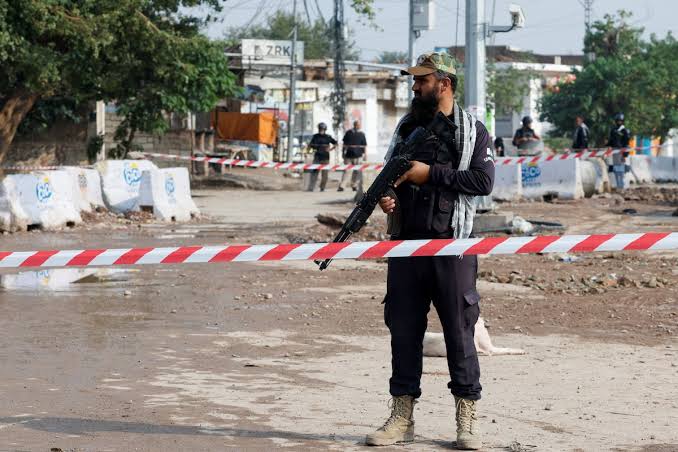
Police and paramilitary personnel were out in force around the Civil Secretariat, which was deserted, and on the road housing the homes of ministers and the governor. An armoured personnel carrier, a prison van and a truck of riot police were seen heading towards the chief minister’s house. Saddar Bazaar stayed partly open. Mobile networks had already been cut for nearly 48 hours days earlier because of the PTI march, and the internet went down on Sunday afternoon.
The monitoring group NetBlocks reported a major disruption to internet connectivity in parts of the province. The blackout has caused widespread confusion across Khyber Pakhtunkhwa and made it harder for people to get information.
Dawn reported that for years protest marches from Peshawar had turned the federal capital into a fortress of containers, but this time Islamabad sent the containers to Peshawar.
Which areas are covered
The emergency covers the eight merged tribal districts: Khyber, Mohmand, Kurram, Orakzai, Bajaur, North Waziristan, South Waziristan Upper and South Waziristan Lower. It also covers Dera Ismail Khan, Tank, Bannu and Lakki Marwat. The Bannu and Dera Ismail Khan divisions are covered in full, along with parts of the Peshawar, Kohat and Malakand divisions. Hazara and Mardan divisions are exempt.
Governor’s rule has been imposed three times before. In 1975, prime minister Zulfikar Ali Bhutto’s government imposed it after Hayat Muhammad Khan Sherpao was killed in a bomb blast at Peshawar University. It came again in 1994 under Benazir Bhutto, during a confrontation with the Muslim League chief minister, Pir Sabir Shah. The third episode followed General Pervez Musharraf’s coup in October 1999 and lasted until the Muttahida Majlis-e-Amal government took office in late 2002. This is the first time governor’s rule has coincided with an emergency in specific districts.
The emergency also raised concern among Punjab police officers deployed in Rawalpindi division to counter the march. Unconfirmed reports said 25,000 of the 40,000 officers there would be moved from Attock to Khyber Pakhtunkhwa. Punjab’s inspector general of police, Abdul Kareem, told Dawn no final decision had been taken. “If it happens, we will make it public officially,” he said.
Officers deployed at Attock and Wah Cantt have complained of foul-smelling food, poor catering and inadequate washrooms. Videos shared on social media purported to show insects in meals. Kareem rejected claims that adulterated food was being supplied on a large scale and said one employee had been caught mixing water into food. He said the Punjab Food Authority had been asked to check quality.
He confirmed that five officers had died during the two-week deployment: constables Zulfiqar Ahmed, Zain Ali, Muhammad Imran, Muhammad Shahzad and Usman Idrees. Two died of heart attacks and one, Ali, drowned in the Ghazi Canal after slipping. Two others died of severe medical complications. He rejected reports that a constable had died after a snakebite, saying the man was still being treated.
Copyright © 2021 Independent Pakistan | All rights reserved