By Staff Reporter
ISLAMABAD: Prime Minister Shehbaz Sharif has created a committee led by his deputy to oversee Khyber Pakhtunkhwa, a day after Islamabad took over the opposition-run province under emergency powers and placed its chief minister in custody.
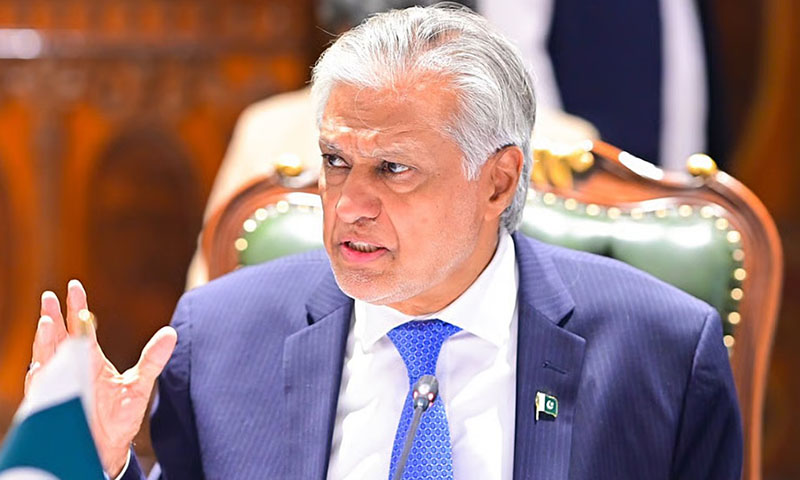
Shehbaz Sharif formed the 11-member body on Monday, headed by Deputy Prime Minister Ishaq Dar, to monitor governance, law and order and day-to-day affairs in the north-western province. It will report to the prime minister daily.
A source close to Sharif told Dawn newspaper that the committee had been formed informally, with no official notification issued. It will work closely with the new administration in Peshawar and help it with its duties and security matters, the source said. Pakistani media reported that the committee held its first meeting under Mr Dar’s chairmanship.
Its members are Law Minister Azam Nazeer Tarar, Planning Minister Ahsan Iqbal, Information Minister Attaullah Tarar, Kashmir Affairs Minister Amir Muqam, Parliamentary Affairs Minister Tariq Fazal Chaudhry, Muttahida Qaumi Movement convener Khalid Maqbool Siddiqui and the prime minister’s adviser Rana Sanaullah. The Pakistan Peoples Party, the Balochistan Awami Party and the Istehkam-e-Pakistan Party, all allies of Mr Sharif’s PML-N at the centre, have one representative each.
On Sunday, the federal government took control of the province after imposing an emergency and governor’s rule. It deployed the army to assist the civil administration, formed an 11-member advisory council and set up a special administrative structure for 12 districts. President Asif Ali Zardari approved the governor’s rule under Article 234 of the Constitution on the prime minister’s advice. The emergency followed a deepening rift between Islamabad and the provincial government led by Imran Khan’s Pakistan Tehreek-e-Insaf (PTI), mainly over counterterrorism policy and engagement with the Afghan Taliban.
The move also coincided with a PTI march that began on 4 October and was led by the chief minister, Sohail Afridi. It had initially been announced as a march on Islamabad but remained within the province.
On Monday, Minister of State for Interior Talal Chaudhry told Reuters that Afridi and some of his cabinet members had been taken into preventive custody. A senior Peshawar police official said eight senior PTI figures were held, among them Mr Afridi, the provincial party president Junaid Akbar and the assembly speaker, Babar Saleem Swati. The governor, Faisal Karim Kundi, later confirmed that Afridi was in protective custody and said those facing cases would face the charges, while others would be freed.
The PTI has called the measures unconstitutional and has vowed to resist them. Its chairman, Gohar Ali Khan, asked why governor’s rule had been imposed across the whole province if the security concerns were concentrated in particular districts. Taimur Jhagra, a PTI leader and former provincial finance minister, rejected the government’s allegations.
Kundi, who belongs to the PPP, assumed executive control on Sunday. At a press conference at Governor House he accused the suspended PTI-backed government of colluding with terrorists and following policies dictated from Kabul, Kandahar and Jalalabad. He said the new advisory council would follow policy set in Islamabad. He claimed citizens and law enforcement personnel had been unsafe under PTI rule.
The governor said there would be no need for full-scale military offensives, and that only intelligence-based operations would be carried out. He said there would be no talks with Kabul and hinted at a major operation against undocumented Afghan refugees. “You will find an Afghan national behind every terrorist activity,” he alleged. He also accused Afghanistan of becoming a facilitator for India and Israel, and the PTI of refusing to speak out against it even though militants were using Afghan soil to launch attacks in Pakistan.
Kundi promised that police salaries would rise, that compensation for the families of those killed would be enhanced, and that their children would receive free education.
The advisory council held its first apex committee meeting earlier on Monday, with Kundi and Interior Minister Mohsin Naqvi in the chair. Military officials, the chief secretary and senior police officers attended. “We can sacrifice development but will never compromise on security,” Mr Kundi said, citing a “lack of synergy” in the province’s counterterrorism effort.
Naqvi said the federal and provincial administrations were “on the same page” on the first day. He criticised the PTI government for failing to lead the fight against terrorism. “It was the [provincial] government’s job to lead the war against terrorism, but they did not do it,” he said. He also outlined a plan to strengthen law enforcement and the district administration in five districts.
The federal government separately handed 10 armoured personnel carriers from the Islamabad police to the Khyber Pakhtunkhwa police.
Naqvi described the imposition of governor’s rule and the emergency as a difficult constitutional course rather than a political decision. He said the government and its allies had exhausted parliamentary engagement, direct dialogue and back-channel diplomacy with the provincial government and PTI leaders. “This was neither a political decision nor an easy step,” he said.
Parliament will now be asked to endorse the decision. Zardari has summoned the Senate and the National Assembly for 6pm today, apparently to meet a constitutional requirement. Sharif has called a meeting of the parliamentary parties of the PML-N and its allies to take them into confidence. Naqvi is due to brief them on security, Tarar on the legal aspects and Chaudhry on the parliamentary agenda.
The emergency must go before a joint sitting of parliament within 30 days and lapses after two months unless approved. Minister of State for Law Barrister Aqeel said the emergency and governor’s rule could last more than six months, depending on the security situation.
The PTI has governed Khyber Pakhtunkhwa for more than a decade. Legal experts have said any imposition of governor’s rule would ultimately be challenged in the high court or the Supreme Court.
Copyright © 2021 Independent Pakistan | All rights reserved