By Staff Reporter
ISLAMABAD: Prime Minister Shehbaz Sharif has defended the federal takeover of Khyber Pakhtunkhwa as a last resort forced on his government by a provincial administration he accused of refusing to confront terrorism, while the opposition denounced it as an unconstitutional assault on an elected government.
Shehbaz Sharif spoke on Tuesday, two days after President Asif Ali Zardari, acting on his advice, proclaimed an emergency in 12 districts of the north-western province and placed it under governor’s rule. The move suspended the administration of chief minister Sohail Afridi of Imran Khan’s Pakistan Tehreek-e-Insaf (PTI), which the Centre accused of “deliberate disengagement” from the fight against militancy.
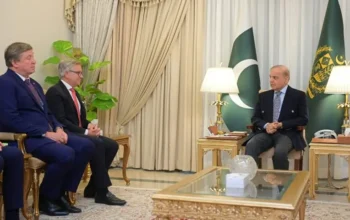
Sharif briefed leaders of the Muttahida Qaumi Movement-Pakistan, then a parliamentary delegation from the PML-Q, Balochistan Awami Party, Istehkam-i-Pakistan Party and PML-Zia. His office said he told them the government had taken the “most difficult decision” in the interest of the people of Khyber Pakhtunkhwa.
“We made every effort to avoid taking this extreme step in any way,” he was quoted as saying. “We engaged in negotiations with an open heart, but did not receive a positive response from the other side.”
He said rising terrorist attacks were hitting civilians and security forces while the provincial government “failed to openly raise its voice against terrorist groups”. He also described the PTI’s long march as a “conspiracy to destroy the country’s improving economy”. According to the prime minister’s office, the MQM-P delegation assured him of its full support, and the second group backed the federal government and praised his leadership.
Sharif told the parliamentary delegation that Islamabad had given Khyber Pakhtunkhwa more than Rs800bn under the National Finance Commission arrangements to support counterterrorism efforts. The province, he said, had failed to strengthen its Counter-Terrorism Department or build Safe City projects.
Addressing his own PML-N lawmakers later, he said there was “not zero, but negative attention” to the schools, hospitals, law and order and anti-corruption work the province’s people had wanted for 13 years. Resources, he said, had gone instead into long marches and protests. “Can any respectable society tolerate this?” he asked. “So what other path did we have?”
He said the Centre was “compelled” to act after talks between the government and the opposition collapsed on 3 October. At one point, he said, “it was set in stone that an agreement was about to be reached”, and a consensus draft was ready. But the PTI’s negotiators asked for more time to consult Afridi, he said, and “the rest is history”. Sharif also claimed the party had been told to “create another May 9”, a reference to the 2023 riots that followed Khan’s arrest.
He said he had reached out to Jamiat Ulema-e-Islam-Fazl chief Maulana Fazlur Rehman to ease tensions, and that the cabinet met on 11 October. “After all consultations and arguments, it was decided that this is the moment to save Pakistan,” he said.
Sharif said even an enemy would not make the remarks Afridi had made in recent weeks. He criticised the PTI leader for not expressing sympathy with the families of those killed and for “not willing to say a single word” against terrorists. He also said the International Monetary Fund’s managing director, Kristalina Georgieva, had recently told him “this is a new Pakistan”, a remark he cited as evidence of the economic progress he said was at risk.
“Political reconciliation is over”
In the Senate, Deputy Prime Minister and Foreign Minister Ishaq Dar said the cabinet had “rightly decided” that political reconciliation with the PTI was over. He said both the PPP and PML-N had tried to reach an understanding with the party and failed. “They said they would talk about it, then consulted with their chief minister, and after that, virtually, they refused,” he said.
Dar said he had supported giving the province an extra one per cent of the divisible pool so that it could “prepare itself for the war against terror”. He asked where the Rs800bn had gone, including on a Counter-Terrorism Department, law enforcement or a forensic laboratory. He said the cabinet had passed on four demands to Fazlur Rehman for the PTI, including replacing its chief minister and denouncing terrorism. He claimed, without presenting evidence in the chamber, that provincial resources were being used through a PTI private account rather than the provincial one.
Interior Minister Mohsin Naqvi told the same session that the government had approached the opposition sincerely and that “none of us wanted” an emergency or governor’s rule. He said talks had opened with a series of points on security, on which PTI figure Asad Qaiser had indicated cooperation, before turning to political issues. Six proposals went into a final draft, he said, which was sent to the chief minister and then to PTI figure Murad Saeed, after which the process broke down.
Naqvi also alleged that about 80 percent of terrorism-related activity in the province emanated from Afghanistan. He said the government had evidence that people linked to the PTI-led administration were connected to the Tehreek-e-Taliban Pakistan and that it held information on related financial transactions.
Opposition: “You had already made up your mind”
The opposition rejected that account. Senate opposition leader Allama Raja Nasir Abbas said the negotiations were a “sham” and that the government “had already made up your mind”. He said the opposition had softened its stance by dropping its demand for a meeting with Khan, who is in jail, while the government refused to reconsider. He warned that pushing young people out of democratic politics could feed frustration and militancy, and said that even Pervez Musharraf, the former military ruler, had tolerated some dissent. “Peace cannot be established through such measures,” he said. “Pakistan will suffer the consequences.”
PTI-backed Senator Ali Zafar accused the government of violating the constitution by detaining the chief minister, the provincial assembly speaker and other ministers. “We are all united in our resolve to defeat terrorism,” he said. “However, while fighting this war, we must not throw the Constitution into the dustbin.” He said an emergency could be justified by a foreign attack, but that internal disturbances required a constitutional process involving the provincial assembly. He challenged the government to put the summary and its evidence before the Senate. “You can remove a government, but you cannot end a movement,” he said.
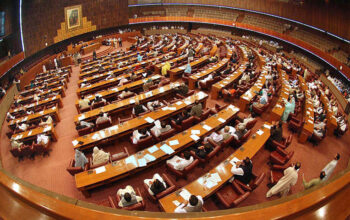
In the National Assembly, there was a brief confrontation when PTI chairman Gohar Ali Khan said the house’s “funeral” had been held on 11 October. Speaker Sardar Ayaz Sadiq replied that the government had offered much in dialogue, and switched off Gohar’s microphone. The speaker said political debate would be allowed on Wednesday, when the session resumes at 11am.
What has happened on the ground
The takeover has moved quickly. Officials confirmed on Monday that Afridi and some of his cabinet members were in preventive custody, Minister of State for Interior Talal Chaudhry told Reuters. A senior police officer said 169 PTI workers had been arrested in a crackdown in Swabi, where the party’s long march, which began in Lakki Marwat on 4 October, had been expected to pass. The march has since lost momentum. The federal government has also approved the deployment of the army in the province under Article 245 of the constitution. Authority now rests with Governor Faisal Karim Kundi, who is assisted by an 11-member advisory council.
The decision faces legal and political challenge. A petition filed in the Peshawar High Court on Monday asks for the emergency and governor’s rule to be declared null and void and for the notification to be suspended. Gohar has said the PTI will fight the move through the courts, the assemblies and public forums. Legal experts are divided on the validity of the measures and on how far judges can review them, and eight members of the Pakistan Bar Council have condemned the move. Rehman, whose party is in opposition, called it an “attack on democracy”.
Zardari issued the proclamations under Articles 232 and 234 of the constitution. Under Article 232, an emergency declared by the president on his own initiative must go before both houses of parliament within 10 days. That requirement does not apply here because he acted on the prime minister’s advice. Governor’s rule under Article 234 must be placed before a joint sitting and lapses after two months unless the sitting approves it by resolution. It can then be extended by up to two months at a time.
Copyright © 2021 Independent Pakistan | All rights reserved