By Staff Reporter
PESHAWAR: Supporters of Imran Khan’s party set fire to government offices and clashed with police in north-west Pakistan on Tuesday, two days after Islamabad suspended the elected provincial government of Khyber Pakhtunkhwa.
The violence centred on Bara, the home constituency of Sohail Afridi, the Pakistan Tehreek-e-Insaf (PTI) chief minister who has been rendered non-functional since President Asif Ali Zardari, acting on the advice of Prime Minister Shehbaz Sharif’s cabinet, proclaimed governor’s rule across the province and an emergency in 12 of its districts, including Khyber.
Police said about 50 people had been arrested. Witnesses and a hospital doctor gave a picture of the unrest that was at odds with the official line that order had been restored.
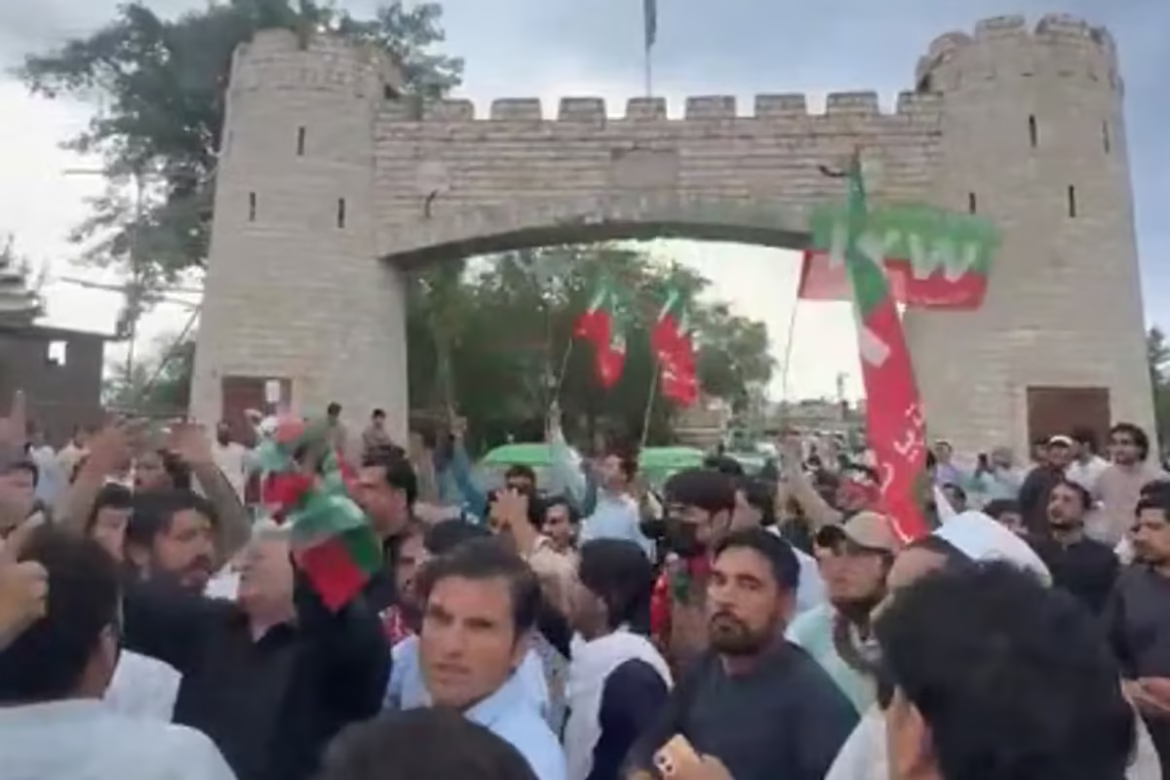
Scores of PTI workers gathered at Khyber Chowk in Bara Bazaar on Tuesday afternoon. Police arrived and initially used batons and tear gas to break up the crowd, eyewitnesses said, and managed to disperse some of the protesters.
The local provincial assembly member, Abdul Ghani Afridi, then arrived with more supporters. Witnesses said the crowd forced the police back, with some officers taking refuge in nearby shops and commercial buildings. Protesters dragged some of them out and manhandled them, according to reports from the area, and police responded with tear gas and live rounds fired into the air.
Local reports said the office of the National Database and Registration Authority (Nadra) was set on fire, along with part of a Rescue 1122 building. Khyber’s district police officer, Waqar Ahmed, said hundreds of protesters marched from Minar Chowk to Bara Chowk about 90 minutes after the first crowd broke up, and set fire to traffic signals on arrival. He said protesters also detained 15 police personnel inside the tehsil municipal office and took their weapons and uniforms.
That account was contradicted elsewhere in official ranks. Capital City Police Peshawar denied that any personnel had been abducted and urged the public to ignore “baseless rumours”. The Khyber Pakhtunkhwa government’s fact-checking account on X went further, calling reports of a severe clash baseless, saying the area was peaceful and blaming a few Afghan and local “miscreant elements” working with some PTI politicians.
Local media confirmed injuries to at least five protesters from eyewitness accounts. A doctor at Hayatabad Medical Complex, one of Peshawar’s three main hospitals, said more than a dozen injured people, including four police officers, had been brought there. Hospital sources separately put the number of injured at 11. Reports from Bara said several people, including two children, had gunshot wounds, and the PTI lawmaker Iqbal Afridi said 11 party workers were hurt and one was killed. The death could not be independently verified.
Police said those arrested were “miscreant elements” who had tried to spread unrest. They said cases would be registered under provisions relating to terrorism and sabotage.
Samar Haroon Bilour, the newly appointed provincial adviser on information, put the number at 42 and said 25 of them were “illegal Afghans”. She accused the protesters of damaging public property and alleged that PTI leaders were behind the unrest. It could not independently verify the number of arrests, the extent of the damage, or the nationality and immigration status of those held. Leaders of the Bara Siyasi Ittehad urged both PTI workers and police to avoid confrontation. All roads into Bara Bazaar were closed after the crowd was cleared. A separate protest was held at Bab-e-Khyber in Jamrud.
The clashes followed a tense start to the week. AFP reported that 278 PTI members had been detained across the province since the emergency was declared. Monday’s “flash protest” in Peshawar drew only 15 to 20 workers, with riot police and prison vans deployed across the city. In Bara, police fired tear gas and shots in the air on Monday to disperse PTI workers.
The Centre announced the measures on Sunday, citing the PTI-led provincial government’s “deliberate disengagement” from the fight against terrorism. The PTI points to the timing, which came during heightened political tension and after talks between the government and the opposition broke down.
Debate in Parliament
The decision was argued over in both houses on Tuesday. In the Senate, PTI’s parliamentary leader, Barrister Ali Zafar, called it a “test of Pakistan’s Constitution” and a “political crisis disguised as a security solution”.
He said no patriotic Pakistani wanted terrorism to flourish, but that it must not be defeated at the expense of constitutional democracy. Article 232, he argued, was meant for genuine emergencies and not as a “political weapon”, and the government had to show that the constitutional conditions had been met and that its response was necessary and proportionate. If terrorism had created an extraordinary situation in particular districts, he said, ministers must explain why the response covered the whole province.
“Today it may be KP; tomorrow the precedent may be used elsewhere,” he warned, urging senators not to become a “rubber stamp”.
The leader of the opposition in the Senate, Raja Nasir Abbas, called 11 October a “black day” and criticised what he described as celebrations over the removal of a government elected with a two-thirds majority. He said the Centre and the opposition had reached an agreement on political issues, and that differences arose when security was linked to them. He called for the measures to be withdrawn at once.
Interior Minister Mohsin Naqvi rejected the argument that the Constitution had been violated, saying the PML-N and the PPP had examined every clause together. He said the government had approached PTI chairman Barrister Gohar Ali Khan on 10 October to propose amendments to the draft agreement. Six amendments were made, and the draft was sent to Afridi, who he alleged passed it to the PTI’s Murad Saeed, after which the process was “sabotaged”.
Naqvi also alleged that some in the PTI were in contact with the Taliban and the Tehreek-i-Taliban Pakistan, and said evidence would be presented when required.
The governor’s rule proclamation must be laid before a joint sitting of Parliament and lapses after two months unless approved. It can be extended by up to two months at a time. A senator from the Jamiat Ulema-e-Islam (F), Kamran Murtaza, has submitted a resolution opposing the measure.
The National Assembly sat on Tuesday evening but made little progress. When Gohar said the “funeral of this house” had been held on 11 October, Speaker Ayaz Sadiq told him the PTI had not been ready to accept what was offered in talks and switched off his microphone. Political debate, the speaker said, would be allowed on Wednesday, when the house reconvenes at 11am. Earlier, the PTI asked the speaker to issue production orders for nine of its MNAs, whom it described as detained, so that they could attend the session.
The measures also face a challenge in court. A petition filed in the Peshawar High Court on Monday by Advocate Salman asks it to declare the emergency and governor’s rule null and void and to suspend the notification imposing them. Mr Gohar said on Tuesday that the PTI would file its own petition. Lawyers in Lahore have announced a Supreme Court challenge. This is the fourth time governor’s rule has been imposed in the province.
Copyright © 2021 Independent Pakistan | All rights reserved