By Staff Reporter
ISLAMABAD: Pakistan’s army chief has pledged to turn longstanding ties with Russia into practical security cooperation during talks with Moscow’s interior minister, who is making the first visit to Pakistan by a Russian holder of the post.
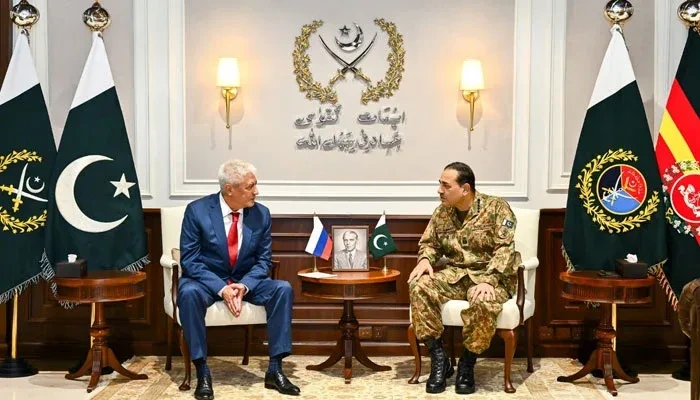
Field Marshal Asim Munir, who serves as both Chief of Defence Forces and Chief of Army Staff, met Vladimir Kolokoltsev at General Headquarters in Rawalpindi on Wednesday, the military’s media wing, Inter-Services Public Relations (ISPR), said.
The two men discussed the regional security environment and ways to strengthen bilateral security cooperation, according to the ISPR. “They underscored the importance of closer institutional linkages and improved coordination between the security institutions of Pakistan and Russia,” its statement said.
Field Marshal Munir reiterated Pakistan’s commitment to deepening ties with Moscow and turning them into concrete cooperation in areas of shared interest, particularly security, the ISPR said. Kolokoltsev praised Pakistan’s contribution to regional peace and stability, and acknowledged the professionalism and sacrifices of its armed forces in the fight against terrorism.
The Russian minister also met Prime Minister Shehbaz Sharif, who witnessed the signing of a memorandum of understanding on strengthening cooperation in combating organised crime, the Prime Minister’s Office said. Official statements did not say whether it was the interior ministry agreement the two sides agreed in July to pursue.
Sharif said he wanted to make effective use of existing bilateral mechanisms and build on what he called positive momentum in relations. He said cooperation should expand into trade and investment, energy and economic development.
Kolokoltsev, according to the same account, thanked Pakistan for its support at multilateral forums, particularly the United Nations. He said there was significant potential to expand trade and economic ties, and that Russia was ready to work closely with Islamabad.
The Russian minister arrived earlier this week on a four-day visit at the invitation of Interior Minister Mohsin Naqvi. On Tuesday he reviewed a police parade at Islamabad Police Lines and laid flowers at the Martyrs’ Memorial at the Pakistan Monument, state news agency APP reported.
The visit is the latest in a run of contacts between Islamabad and Moscow this year, much of it focused on security.
In February, President Vladimir Putin offered to strengthen counterterrorism cooperation with Pakistan after a suicide attack on an Islamabad imambargah killed at least 31 people. In letters to President Asif Ali Zardari and Mr Sharif, he expressed solidarity and said Russia was willing to work with Islamabad against terrorism.
In May, officials from both countries met in Moscow for the 16th session of the Russia-Pakistan Consultative Group on Strategic Stability, which covered arms control, disarmament and non-proliferation. Pakistan’s Foreign Office said the two sides found their approaches “aligned” on most issues. The next meeting is due in Islamabad in 2027.
In June, Naqvi and Kolokoltsev signed agreements on illegal immigration, the repatriation of citizens residing illegally in each other’s countries, and counter-narcotics efforts. They were signed on the sidelines of a Shanghai Cooperation Organisation interior ministers’ meeting in Bishkek, Kyrgyzstan. Their talks also covered terrorist camps and drug production in Afghanistan.
The two ministers met again in July at the United Nations in New York, Pakistan’s interior ministry said. They agreed to pursue a memorandum of understanding between their ministries and discussed counterterrorism, cybercrime and joint police training. Mr Naqvi invited his counterpart to Pakistan at that meeting.
Pakistan’s relations with neighbouring Afghanistan have deteriorated sharply since late 2024. Islamabad accuses the Taliban administration of failing to curb the Tehrik-i-Taliban Pakistan, whose fighters it says launch attacks from Afghan territory. Naqvi has told Russian officials that more than 25 terrorist organisations operate there.
Military contacts have also grown. On 18 August, Deputy Prime Minister and Foreign Minister Ishaq Dar met the Russian ambassador, Albert Khorev, in Islamabad and called for sustained high-level exchanges. In late September, the two armies held the ninth edition of their joint exercise, Druzhba-IX, at Cherat and at the National Counter Terrorism Centre in Pabbi. The two-week exercise focused on counterterrorism drills and interoperability.
Sharif was also busy with other diplomacy on Wednesday. He received Oman’s foreign minister, Sayyid Badr bin Hamad bin Hamood Albusaidi, who is co-chairing the eighth session of the Pakistan-Oman Joint Ministerial Commission. Six agreements and memoranda were exchanged, including a visa exemption deal for holders of diplomatic, special, official and service passports and accords on archives, broadcasting, telecommunications and media cooperation.
The prime minister also met Lieutenant General (retd) Nauman Mahmood, the first secretary general of the Makkah Joint Defence Agreement, signed by Pakistan, Saudi Arabia and Turkey on 7 August. Sharif said Pakistan stood shoulder to shoulder with Saudi Arabia and fully supported its right to self-defence.
Pakistan named Lt Gen Mahmood to the post last month. The pact’s Strategic Political and Defence Committee met in Riyadh on 5 October and agreed to take steps to deploy joint forces in Saudi Arabia, amid repeated attacks on the kingdom by Yemen’s Iran-aligned Houthis.
Copyright © 2021 Independent Pakistan | All rights reserved