By Staff Reporter
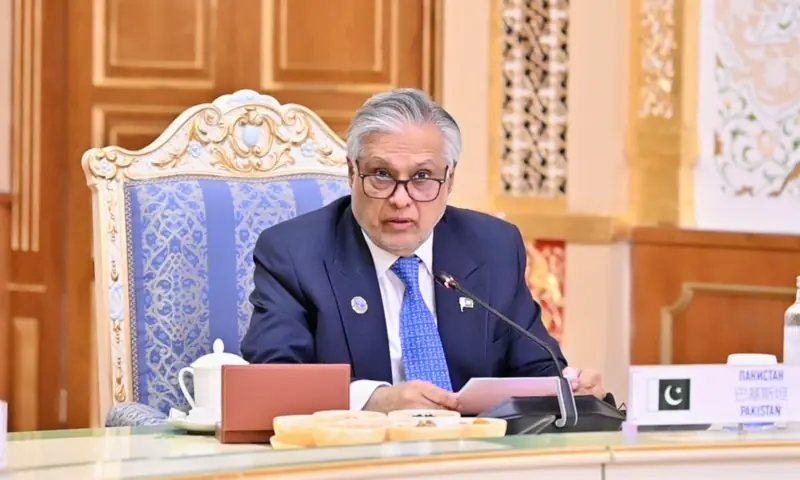
ISLAMABAD: Pakistan urged members of the Shanghai Cooperation Organisation to settle trade in their own currencies and to set up a regional development bank and funds meant to cushion the bloc against international financial shocks, Deputy Prime Minister Ishaq Dar told the group’s heads of government on Tuesday.
Dar, who is also foreign minister and previously served as finance minister, said member states needed to “accelerate efforts to promote the use of national currencies for mutual settlement.” He also called for an SCO Development Bank, an SCO Development Fund and an SCO Investment Fund, tools he said would advance development initiatives and help the region “offset international financial shocks.”
He spoke at the Council of Heads of Government in the Tajik capital, where he arrived a day earlier. The two-day meeting, held October 19-20 as the organisation marks its 25th anniversary, was expected to yield a joint communiqué, a concept for a unified digital platform to manage multimodal ground freight, and an initiative on international rail development. The body is the SCO’s second-highest decision-making forum, providing guidance on economic, financial, trade and connectivity matters and on the organisation’s budget.
The group has 10 members: Pakistan, China, India, Iran, Russia, Kyrgyzstan, Belarus, Kazakhstan, Tajikistan and Uzbekistan. Afghanistan and Mongolia are observers. Prime ministers of Belarus, China, Kazakhstan, Kyrgyzstan, Russia, Tajikistan and Uzbekistan attended, along with Iran’s vice president and India’s external affairs minister.
Two members, Russia and Iran, face Western sanctions that restrict their access to international markets and weigh on growth. The push for local-currency settlement is not new. Last year’s communiqué from the Pakistan-chaired meeting reaffirmed a roadmap for gradually raising the share of national currencies in mutual settlements and called for reducing reliance on the dollar in international trade. Prime Minister Shehbaz Sharif said at that summit that such a shift would “shield us from global financial disruptions.”
Dar returned to the theme in a second address to an expanded-format session, where he proposed three steps. He called for empowering the SCO’s chambers of commerce and business council through direct business-to-business links and joint trade expos, and for streamlined customs procedures to help small and medium-sized enterprises. He urged a stronger SCO Interbank Consortium, saying it could finance infrastructure upgrades until a development bank exists. And he recommended wider partnerships with the United Nations, Asean, the Economic Cooperation Organisation and other regional financial institutions.
Habib Bank Ltd., the consortium’s current chair, can help advance the agenda through close coordination with other members, Dar said. HBL’s chairmanship of the consortium began in October 2026, according to the SCO secretariat.
Dar also criticised “protectionist policies and unilateral coercive measures,” saying they run counter to international law and “suppress economic growth, block technological progress and increase inequality.” He said reform of the global financial architecture and trade regimes was essential. He pointed to the China-Pakistan Economic Corridor as an opening for other members and said investment in energy and transport was “absolutely imperative” for regional integration. Pakistan also favours investment in agriculture, mining and minerals, and information technology, he said, and sees artificial intelligence, digital transformation and energy cooperation as pillars of future SCO work.
Islamabad takes over as host of the Council of Heads of State, which meets in August 2027, and Dar recalled the priorities Sharif has set: peace, security and mutual trust; connectivity and trade; innovation and AI; climate resilience and sustainable energy; and people-to-people exchanges.
On security, Dar raised cross-border terrorism from Afghanistan, saying economic development cannot be guaranteed without durable peace in the region. Pakistan wants a “peaceful, stable, regionally integrated and prosperous Afghanistan,” he said, and has one expectation of the Taliban government: that Afghan territory not be used for terrorism against Pakistan or the world. Islamabad has repeatedly urged Kabul to dismantle sanctuaries, particularly those linked to the banned Tehreek-i-Taliban Pakistan, and officials say those appeals have gone unheeded. Pakistan said on Sept. 21 that its forces struck three sites linked to the TTP in the border region.
Dar also cited Pakistan’s role in mediation between the U.S. and Iran, saying dialogue and diplomacy offer the most effective path to resolving regional tensions. President Donald Trump said in July that the U.S. had agreed to continue talks with Iran while declaring the ceasefire between the two countries over.
Ahead of the session, Dar called on Tajik President Emomali Rahmon and was received by Prime Minister Qohir Rasulzoda. He later met Tajik Foreign Minister Sirojiddin Muhriddin, with both sides pledging to expand trade, connectivity and energy cooperation, Pakistan’s Foreign Office said. On Monday he met Rasulzoda, Chinese Premier Li Qiang and Mongolia’s First Deputy Prime Minister Jadambyn Enkhbayar. Dar flew back to Islamabad on Tuesday evening after what the Foreign Office called a productive visit.
Copyright © 2021 Independent Pakistan | All rights reserved