By Staff Reporter
ISLAMABAD: A senior Pakistani nuclear policy adviser has told an audience in London that a “dangerous ideology” which “conflates mythology with national power” is shaping Indian military thinking and endangering South Asia and beyond.
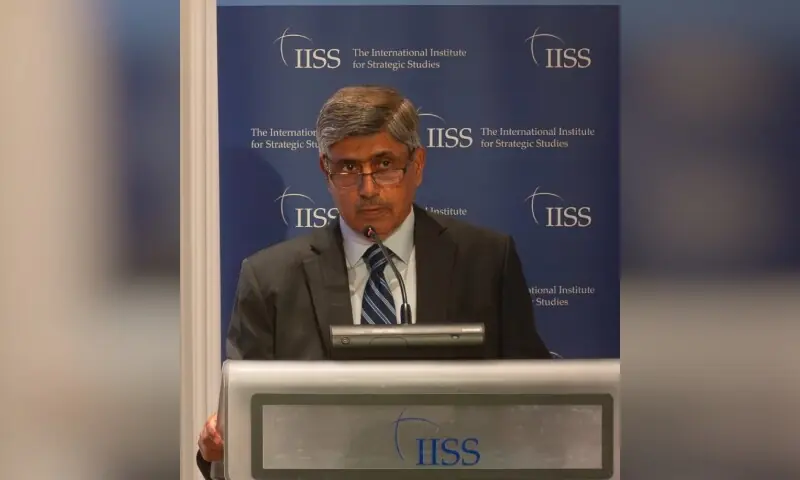
Retired Lieutenant General Mazhar Jamil, an adviser to Pakistan’s National Command Authority (NCA) and the former director general of its Strategic Plans Division (SPD), made the remarks in a keynote address at a workshop on nuclear deterrence and strategic stability in South Asia, held at the International Institute for Strategic Studies (IISS) on 13 October. The think tank released a transcript of the speech late on Monday.
“Indian military thinking is being shaped by a dangerous ideology, which conflates mythology with national power,” Jamil said. “The outcome is very risky and delusional Indian military doctrines with a poor strategic sense of nuclear realities are endangering South Asia and beyond.”
The address, among the sharpest public attacks on India by a figure so closely tied to Pakistan’s nuclear establishment, comes at a time of deep hostility between the two nuclear-armed neighbours. Relations have not recovered from the four-day conflict of May 2025, which followed the killing of 26 civilians in Pahalgam in Indian-occupied Kashmir on 22 April. India blamed Pakistan-based groups and launched strikes under what it called Operation Sindoor. Islamabad denied involvement and called for an independent investigation.
Kashmir and ideology
Jamil began by arguing that any model of strategic stability must account for the political beliefs of the states involved, since those shaped policy. Military adventurism and hegemonic ambition were, he said, “highly risky and unaffordable” in a nuclearised South Asia.
Kashmir, he said, remained the core dispute and should be settled in line with UN Security Council resolutions. He accused New Delhi of avoiding a political resolution, perhaps because its leaders believed India had no standing on Kashmir when the matter was raised at multilateral forums, and of instead trying to manage the conflict with violence inside the territory and “military aggression against Pakistan”. That approach had failed, he said, leaving Kashmir a nuclear flashpoint.
He went on to describe a long history of Indian coercion of its neighbours, and tied it to Hindu nationalist ideology. India’s constitutional use of the name Bharat, he said, pointed to a “revisionist” goal of reclaiming South Asia for “Hindu civilisation”, and he cited a map of “greater Bharat” on display in the Lok Sabha as evidence that such thinking was no longer concealed. He also accused the governing establishment of seeking to marginalise India’s non-Hindu population, particularly Muslims, and said that mindset had “penetrated deeply” into the military.
‘Two diametrically opposing’ approaches
Jamil said Indian leaders appeared “frozen in time” and had failed to absorb three lessons vital to stability: that conflicts outlast wars unless resolved politically; that military action between two nuclear powers can only escalate a crisis without serving any policy goal; and, citing Clausewitz, that war is “the realm of uncertainty”, in which control often proves illusory.
“In a nuclearised environment of South Asia, that realisation may come too late to manage safely,” he said, if India persisted with a policy of provocation and a false sense of “escalation domination”.
The result, he argued, was two opposing strategic approaches: an Indian one seeking political and military dominance as a regional hegemon, and a Pakistani one aimed at settling disputes politically while defending sovereignty against what he called a “regional bully”.
Jamil blamed part of India’s posture on the international environment. He said the US and Western powers had been too quick to cast India as a net security provider in the Asia-Pacific balance of power, giving it “a false sense of hegemony”. He criticised the Nuclear Suppliers Group waiver granted to India “in spite of its irresponsible nuclear behaviour”, and said the policy of appeasement by “certain powers” had convinced New Delhi its exceptionalism would always be tolerated.
India was now running “one of the fastest-growing nuclear and missile programmes” with no regard for arms control, he said, developing intercontinental and submarine-launched ballistic missiles able to reach the entire globe. He said eight Indian reactors remained outside International Atomic Energy Agency safeguards, and noted that India is not a party to the Non-Proliferation Treaty. He also cited an assessment by the Stockholm International Peace Research Institute that India had mated some warheads with submarine-launched missiles and carried out deterrence patrols without pre-notification.
Dual-use, precision-guided systems, he added, were blurring the line between conventional and nuclear weapons in a region where distances are short.
He pointed to the accidental firing of a BrahMos missile into Pakistan on 9 March 2022, which he described as intentional. India said the launch was an accident, and Jamil said it had taken 48 hours to inform Islamabad. The episode, he said, spoke volumes about the “dysfunctionality” of Indian command-and-control systems, and he said India had never shared the findings of its inquiry. The launch of dual-capable BrahMos missiles during the May 2025 conflict, he went on, was “a deliberate act of provocation that could have caused catastrophic miscalculation”.
Crisis behaviour
Turning to the 2019 and 2025 crises, Jamil said responsible leadership was “the spirit and the key” to crisis management. He accused Narendra Modi of nuclear sabre-rattling in 2019, recalling an election rally at which the Indian prime minister said India was not keeping its nuclear weapons “for Diwali”, and later remarks describing the night of 27 February as “Qatal ki Raat”, or night of slaughter.
In 2025, he said, Indian leaders blamed Pakistan for the Pahalgam attack without evidence and before any inquiry, then launched an offensive designed to intimidate Islamabad through the sheer tempo of the operation. Indian planners, he said, had “closely underestimated” Pakistan’s resolve and capability. He said the crisis could have taken the region to “the brink of nuclear catastrophe” and was averted only by Pakistani restraint, which India now wrongly presented as a bluff. Pakistan’s ceasefire decision, he said, was a deliberate choice, adding: “I think in all fairness, India owes a thanks to (US) President Trump.”
Looking ahead, Jamil said the risk of escalation had grown since May 2025. He cited India’s decision to hold the Indus Waters Treaty in abeyance, and continuing “threats and compellence”, as steps that had “dangerously enhanced the conflict profile” of South Asia. He accused India of supporting the Pakistani Taliban (TTP) and Balochistan Liberation Army (BLA) as an “instrument of policy”, and said Pakistan had given the UN Security Council and the wider international community “irrefutable evidence”. He called on the international community to hold New Delhi to account.
“The space is shrinking between Indian aggressive posturing and Pakistan’s restraint,” he said. Pakistan remained committed to peace and “responsible nuclear stewardship”, but “reserves the right to undertake all appropriate measures” to safeguard national security. Its restraint, he warned, “has its own thresholds”, and any future aggressor would “bear a heavy cost”.
He said Pakistan was ready for political dialogue on all disputes, including Kashmir, and had offered to set up a crisis management mechanism as a first step.
“Bharatiya leadership should not be allowed to hold hostage the welfare of two billion people of South Asia, in favour of their hegemonic and delusional revisionist aspirations,” he concluded.
The wider relationship between the two neighbours shows little sign of thaw. India has kept the Indus Waters Treaty in abeyance since the Pahalgam attack, and in early September rejected an order by the Permanent Court of Arbitration in The Hague, which Pakistan had asked in March to rule on the treaty’s status. New Delhi says the treaty will stay suspended until Pakistan ends its support for cross-border terrorism, while Islamabad has urged it to return to the treaty framework.
On 3 October, Pakistan summoned India’s chargé d’affaires after two Pakistani civilians were killed by Indian border forces. In August, Islamabad’s Foreign Office rejected claims by India’s home minister linking arrests in India to Pakistan, calling them part of a “malicious campaign”. The US Council on Foreign Relations listed renewed armed conflict between the two countries as a moderate-likelihood contingency for 2026, citing militant activity and tensions in Kashmir.
Copyright © 2021 Independent Pakistan | All rights reserved