By Staff Reporter
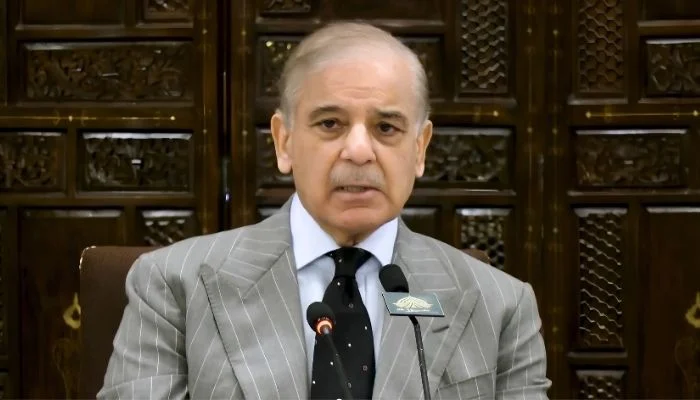
PESHAWAR: Prime Minister Shehbaz Sharif has promised to “bring back” progress to Khyber Pakhtunkhwa and defended the federal takeover of the province on his first visit since governor’s rule was imposed.
Chairing an apex committee meeting in Peshawar on Thursday, Sharif said the emergency and governor’s rule had been imposed “under extreme compulsion”. He pledged that the Centre would “place all possible resources at your feet”.
The meeting was attended by Field Marshal Asim Munir, who is both chief of defence forces and army chief, and by the provincial governor, Faisal Karim Kundi. Federal ministers and the newly appointed provincial advisers also took part. The governor now runs the province with the help of an 11-member advisory council that includes Dr Syed Amir Abdullah, Tariq Mahmood Pasha and the retired Lieutenant General Nigar Johar Khan.
Sharif promised to “leave no stone unturned” in restoring what he called the happiness and progress of the province. He said he, the governor-led council, the president and the military leadership would ensure it not only matched the other provinces in development but moved ahead of them.
The prime minister directed much of his criticism at the Pakistan Tehreek-e-Insaf (PTI), which governed the province from 2013 until the federal intervention. He said “terrorists were summoned back” after peace had been established, which he said washed away the sacrifices of the security forces. He called for an “all-encompassing analysis” of how that happened.
He alleged that 5,000 police vacancies had gone unfilled, that Safe City projects remained unfinished, and that the Counter-Terrorism Department had not been significantly strengthened. He also said police training had received no special attention.
Sharif said all provinces had agreed under the 2010 National Finance Commission Award that Khyber Pakhtunkhwa, as the front-line region in the fight against terrorism, needed extra resources. More than Rs800bn had been provided or was being provided since then, he said, yet militancy had resurfaced. He said the weapons, capacity and trained officers needed to counter it were “nowhere to be found”.
The prime minister said he had assured the governments of two former chief ministers, Ali Amin Gandapur and Sohail Afridi, of the Centre’s full support against terrorism. “Nothing was done regarding this,” he said. He told the meeting the government could not remain a “silent spectator” and had made “one last effort” by handing the province to federal control.
He also repeated allegations of graft in the province. He cited Rs100bn in a clean drinking water project under the Cities Improvement Project and Rs37bn in what he called the “infamous looting” in the Kohistan District Accounts Office. He further alleged that contracts for a placer gold project had gone to favoured individuals. The PTI has rejected the federal government’s accusations.
He said a political committee had been formed to find a negotiated settlement and had worked for 48 hours. He added that he had consulted President Asif Ali Zardari twice before the decision was taken. He thanked coalition partners, naming Mr Zardari and the PML-N president, Nawaz Sharif.
Rs160bn for development
Sharif later addressed the Area Representative and Development Council, a body of 48 tribal elders and prominent figures from 12 districts facing serious security challenges. These are Dera Ismail Khan, Tank, Lakki Marwat, Bannu, Bajaur, Mohmand, Khyber, Kurram, Orakzai, North Waziristan and Upper and Lower South Waziristan.
He announced Rs160bn in federal funds for development projects in the province. To ease a wheat shortage, he said the Centre would supply “as much wheat as is needed” from the stocks of the Pakistan Agricultural Storage and Services Corporation. He warned against hoarding and said consumers should pay the price the Centre set.
He promised whatever help was needed in operations and resources to fight terrorism, and said he had directed that the Counter-Terrorism Department be strengthened and the Safe City projects completed.
The council’s chairman, Shaukatullah Khan, had told the meeting that development work was “zero”, corruption “100 percent” and terrorism “at its peak”. Sharif replied: “I completely agree with him.”
On October 11, President Zardari approved the prime minister’s advice to impose an emergency and governor’s rule under Articles 232 and 234 of the Constitution. The government cited a rise in attacks and the provincial government’s “deliberate disengagement” from counterterrorism. Executive powers passed to the governor, and Mr Afridi and his cabinet were removed. A new chief secretary, Dr Muhammad Fakhre Alam Irfan, was appointed the same day.
Security reports presented to the federal cabinet showed that terrorist incidents in the province rose by 195 per cent between 1 March 2024 and 23 September 2026. They also showed that 73 per cent of attacks recorded in 2026 targeted police and security personnel.
The move followed the failure of talks between the Centre and the PTI on 2 and 3 October, in which counterterrorism policy was a central dispute. It also followed the party’s planned march on Islamabad to demand the release of its jailed founder, Imran Khan. The Centre objected to the provincial government’s stance on talks with the Afghan Taliban, and federal ministers alleged the PTI-led government had a “nexus” with militant groups. The PTI says it was excluded from security decisions and that the province is itself bearing the brunt of terrorism.
Police arrested dozens of PTI workers as the march was disrupted, and internet and mobile services were suspended in Swabi. On 12 October, the Minister of State for Interior, Talal Chaudhry, confirmed that Mr Afridi and some of his cabinet had been taken into preventive custody. They included the provincial assembly speaker, Babar Saleem Swati.
Parliament endorsed the measures at a joint sitting after a heated debate. The opposition alliance Tehreek Tahaffuz Aiyeen-e-Pakistan, led by Mahmood Khan Achakzai and Allama Raja Nasir Abbas, pledged a joint struggle against them. Mr Achakzai said an all-parties conference would be called and that resigning from the assemblies remained an option.
The PTI’s chairman, Barrister Gohar Ali Khan, has challenged the move in the Peshawar High Court. The petitioners argue that governor’s rule was never imposed in Balochistan despite militant violence, or in Khyber Pakhtunkhwa between 2007 and 2015. They also say the legal requirements of Article 234 were not met.
On Tuesday, a two-judge bench issued notices to the federal and provincial governments and adjourned proceedings until 10 November. The bench also directed that notices go to the attorney general and the provincial advocate general.
Copyright © 2021 Independent Pakistan | All rights reserved