By Staff Reporter
ISLAMABAD: Pakistan’s top anti-money laundering committee approved a revision to the cash-transaction reporting thresholds that feed the country’s financial intelligence unit and cleared the new virtual-assets regulator for inclusion under the Anti-Money Laundering Act, a push to keep the framework in step with emerging financial risks and technologies.
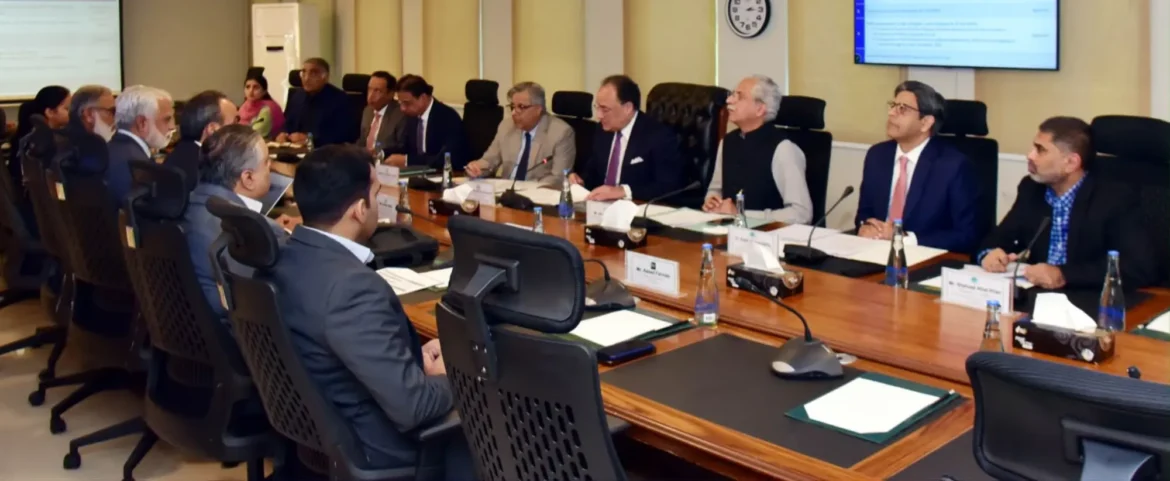
Finance Minister Muhammad Aurangzeb chaired the 19th meeting of the National Executive Committee on AML-CFT in Islamabad on Tuesday, according to a Finance Division statement. The committee oversees policy and implementation of Pakistan’s regime against money laundering and terrorism financing.
The panel approved the proposed revision to the thresholds for Currency Transaction Reports under the framework used to analyze those filings alongside Suspicious Transaction Reports. The statement didn’t disclose the new levels or say when they would take effect. Reporting entities have been required to file such reports on cash transactions of Rs2 million or above, a level the government set in January 2015. Under the Anti-Money Laundering Act, the amount is specified by the National Executive Committee through a notification in the official gazette.
The committee also approved including Section 28 of the Pakistan Maritime Zones Act, 2023, in Schedule I of the Anti-Money Laundering Act, and placing the Pakistan Virtual Assets Regulatory Authority in Schedule IV. The statement didn’t elaborate on the maritime provision. Taken together, the decisions bring the virtual-assets regulator under the country’s anti-money laundering legal framework.
The regulator is a recent creation. At its first board meeting in August 2025, Aurangzeb attended as a special invitee, and the agenda centered on operationalizing the authority in line with international AML/CFT standards.
The meeting also reviewed compliance with decisions taken at the 18th committee meeting, along with the performance of the Financial Monitoring Unit, institutional capacity and initiatives involving artificial intelligence and machine learning. The unit receives and analyzes the suspicious-transaction and currency-transaction reports that banks, exchange companies and other reporting entities file.
Aurangzeb stressed regular and timely follow-up and closer coordination among the institutions responsible for carrying out the national framework. He said the unit’s analytical and operational capacity should be strengthened through a clear implementation roadmap with defined timelines. He described the committee as an effective strategic forum for coordination, inter-agency cooperation and consistent monitoring of the measures it discusses.
Members agreed the framework must remain responsive to evolving financial risks and emerging technologies, and that the analytical capabilities of the relevant institutions need to be strengthened.
The meeting was attended by the federal law and justice minister, the State Bank of Pakistan governor, the finance secretary, the chairman of the Securities and Exchange Commission of Pakistan, the director general of the AML-CFT Authority, and senior officials from the Financial Monitoring Unit and other ministries and divisions.
The decisions come four years after the Financial Action Task Force removed Pakistan from its “grey list” of jurisdictions under increased monitoring, where it had been placed in 2018. The Paris-based watchdog’s decision followed Pakistan’s completion of two action plans comprising 34 points. The Asia/Pacific Group on Money Laundering, which assesses Pakistan on the FATF’s behalf, lists a possible on-site visit in November 2029 and a possible plenary discussion in July 2030 for the country’s next mutual evaluation.
The reporting rules have been under revision for some time. The Financial Monitoring Unit finalized new Suspicious Transaction and Currency Transaction Reporting Regulations in November 2025, following approval by the National Executive Committee.
Copyright © 2021 Independent Pakistan | All rights reserved