By Staff Reporter
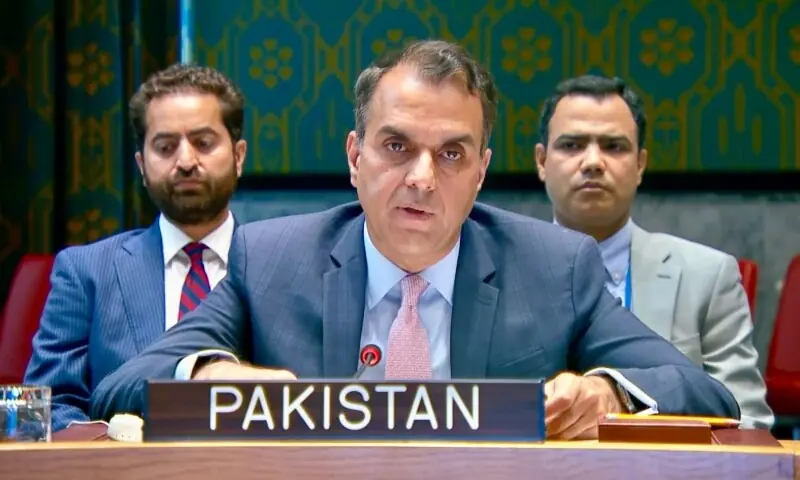
ISLAMABAD: Pakistan has told the UN Security Council that the dispute over Iran’s nuclear programme has “sharply deteriorated”, urging every party to step back from a conflict that has spread from the Strait of Hormuz to the Saudi border.
Ambassador Usman Jadoon, Pakistan’s acting permanent representative, said on Tuesday that mounting tensions and a lack of consensus among council members had made a diplomatic settlement more urgent. He told a briefing on Iran and nuclear non-proliferation that the worsening situation was damaging the council’s ability to consider the issue at all.
Jadoon called on all sides to avoid “irresponsible and destabilising rhetoric” and postures that could raise the risk of conflict. He said disputes over non-compliance belonged with “competent technical bodies like the IAEA”, free of politics, and that the agency “must be enabled to carry out its work without any hindrance”.
Rafael Grossi, the agency’s director general, used the same session to press Iran for immediate access so inspectors can verify its nuclear material. The agency has said it lost sight of Iran’s stockpile of uranium enriched to 60 percent after the strikes of June 2025.
The council has been split for months over whether the framework of the 2015 nuclear deal still has force, with the US, UK and France insisting that it does. That agreement limited Iran’s programme in exchange for sanctions relief. The US withdrew from it in 2018 during Donald Trump’s first presidency, and later efforts to restore it failed.
Jadoon pointed to Pakistan’s own mediation as proof that talking can work. Islamabad brokered the April ceasefire and hosted the first high-level US-Iran talks in decades. It then endorsed the Islamabad memorandum of understanding that Mr Trump and Iran’s president, Masoud Pezeshkian, signed electronically in June. “It demonstrates that progress on the diplomatic track is possible,” he said, thanking Qatar, Saudi Arabia, Turkey, Egypt, China and others for their support.
The war began on 28 February, when the US and Israel launched surprise attacks on Iran. An April ceasefire ended the heaviest bombardment, but the two sides have since fought over the Strait of Hormuz, through which about a fifth of the world’s oil and liquefied natural gas once passed. Iran claims control of the waterway and regularly targets ships that cross without its permission. The US has answered with a naval blockade of Iranian ports.
On Tuesday, the Iranian army said a tanker had struck mines and caught fire while trying to use a route Tehran had not approved. Iran’s Persian Gulf Strait Authority, the body it set up to manage passage requests, said all vessels owned by the South Korean shipper Sinokor would face “legal action” from 1 November. An oil slick in the Gulf has reached a beach in the United Arab Emirates, and experts have warned it could threaten desalination plants as it spreads.
Saudi Arabia is now absorbing the sharpest blows. The Houthis, Yemen’s Iran-backed rebels, said they fired missiles on Tuesday at the defence ministry in Riyadh and at the Ras Tanura refinery on the east coast, the kingdom’s largest. Saudi authorities did not comment on specific targets but said they shot down two ballistic missiles fired at the capital, with shrapnel hitting a building, a construction project and a car. Three more missiles aimed at the Eastern Province were intercepted, the Saudi-led coalition said.
The Houthis also claimed strikes on two military transport aircraft in southern Saudi Arabia and a drone attack on Abha airport. The US State Department ordered non-emergency government staff and their families to leave the kingdom, citing attacks on civilian airports and infrastructure that it said could “escalate rapidly”.
On the ground in south-western Yemen, 97 fighters have been killed since Saudi air strikes began late on Monday, according to an AFP tally compiled from military sources on both sides. At least 63 were Houthi fighters and 34 were pro-government combatants, most of them near the Bab al-Mandab strait. It is the fiercest fighting since the Houthis seized swathes of territory in a lightning offensive in September. The group also condemned Egypt’s parliament for authorising defensive military support for Saudi Arabia, calling the decision a declaration of war and saying it was “not afraid of any alliance that may be formed”.
The attacks came within hours of an unusual diplomatic gathering in Tehran. Saudi Arabia’s defence minister, Prince Khalid bin Salman, Pakistan’s army chief, Field Marshal Asim Munir, and Turkey’s intelligence chief, Ibrahim Kalin, met Mr Pezeshkian and Mohsen Rezaei, secretary of Iran’s Supreme National Security Council, on Monday. It was the first joint visit to Tehran by the three signatories of the Mecca defence pact, which they agreed in August and which treats an armed attack on one member as an attack on all. Field Marshal Munir had travelled to Iran the week before.
The talks produced no agreement, but the four sides agreed to keep talking. Rezaei called the discussions “very good” and said a new atmosphere was emerging in the region. On Tuesday the Saudi cabinet, chaired by Crown Prince Mohammed bin Salman, reaffirmed its backing for mediation by Qatar and Pakistan and praised its air defences for intercepting Houthi attacks aimed at Mecca and Medina.
Washington is counting the cost. The US has spent more than $47bn on the war so far, according to Pentagon data obtained by Reuters. That is over 25 percent above the $37.5bn estimate defence secretary Pete Hegseth gave in July. The figure includes more than $29bn to replace munitions and over $6bn for lost equipment, including aircraft and many drones. It does not clearly account for the expected cost of repairing US bases damaged by Iranian missile and drone strikes. The Pentagon did not immediately respond to a request for comment.
The bill lands a week before the 3 November midterms, which will decide control of Congress. The war’s effect on energy prices has weighed on Republican candidates and on Mr Trump’s approval ratings. He has said he will not attack Iran before the election, and the blockade stays. US officials, speaking anonymously, say the Pentagon is planning to resume heavy fighting if ordered to after the vote.
Trump’s early plan was to use expensive precision missiles to knock out Iran’s defences, then switch to cheaper weapons such as JDAM gravity bombs. The April ceasefire gave Iran time to dig out underground storage sites and bring back some air defences, missiles and drones that had been out of reach.
Tehran, for its part, has been looking east and north. In Moscow on the margins of a Gas Exporting Countries Forum summit, Pezeshkian told Vladimir Putin that the region could solve its problems “without relying on the United States”. Putin said the situation could “not help but cause concern” and that he hoped it would evolve positively. Mr Pezeshkian also met Qatar’s emir, Sheikh Tamim bin Hamad Al Thani.
A Qatari foreign ministry official, Ibrahim Al-Hashmi, said the region needed a new security framework and that “the ball is now in Iran’s court”. He said Tehran must stop threatening its neighbours and reopen Hormuz.
Iran’s supreme leader, Ayatollah Mojtaba Khamenei, who has not appeared in public since taking office in March, met Rezaei on Tuesday, his office said. It was the first publicly announced meeting between the two. The leader stressed Iran’s conditions for ending the war and what his office called “the state of neither war nor peace”. The statement gave no date or location.
Copyright © 2021 Independent Pakistan | All rights reserved