By Staff Reporter
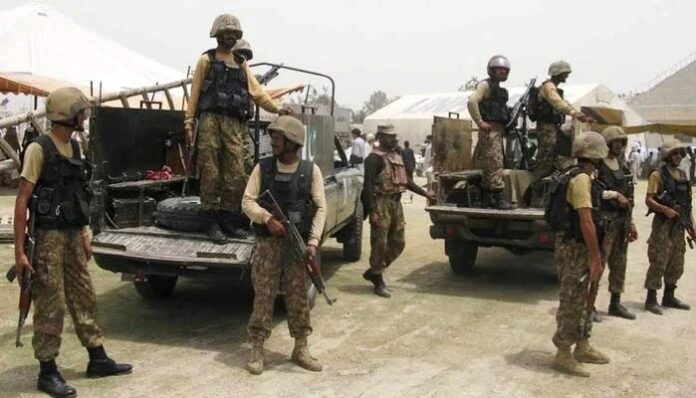
QUETTA: Security forces have killed nine militants in two operations in Balochistan on Monday, the military said, describing the dead terrorists as members of groups sponsored by India.
The army’s media wing, Inter-Services Public Relations (ISPR), announced the raids on Wednesday, two days after they took place. It said troops acted on intelligence about the presence of militants in the Kachhi and Wadh districts on 26 October.
In Kachhi, soldiers located and destroyed a hideout and killed seven people in an exchange of fire, the ISPR said. In Wadh, forces “tracked and intercepted” the movement of militants, and two more were killed after a second firefight. Weapons and ammunition were recovered at both sites, the statement said, without specifying what was found.
The statement labelled Fitna al-Hindustan, which Pakistan’s interior ministry announced in May 2025 would be applied to all terrorist groups and organisations operating in Balochistan. The term carries an accusation of Indian sponsorship within it. The ISPR said the seven in Kachhi were “sent to hell”.
The ISPR said “sanitisation operations” were continuing in both areas. It added that the counterterrorism campaign under Azm-e-Istehkam, a strategy approved by the Federal Apex Committee on the National Action Plan, would proceed “at full pace”.
President Asif Ali Zardari praised the forces’ professionalism on X and said the plots of the militants’ foreign sponsors and local facilitators would be defeated. “The nation stands shoulder to shoulder with its security forces and law enforcement agencies,” he said.
Prime Minister Shehbaz Sharif said in a statement from his office that those seeking to undermine Pakistan’s peace would “never succeed in their nefarious designs”. “We would continue the fight against terrorism until this menace is completely eliminated from the country,” he said.
A run of operations
The raids followed a series of similar announcements. On 23 October the ISPR said ten militants, including a woman, had been killed in Gwadar after attempted attacks the day before near the Gabd border crossing and in Gwadar city. The military said one civilian was killed and no security personnel were hurt. It accused militants of coercing a Baloch woman into taking part, though it did not identify her. Pakistan had suspended trade through two crossings with Iran over security concerns days earlier, and army chief Field Marshal Asim Munir said the border had since reopened.
Earlier in October, state media reported that five militants were killed in Mastung district. On the night of 12-13 October, security forces killed five more in Washuk, the ISPR said. Eight were killed on 17 October in operations in Quetta, Nushki and Khuzdar. The next day, an army major and four militants died in a series of raids.
Provincial government officials later said that six suspected members of the banned Tehreek-i-Taliban Pakistan (TTP), two would-be female suicide bombers and two commanders of a banned organisation had been arrested across Balochistan. They said about 90 detained suspects were being held at a centre where investigations and legal proceedings were under way.
Violence at a 12-year high
Figures from the Pakistan Institute for Conflict and Security Studies (PICSS), an Islamabad-based research group, show how heavily the province features in the country’s security picture. The group recorded 225 militant attacks nationwide in September, up 13.1 per cent from 199 in August and the highest monthly total in 12 years. Balochistan was the “principal theatre”, with 131 attacks, or 58.2 per cent of the total.
Security forces carried out 74 operations in September and killed 280 militants, PICSS said. Balochistan accounted for 35 of those operations and 171 of the deaths.
Pakistan has seen a surge in attacks over the past three months, many of them in Khyber Pakhtunkhwa. Last week, 12 people were killed and 35 injured when a blast hit a joint checkpoint near Aman Mela in the Darazinda area of Dera Ismail Khan. The TTP claimed responsibility.
In September, a bombing at a mosque in the Police Lines in Kohat killed 23 people, 15 of them police personnel. Eight attackers died in a search and clearance operation afterwards. The Ittihadul Mujahideen Pakistan, led by the Afghanistan-based Hafiz Gul Bahadur, claimed the attack. Separately, a captain and a lieutenant were among six security personnel killed in an exchange of fire in Hangu, where eight militants also died.
On 1 September, six personnel, including two officers, and a customs official were killed as security forces foiled an attempt to breach the Customs House in Balochistan. In July, at least 30 people, 27 of them police, were killed when militants the state calls Fitna al-Hindustan ambushed police in the Kach Mangi Phase III area of Ziarat, setting off hours of gun battles. The attackers also abducted several civilians and police personnel.
Pakistan also launched a military campaign in February against the Afghan Taliban, which it called Operation Ghazab lil-Haq, saying it followed unprovoked cross-border attacks.
Copyright © 2021 Independent Pakistan | All rights reserved