By Staff Reporter
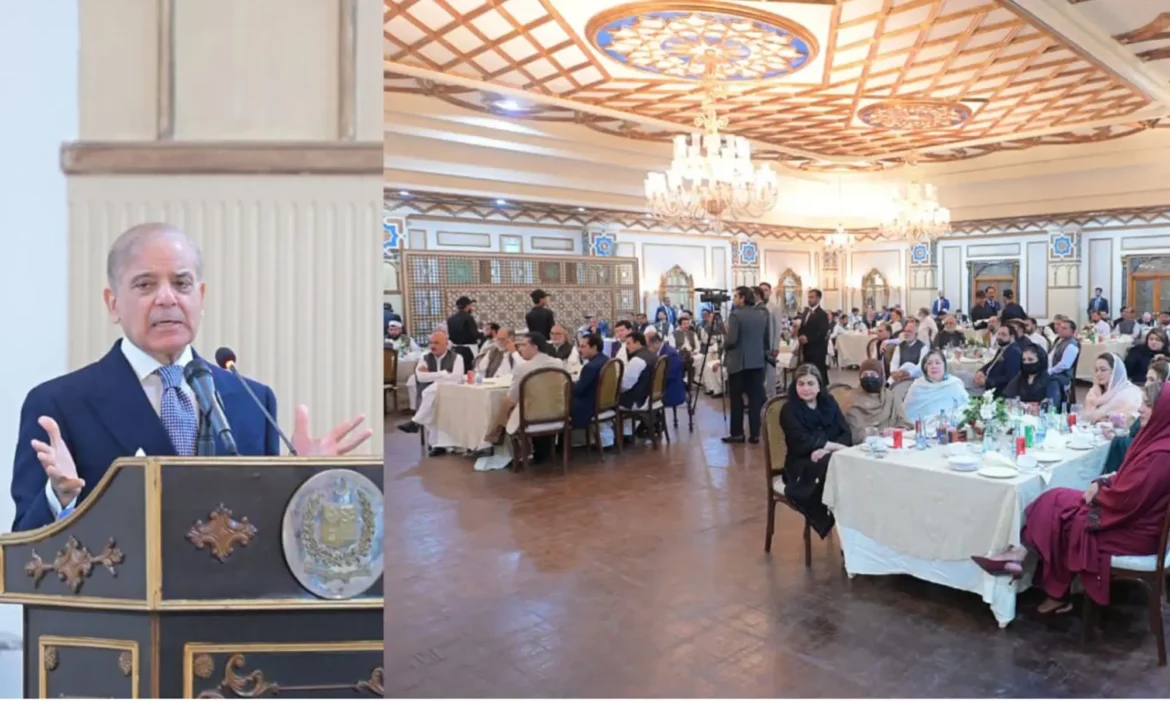
ISLAMABAD: Prime Minister Shehbaz Sharif has accused Imran Khan’s Pakistan Tehreek-e-Insaf (PTI) of wasting 13 years in power in Khyber Pakhtunkhwa, and told his own party’s lawmakers from the province to shelve long-term projects in favour of quick relief for voters.
“Long-term projects should be suspended. If you take small steps to improve law and order, build a school and ensure medicines reach hospitals, people who have been deprived for 13 years will pray for you,” Sharif told a meeting of the PML-N’s parliamentary party from the province in Islamabad on Saturday.
He urged the lawmakers to concentrate on short-term welfare schemes “so that you can help turn people’s fortunes around within the next six months to a year”.
His remarks came less than three weeks after the federal government imposed governor’s rule and an emergency in the province on 11 October, citing the PTI-led administration’s “deliberate disengagement” from the fight against terrorism. A joint sitting of parliament approved the move within a week, over strong protests from the opposition. The decision also drew criticism from Maulana Fazlur Rehman, who had tried to ease tensions between Islamabad and the provincial government.
On 22 October, Sharif made his first visit to the province since the takeover, travelling to Peshawar, where he defended the decision as one taken “under extreme compulsion”.
Addressing the PML-N lawmakers, he said the PTI had promised hundreds of dams, hundreds of megawatts of solar power, and new hospitals, universities and schools, and asked what had come of them.
“How many universities have been established there? How many new hospitals have been built? How much has the healthcare system improved? What facilities have actually been provided to the people? And how much corruption has taken place in the process?” he asked.
“From Peshawar to Kohistan and Hazara, and across the entire southern region of Khyber Pakhtunkhwa, the majority of people would tell you that the PTI government has done very little, if anything, to address their basic needs,” he said.
Sharif also questioned whether public money had been spent transparently, and accused the PTI of spending its years in office on protests and sit-ins rather than the province’s economic and social problems.
Security formed the core of his argument. Sharif said that terrorism in the province had been brought largely under control by 2017-18 under his brother, Nawaz Sharif, whose policies after the 2014 Army Public School attack in Peshawar, in which more than 140 students and teachers were killed, he praised. He alleged that militants were later brought back from Afghanistan and resettled in Swat, and in the province more widely, in 2019 and 2020, and said this allowed militancy to regain momentum.
Pakistan, he said, had lost about 80,000 lives to terrorism, with economic losses estimated at between $150bn and $200bn.
He questioned how the province had used its resources. The 2010 National Finance Commission (NFC) Award, finalised under then prime minister Yusuf Raza Gilani, gave Khyber Pakhtunkhwa an additional 1 per cent share, worth about Rs800bn over the years, he said. Hundreds of billions more had been allocated under a special NFC arrangement for counterterrorism.
“How many Safe City projects have been initiated in KP? How much money has been spent on strengthening the Counter-Terrorism Department (CTD)?” he asked.
Even Rs80bn spent on the police and other law enforcement agencies would have left them better equipped, he said. “But unfortunately, that did not happen.” About 8,000 police posts in the province remained vacant, he added.
Sharif also returned to the PTI’s 2014 sit-in at D-Chowk in Islamabad, saying it forced the postponement of a visit by Chinese president Xi Jinping. Major bilateral agreements were signed in 2015, he said, and his brother’s government went on to tackle electricity load-shedding.
Defending the emergency, he said the Centre had tried negotiation first. A committee of PML-N and Pakistan Peoples Party (PPP) members held 48 hours of talks with the PTI, he said, and he was told a draft had been agreed and would be signed within minutes once Sohail Afridi, then chief minister, approved it.
“However, the approval never came, and we are still waiting,” he said.
The government had “no other option” but to act, and the decision had been “timely”, he said, warning that the consequences would have been severe had it been delayed. “We had no other option but to save the country, the economy, society and KP,” he said.
The PTI rejected the criticism. Sheikh Waqas Akram, the party’s central information secretary, said the prime minister had no moral authority to lecture it on democracy and governance, alleging that the present government had come to power through electoral manipulation and political arrangements.
He accused the federal government of shifting responsibility for the province’s worsening security on to the PTI, and of failing to provide the resources and equipment needed for counterterrorism operations. He also alleged that PTI leaders and workers had faced raids, arrests and intimidation, and challenged Sharif to present an account of his government’s four years in office.
The events of 11 October followed weeks of tension between the Centre and the PTI, after the party announced a long march on Islamabad to demand the release of Khan, its jailed founder. Federal ministers alleged that the provincial government had a “nexus” with terrorist groups. The two sides had been at odds over counterterrorism policy, one of the main reasons for the collapse of their talks on 3 October. The PTI said it was being left out of security decisions on the province, which the Centre denied, and the Centre objected to the provincial government’s stance on talks with the Afghan Taliban.
On the economy, Sharif said the crisis in the Gulf had pushed up international energy prices, but that supplies of petrol and diesel had continued across the country. A targeted fuel subsidy scheme launched in February, with an allocation of Rs75bn, had provided relief vouchers to about 130 million citizens, he said.
Copyright © 2021 Independent Pakistan | All rights reserved