By Staff Reporter
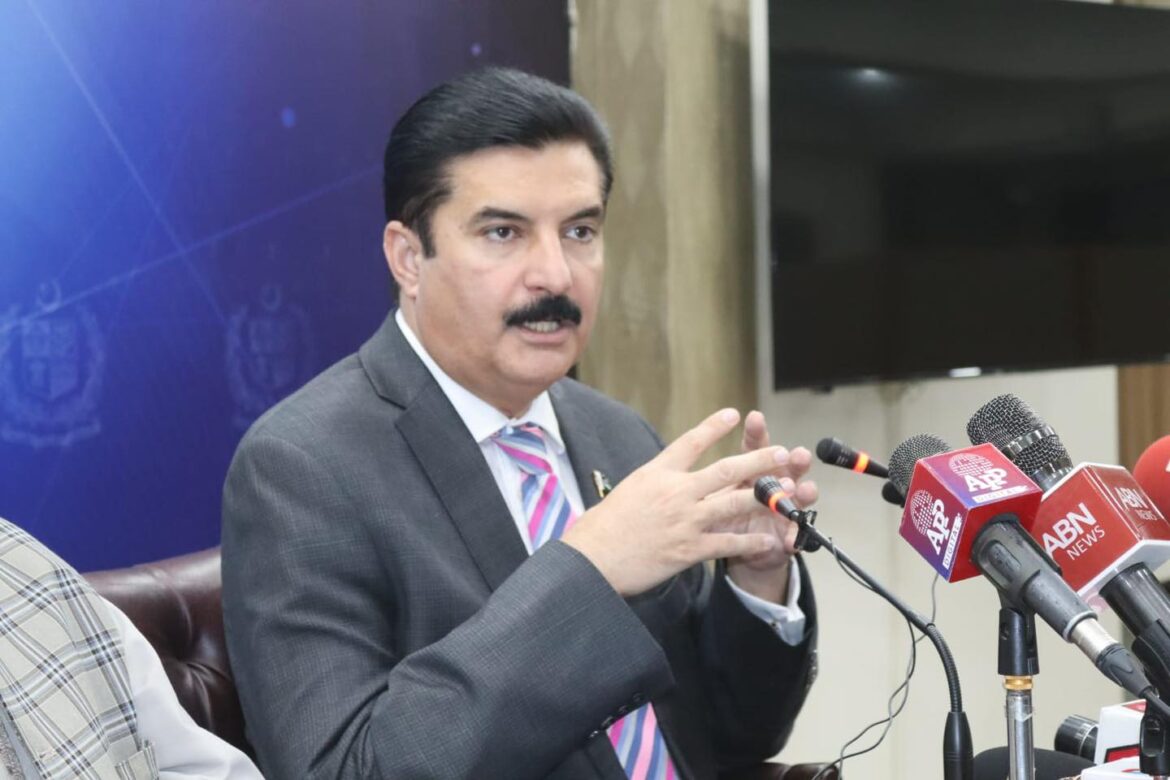
PESHAWAR: The governor running Khyber Pakhtunkhwa since Islamabad removed its elected government has vowed that no outsider will be allowed to “loot” the province, seeking to quell fears that emergency rule is a cover for taking control of its mineral wealth.
Faisal Karim Kundi told a ceremony in Peshawar on Sunday that the people of the province would have the “first right” to its natural resources for as long as he held office.
“No one should think that foreigners will come and loot this province. Till I am here, the people of the province will have the first right to its resources,” he said at the event, which marked the annual Urs of Darbar-e-Aalia Murshidabad Sharif.
Kundi said a third party from outside the province, whether a foreigner or a Pakistani, could enter a joint venture with local people if willing. He said his first priority was “the protection of the people” of Khyber Pakhtunkhwa, then the province itself, then Pakistan.
He listed the province’s assets, saying it was the country’s largest oil producer and second-largest gas producer, and also generated electricity and had tourism, minerals and tobacco. “Wherever there are resources, there will always be issues,” he said, quoting an Urdu proverb.
The remarks come after his own comments on October 17, six days after the federal government imposed governor’s rule and an emergency in the province. Kundi said then that Khyber Pakhtunkhwa’s minerals would be “extracted and sold”, and invited domestic and foreign companies to invest through joint ventures with Pakistani firms and local communities. He argued that such deals would create jobs and support local businesses, and called for oil and gas reserves to be developed too.
Opposition parties said the comments fuelled their concern that governor’s rule could be used to gain control of the province’s mineral wealth. Parliamentary Affairs Minister Tariq Fazal Chaudhry rejected any link between the emergency and mineral extraction, saying the move was a response to the security situation. He said the federal government’s position was that Khyber Pakhtunkhwa and Balochistan would each have the first right to their own minerals, with the proceeds spent on provincial development.
Maulana Fazlur Rehman, the chief of the Jamiat Ulema-i-Islam-Fazl, has alleged that the emergency was driven by the government’s wish to control the province’s resources. He raised the issue in the National Assembly earlier this week, when he also criticised the Centre over the emergency and governor’s rule.
Claims have also circulated on social media that the province’s minerals would be handed or sold to the United States. They followed an interview on September 30 in which the US chargé d’affaires, Natalie Baker, told The Centrum Media that Washington was interested in Pakistan’s mineral resources. Kundi did not name any of the reports, but said several might be circulating and that his priority remained protecting the province’s people.
The ownership of the province’s minerals has been contested for some time. In April 2025, parties across the provincial assembly opposed a proposed Mines and Minerals Bill, arguing that it threatened provincial autonomy and the assembly’s authority over natural resources. In January, a separate Mineral Development and Management Company Bill drew criticism from PTI leaders and supporters. The provincial government defended it as a way to regulate mining and ensure local communities benefited, but its implementation was put on hold after public and political backlash.
Kundi also spoke about security, saying residents had made immense sacrifices in the fight against terrorism. Schoolchildren, security forces, police and journalists were among those who had died, he said.
“Our mission is to make the province a cradle of peace,” he said, adding that differences on other issues should not prevent people from standing together. He urged religious scholars to promote peace, saying people listened to and respected them. He added that more than half of the national cricket team’s players came from the province.
On development, he said Rs160 billion pledged by the federal government would be split, with 70 percent going to the 12 districts under the Area Representative and Development Council and 30 percent to the rest. “My brothers and sisters in the merged districts will not be deprived of their rightful share,” he said.
Asked about alleged corruption by Sohail Afridi, the province’s ousted chief minister, the governor said due legal process would follow if the charges were proven. On Friday, Samar Haroon Bilour, the governor’s adviser on information, said evidence of financial corruption by Afridi was being compiled. Afridi remains in preventive custody and has not been seen since governor’s rule began.
The emergency was imposed on October 11, with the Centre citing the PTI-led provincial government’s “deliberate disengagement” from the fight against terrorism. Executive authority passed to the governor, who has an 11-member advisory council. Less than a week later, a joint sitting of parliament approved the move despite strong protest from the opposition. Federal ministers have alleged a “nexus” between the provincial government and terrorist groups. The PTI rejects that.
It followed weeks of tension between the Centre and the PTI over the party’s long march to Islamabad to demand the release of its jailed founder, Imran Khan. Governor’s rule under Article 234 is limited to six months unless parliament extends it.
Prime Minister Shehbaz Sharif defended the intervention on Saturday, telling PML-N lawmakers from the province in Islamabad that the PTI had done “very little, if anything” for people in 13 years in power there. He said the Centre had no option but to act, and that delay would have had severe consequences. Sharif said a draft agreement had been finalised after 48 hours of talks but was never approved by Afridi.
The PTI hit back, accusing the government of blaming the party for the security situation while denying the province resources for counter-terrorism. On Thursday, the party’s chairman, Gohar Ali Khan, said Afridi remained chief minister, after reports of unease within its ranks over his role.
Copyright © 2021 Independent Pakistan | All rights reserved