By Staff Reporter
ISLAMABAD: Prime Minister Shehbaz Sharif ordered the central bank and the Finance Ministry to withhold concessions from lenders that are slow to extend credit to farmers, small businesses and buyers under a subsidized housing program, a week after the monetary authority raised interest rates for the first time since April.
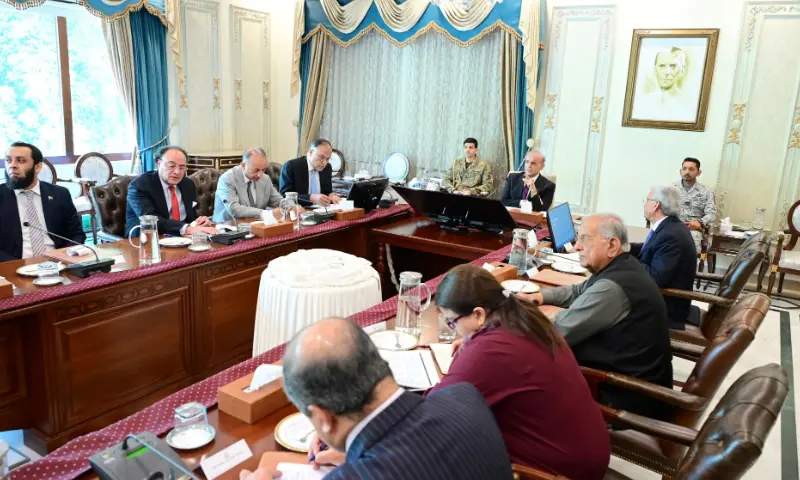
Sharif made the demand Monday at a review meeting in Islamabad on lending to what the government calls priority sectors, according to a statement from his office. Banks that fail to deliver on government initiatives should get no relief from the State Bank of Pakistan or the Finance Ministry, the statement said. It didn’t specify what the concessions are.
“Banks are of key importance for the development of the private sector,” Sharif said, according to the statement. He said he expects lenders to cooperate on priority-sector financing to the same degree that the government and its institutions cooperate with the banking industry. He also praised banks that have performed well, without naming them in the statement.
Sharif separately told the central bank and the Federal Board of Revenue to work together on tax problems facing small and medium-sized enterprises and exporters. The statement gave no details of those problems. He asked the Finance Ministry to address financing obstacles in the small-business, agriculture and housing sectors and to draw up a comprehensive strategy, and he called for a risk-coverage mechanism to make it easier for small companies to borrow. The revenue board ordered payment of 126 billion rupees in pending sales tax refunds in September, ProPakistani reported.
The push for faster lending comes at an awkward moment for monetary policy. The State Bank raised its benchmark rate by 50 basis points to 12% on Oct. 26, with nine of the 10 committee members in favor, citing elevated energy prices linked to the Middle East conflict. Governor Jameel Ahmad said crude was trading around $100 a barrel, and headline inflation reached 10.3% in September, above what the bank had expected. Credit isn’t scarce in aggregate: private-sector credit grew 14.1% from a year earlier, according to the central bank. The government’s complaint is about where the lending goes.
Officials told the meeting that lending to agriculture has reached 1.33 trillion rupees ($4.8 billion), reaching about 3.5 million people. Small-business financing stands at 1.15 trillion rupees across 342,458 companies. Total housing finance has reached 455 billion rupees, benefiting 187,317 borrowers. The government’s target is to raise both agriculture and small-business lending to 1.5 trillion rupees by the end of the fiscal year in June 2027. That leaves roughly 171 billion rupees to add in agriculture and 352 billion in small-business loans in about eight months. Officials have also set a goal of 575,000 small businesses with loans by June 2027.
The gap between approvals and cash is widest in housing. As of Oct. 23, banks had approved 511 billion rupees of loans under the Prime Minister’s Apna Ghar program, covering 86,899 applications, but had disbursed 91 billion rupees to 15,584 applicants, or about 18% of the approved amount. Data from Khurram Schehzad, an adviser to the finance minister, showed banks had received 217,001 applications. When Sharif met bank chiefs on Oct. 9, he was told only 76 billion rupees of 426 billion rupees in approved loans had been paid out, against a financing target of 700 billion rupees for the fiscal year and 125,000 housing units.
The scheme was launched on April 30 and offers loans of up to 10 million rupees at an introductory fixed markup of 5%, moving to market pricing after 10 years. The federal budget for the year through June 2027 allocates 71 billion rupees in subsidy to the program.
The State Bank briefed the meeting on three areas of work: improving regulations, sharing risk and cost between the government and banks, and expanding digital services. It recently launched SME Connect, an online portal where business owners can apply for loans and track their applications. The government has introduced risk-sharing and credit-guarantee measures for housing, agriculture and small business, and is working to simplify loan procedures and cut documentation requirements, officials said.
Monday’s meeting was at least the fifth Sharif has chaired on the subject since early September, and his language has hardened. At a Sept. 9 meeting on the Access to Finance Plan 2026-28, he said the government would encourage banks that make a proactive contribution to expanding credit. On Oct. 9 he met the heads of the country’s 10 leading commercial banks and thanked them for their support. Monday’s statement is the first in this series to threaten to withhold concessions.
Sharif called agriculture the backbone of the economy and said the government wants to raise exports through value addition in farm produce. He said the housing program would support a range of industries tied to construction.
The government is under pressure to keep growth moving. The central bank has projected real GDP growth of 3.5% to 4.5% for the current fiscal year, after 3.7% in the last one. Pakistan and the International Monetary Fund reached a staff-level agreement this month that could unlock about $1.2 billion, subject to approval by the Fund’s executive board.
Finance Minister Muhammad Aurangzeb, State Bank Governor Jameel Ahmad, several other federal ministers, lawmakers and senior officials attended Monday’s meeting, along with heads and representatives of leading commercial banks, the statement said.
Copyright © 2021 Independent Pakistan | All rights reserved