By Staff Reporter
ISLAMABAD: Pakistan has accused Israel of working against a lasting peace between the United States and Iran, saying its “unwarranted expansionist attempts” have pushed the Middle East into crisis.
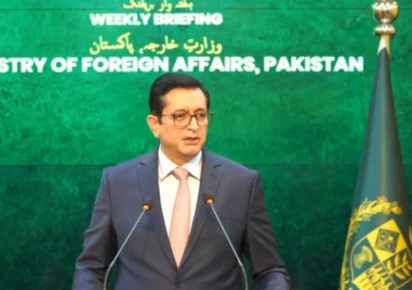
Foreign Office spokesperson Sajjad Haider Khan singled out Israel at his weekly briefing in Islamabad on Friday, when he was asked which countries could undermine the peace process. He said peace in the region was not in Israel’s interest.
“One reason that the entire region is today facing all these crisis situations is because of these unwarranted expansionist attempts by Israel, not only toward Iran, but also in its immediate neighborhood, may it be Palestine, Syria, Lebanon and the other countries in the neighborhood,” he said.
Pakistan and Qatar helped broker a June agreement that halted the war between Washington and Tehran, which began in February, and laid the groundwork for talks on a broader settlement.
The Islamabad Memorandum of Understanding committed both sides and their allies to ending military operations, including in Lebanon. It also set out a framework for negotiations on sanctions relief, Iran’s nuclear programme and the reopening of the Strait of Hormuz, a vital route for global energy supplies.
The process has stayed fragile, with disputes over implementation and renewed regional tensions threatening progress.
Khan said Pakistan would keep up its diplomacy, with Saudi Arabia, Qatar and other regional states also playing an active part. Islamabad, he said, would support any country able to bring Washington and Tehran closer to a settlement.
He said a lasting deal could come only through political engagement rather than military confrontation, and conceded that negotiations could take time. “I believe that peace will eventually prevail and that countries will be able to resolve these matters peacefully,” he said.
The briefing came as the diplomatic temperature rose on several fronts. Trump said on Friday that the US was talking to Tehran, adding: “We are doing very well with Iran.”
Bloomberg reported that Iran was studying proposals on its nuclear activities put forward by Qatar, the chief mediator. It cited a diplomat who asked not to be named and described the development as a potential breakthrough.
Trump spoke by telephone with Qatar’s Emir, Sheikh Tamim bin Hamad Al-Thani. A statement from Doha said the two discussed efforts to reach “a comprehensive agreement that ends the crisis and achieves security and stability in the region”.
An Iranian official told Reuters on Thursday that Tehran had sent a nuclear proposal to Washington through Qatar. He said it would not be discussed until the US met seven Iranian demands, including the lifting of sanctions, the release of frozen assets and compensation for the war.
Washington insists that nuclear issues must be part of any preliminary negotiations. The White House has also warned that Trump was weighing a fresh round of strikes on Iran.
On Saturday, Qatar’s prime minister and foreign minister, Sheikh Mohammed bin Abdulrahman Al Thani, urged both sides not to hold out for a “perfect moment” to conclude a deal.
Asked whether the Democrats’ victory in Tuesday’s midterm elections could affect the talks, Khan said Pakistan’s overriding concern was regional peace and stability. The result cost Trump’s Republican Party control of both chambers of Congress. Trump has said the losses were driven largely by the Iran war and the rising cost of living.
Khan called elections an internal matter for the US. He said Pakistan had kept its ties with successive American administrations whichever party held power, and that Washington remained an important partner on trade, investment, security and counterterrorism.
He pointed to Pakistan’s record as mediator. “The fact that we were able to bring the two countries, which had not been even talking to each other for the past 47 years, in the same room and to discuss, which culminated into the successful signing of Islamabad MoU, is a testimony of the fact that shows how serious Pakistan has been toward building peace,” he said, referring to the US-Iran talks Pakistan hosted in April.
Khan also confirmed that the liquefied natural gas carrier Al Mayeda, registered in the Marshall Islands and operated by QatarEnergy, was struck by projectiles in the Arabian Gulf on 30 October.
The vessel was carrying LNG to Karachi and had 25 multinational crew members, including Pakistanis. A small fire broke out, but no one was hurt and the ship returned safely to Qatar, he said.
Pakistan relies heavily on Qatari LNG imports, and the attack underlined the exposure of its energy supplies to renewed insecurity in the Gulf. Mr Khan said Pakistani authorities were working with the relevant parties to establish further details.
Bloomberg reported that Pakistan had negotiated with Iran for safe passage for the ship before it was hit. No party has claimed responsibility for the attack.
Afghan deportations
Khan said Islamabad was considering a US proposal to deport about 150 Afghan nationals to Pakistan for onward repatriation to Afghanistan. Refugee advocates have objected to the plan and the Taliban authorities in Kabul have voiced concern.
“The matter is under consideration as we speak, and all relevant aspects are being carefully examined in consultation with the concerned stakeholders,” he said. “So, we are hopeful that a mutually agreeable way forward will be reached.”
He declined to say whether Washington had formally approached Islamabad.
A federal judge in Manhattan, Valerie Caproni, issued a temporary restraining order this week barring the Trump administration from sending Afghans to Afghanistan or Pakistan. Sixty-six US lawmakers have urged the administration to halt the deportations. Pakistan has itself deported or forced the return of more than 2.7 million Afghans since 2023, according to the New York Times.
Makkah defence alliance
The Foreign Office said the secretary general of the Makkah Defence Alliance, retired Lieutenant General Nauman Mahmood, was expected to take up his duties in Riyadh soon.
He was appointed on 23 September as the first secretary general of the alliance between Pakistan, Saudi Arabia and Turkey. Under the Makkah Joint Defence Agreement, signed on 7 August, an armed attack on one member is treated as an attack on all. Mr Khan said the three would decide jointly on convening a meeting of the alliance.
Turkey’s parliament approved a bill on Thursday ratifying the pact, clearing the way for it to come into force. Pakistan and Saudi Arabia completed their own ratification processes last month, the Foreign Office said.
The alliance has drawn attention as Saudi Arabia faces attacks by Yemen’s Houthi rebels, including a deadly strike that closed Riyadh’s international airport for two weeks last month.
The military’s spokesman, Lieutenant General Ahmed Sharif Chaudhry, said in mid-October that Pakistan was giving Saudi Arabia “whatever support is needed”. He stressed that all members were “absolutely clear […] that this alliance has no offensive intent; it is purely defensive”.
Pakistan also condemned the Houthi missile attacks of 26 October on the Makkah and Madinah regions. It called them a violation of Saudi sovereignty and reaffirmed its “unwavering solidarity” with Riyadh.
On 23 October, the foreign ministers of Pakistan, Turkey, Egypt and Saudi Arabia met in Istanbul. They called for the safe and unimpeded resumption of navigation through the Strait of Hormuz and backed the Islamabad MoU. They also met their French, German, Italian and British counterparts, and agreed to continue consultations on regional peace and stability.
Copyright © 2021 Independent Pakistan | All rights reserved