By Staff Reporter
ISLAMABAD: Two prominent Pakistani human rights lawyers sentenced to 10 years in prison under anti-terrorism legislation for the alleged removal of a security barrier have appealed against their convictions, arguing that their trial in a jail was neither fair nor lawful.
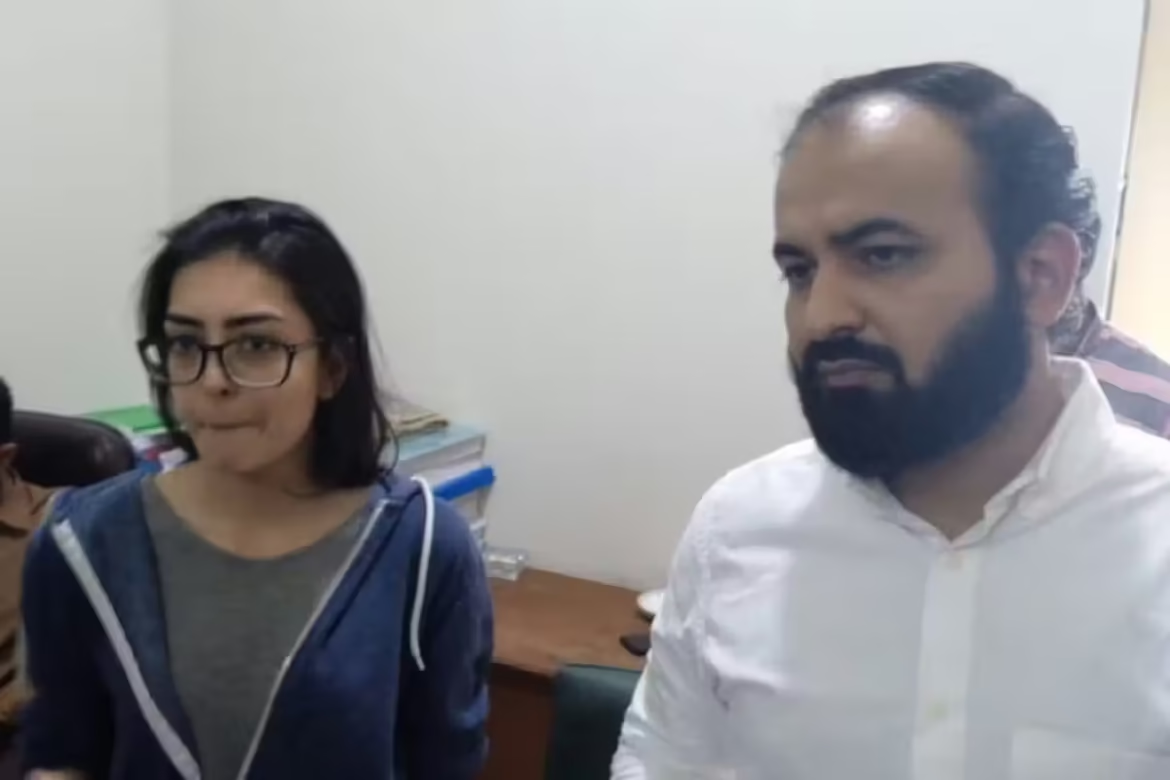
Imaan Zainab Mazari-Hazir and her husband, Hadi Ali Chattha, filed their appeals in the Islamabad High Court on Friday, a little over a week after an anti-terrorism court (ATC) handed down the sentences at Adiala jail in Rawalpindi on 29 October.
The couple also applied for their sentences to be suspended and for release on bail while the appeals are pending. The appeals, numbered 283/2026 for Mazari-Hazir and 282/2026 for Chattha, were filed by the lawyers Faisal Siddiqui, Riasat Ali Azad and Zainab Janjua. It was not immediately clear when the high court would hear them.
The case dates to October 2024, when the pair were accused of removing barriers along the route of a visiting international cricket team in Islamabad. The ATC convicted them under Section 7 of the Anti-Terrorism Act and sentenced each to 10 years, together with a fine. It also imposed one-year terms under Section 186 of the Pakistan Penal Code, for obstructing a public servant, and two years under Section 353, for assault or criminal force to deter a public servant from his duty. Reports of the judgment say the sentences run concurrently, so the effective term is 10 years each.
The couple deny the charges and say they are being targeted for their professional work and activism.
In the near-identical appeals, their lawyers argue that the trial court “failed to meet the requirements of a fair trial” and that the conviction was the product of “patently illegal and arbitrary proceedings”.
The appeals say the charge was framed without the couple being given the documents required under Section 265-C of the Code of Criminal Procedure, and that a plea of not guilty was recorded on their behalf although none was entered. Prosecution evidence was also recorded in the absence of the couple and their counsel, they say, contrary to the criminal procedure code and Article 10-A of the constitution, which guarantees a fair trial.
The jail trial itself is also challenged. The appeals say it was conducted in a manner akin to a secret trial and without lawful authority, and that the couple were denied a proper, confidential consultation with their lawyers. State counsel was imposed on them against their stated wishes, according to the filing, and the court pressed ahead despite a transfer application pending before the high court, in breach of Section 526(8) of the procedure code.
On the substance, the appeals argue that the terrorism conviction cannot stand because the prosecution failed to prove the design or purpose required under Section 6 of the Anti-Terrorism Act. They point out that the trial court itself described the episode as “a very common nature, ordinary type of incident”, and that the evidence showed the couple were on their way to court when they were held up at the barrier.
The applications to suspend the sentences argue that the verdict came while a transfer application was pending, and that the bar on suspension under Section 25(8) of the Anti-Terrorism Act is not absolute when read with Section 25(5).
The couple have been in custody since 23 January, when they were arrested in a separate case over social media posts that prosecutors described as anti-state. A sessions court sentenced them the next day to 17 years each under the Prevention of Electronic Crimes Act. The Supreme Court suspended those sentences on 17 September, but police rearrested them the same day in the security barrier case.
On Tuesday, a separate anti-terrorism court in Islamabad granted them bail in a third case, in which they are accused of blocking a road outside the National Press Club and clashing with police.
Also on Friday, 23 international organisations, including Amnesty International, the New York City Bar Association, the Council of Bars and Law Societies of Europe, the Geneva Bar Association, Lawyers for Lawyers, the Alliance for Lawyers at Risk and PEN Norway, called on the Pakistani government to release the couple “immediately and unconditionally”.
In a joint statement, they said the convictions raised “serious concerns” over anti-terrorism laws being used “to criminally punish and intimidate lawyers undertaking permissible human rights work”. They noted that the verdict was delivered while a petition was pending in the Supreme Court, and said the trial at Adiala jail did not meet fair trial standards.
The groups said the couple were kept in a “cage-like” structure in the courtroom throughout the trial and so could not communicate effectively with their counsel, who were also denied sufficient access to them. The prosecution relied mainly on police testimony, they added, while the defence was denied adequate opportunity to challenge it.
Applying such legislation to the alleged removal of security barriers raised “serious questions about the proportionality of the charges”, the organisations said. They described the case as part of “successive, politically motivated, criminal proceedings” intended to punish the couple and deter them from continuing their human rights work.
“The successive proceedings in the barrier removal case, and their prolonged deprivation of liberty despite the SC’s intervention, reinforce our concern that the criminal proceedings are calculated to make an example of the two lawyers,” the statement said. It warned of a chilling effect on the independence of the legal profession in Pakistan.
The groups urged the government to quash the convictions, drop any charges arising solely from the couple’s work, and review the use of the Prevention of Electronic Crimes Act and anti-terrorism legislation against lawyers, journalists, human rights defenders and peaceful critics. They also called on Pakistan to meet its obligations under the International Covenant on Civil and Political Rights.
“Judicial remedies cannot be meaningful if a grant of liberty by one court is followed immediately by detention through another proceeding without sufficient credible evidence,” the statement said.
Copyright © 2021 Independent Pakistan | All rights reserved