By Staff Reporter
ISLAMABAD: The government and the Islamist party Jamaat-e-Islami have agreed the “basic outlines” of a deal on fuel prices, the party’s vice-emir said on Tuesday after a tenth round of talks that leaves a threatened march on Islamabad dependent on the prime minister’s next move.
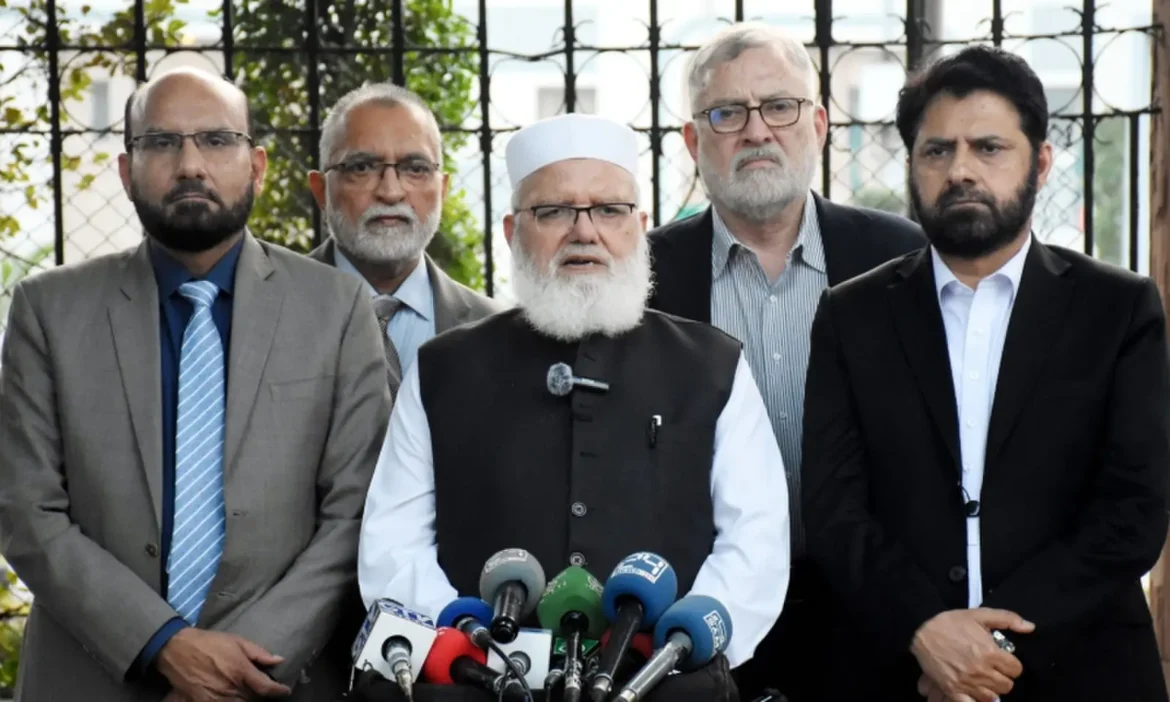
Liaqat Baloch told reporters outside the Ministry of Foreign Affairs that a final decision was expected after a possible meeting between Prime Minister Shehbaz Sharif and the party’s chief, Hafiz Naeemur Rehman, according to a statement from the party. Baloch said that meeting would involve detailed discussions before any agreement was finalised. He described the latest session as the most important of the negotiations so far and said securing relief for consumers remained the “central objective”.
The talks centred on two questions: how to cut costs for consumers, and what measures could achieve it. The party said the government had acknowledged the hardship caused by the regional conflict, and that both sides had agreed to expand and continue the existing relief package. Jamaat-e-Islami proposed extending the scheme to vehicles with engines of up to 1,000cc and to the agriculture sector, tractors included.
Baloch said the government had also accepted that the demand to abolish the petroleum levy was justified and could bring substantial relief to the public. The party pressed for “immediate and visible reductions” in petrol prices alongside abolition, and put forward a mechanism for phasing the levy out. In response, he said, the government promised to set out a future course of action on abolition while explaining the limits of its finances.
The Foreign Office gave a more measured account on social media. It spoke of “broad agreement” on the need to address public concerns “through continued consultation and cooperation”, and called the discussions “constructive”. Deputy Prime Minister Ishaq Dar, it said, welcomed the “positive spirit” of the engagement and restated that the government was focused on supporting ordinary households through economic hardship.
The government side included Rana Sanaullah, the minister for inter-provincial coordination, and Tariq Bajwa, a special assistant to the prime minister. The special secretary and the director general (oil) of the Petroleum Division and an additional secretary of the Finance Division also attended, the Foreign Office said. Jamaat-e-Islami’s delegation included Syed Firasat Shah, Nasrullah Randhawa, Inayatullah Khan and Ziauddin Ansari.
The party’s statement quoted Baloch as saying that it was for the government to persuade the International Monetary Fund to allow relief measures to continue. The Fund has urged Pakistan to phase out the fuel support scheme quickly, citing its cost and its broad targeting. Reports in early October said the lender wanted broad fuel subsidies ended in favour of targeted help, and estimated the three-month relief programme could cost more than Rs75bn.
Baloch accused the government of refusing to rein in lavish spending and non-development funds while the Federal Board of Revenue missed its collection targets. He said ministers were passing the burden of their “financial shortcomings onto ordinary citizens instead of reducing its own expenditure and improving revenue collection”. Rulers, he said, should cut their own spending and give consumers relief gradually.
The party said the negotiations had reached the “stage of final decisions” and that the two sides had worked on drafting a proposed agreement during the meeting. Whether Jamaat-e-Islami goes ahead with its long march will depend on the government’s response, it said. It claimed its protests had already helped prevent further rises in petrol prices.
The party also set a limit on its patience. It would not negotiate indefinitely, the statement said, and would walk away “the day it felt talks no longer served any purpose”.
Jamaat-e-Islami has campaigned for more than two months for the Centre to abolish petroleum levies, after fuel prices soared following conflict in the Middle East that began in March. In May, the government raised the levy on petrol and diesel to an average of Rs160 a litre, in line with a commitment to the IMF, with retail fuel at around Rs415 a litre.
On 3 September, a government delegation led by the planning minister, Ahsan Iqbal, met Mr Rehman at the party’s Mansoorah headquarters in Lahore to try to end its sit-ins, and both sides formed negotiating teams. The party launched a march towards Islamabad on 20 September, warning that the protest could become a campaign to remove the government if the levy was not scrapped. Two days later, with its convoy in Multan, Rehman postponed the march at the prime minister’s request, pending a meeting.
Sharif and Rehman met a month later, on 27 October, and agreed to set up a joint committee to recommend ways of expanding the fuel relief scheme and of reducing the levy in stages in the next budget. Rehman said afterwards that the prime minister had asked for another seven to 10 days, and that the march would go ahead in mid-November regardless.
On 3 November, the two sides held what the party called “candid discussions” on relief for low-income households. Jamaat-e-Islami said then that the government had agreed relief for agriculture, public transport and certain categories of vehicle, but had refused to end the levy. Baloch said the party had presented six proposals, including abolition of the levy, a relief package and lower public transport costs. He announced last week, after a telephone call with Dar, that the final round of negotiations would be held on 10 November.
Copyright © 2021 Independent Pakistan | All rights reserved