By Staff Reporter
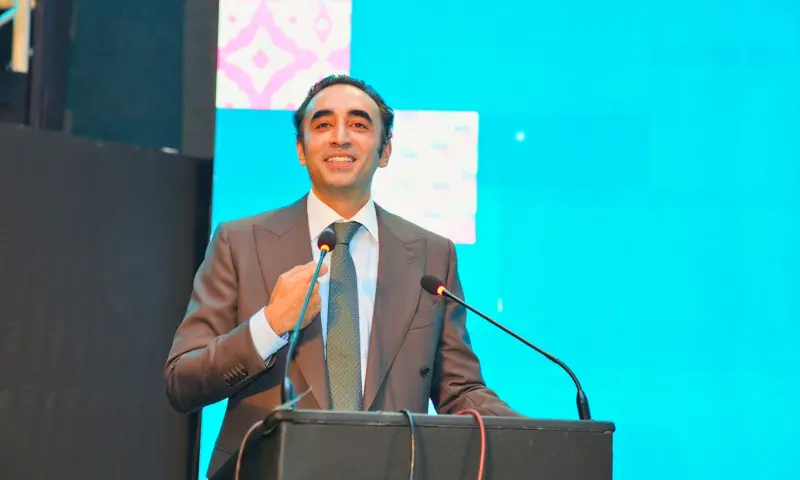
KARACHI: Bilawal Bhutto-Zardari, whose Pakistan Peoples Party is an ally of the federal government, urged Prime Minister Shehbaz Sharif on Tuesday to rebuild trust with his coalition partners and then the opposition, warning that the country cannot survive an oil-driven “economic catastrophe” without a “political reset”.
The PPP chairman made the appeal at a ceremony in Karachi marking the completion of one million houses for victims of the 2022 floods under the Sindh Flood Resilience Project. He said Pakistan and the wider world faced one of the worst economic crises in history, and that politics would “definitely have to be reset” to meet it.
“But via this reset, political parties will have to work together instead of fighting,” he said, adding that the public did not want to see more infighting.
Bhutto-Zardari, a former foreign minister, invited the prime minister to “restore the trust of his allies” first, then that of opposition parties, “instead of picking new fights with them”. The country’s difficulties would not ease unless all Pakistanis, opposition included, stood together, he said. “Unless we face this crisis together, we will not be able to save our people from this difficulty.”
He also set out a contrast in how the country should be run. Some politicians believed Pakistan would advance if it were reset and governed according to the wishes of the rich, he said, but he believed it should answer to the will of the poor and the homeless.
The war between the US, Israel and Iran has hit Pakistan hard. The conflict began on 28 February, and Iran effectively closed the Strait of Hormuz, through which nearly a fifth of global oil trade passes. Pakistan ordered emergency austerity measures in March, including a four-day working week for government employees and a two-week closure of schools. Inflation reached 11.7 percent in May, a two-year high, and Sharif has said the weekly oil import bill had almost tripled to $800m.
Prices have eased since then. Crude fell below $95 a barrel last week, though that remains well above the roughly $70 recorded before the conflict. Islamabad has also cast itself as a mediator: it hosted US-Iran talks in April after a 15-day truce reportedly brokered by Sharif and Field Marshal Asim Munir.
Bhutto-Zardari’s remarks follow weeks of sharp exchanges between federal ministers and Maulana Fazlur Rehman, the veteran leader of the Jamiat Ulema-i-Islam-Fazl, who has now decided to strengthen his ties with the opposition alliance led by former prime minister Imran Khan’s Pakistan Tahreek-e-Insaf party.
The row began after the Centre imposed governor’s rule and an emergency in the PTI-ruled province of Khyber Pakhtunkhwa. President Asif Ali Zardari proclaimed both measures on the prime minister’s advice, citing the province’s worsening security situation. The Centre has repeatedly pointed to the provincial government’s “deliberate disengagement” from the counterterrorism fight. A governor from Bhutto-Zardari’s own party now heads the provincial administration.
Rehman called the move an “attack on democracy”. Last Friday, Interior Minister Mohsin Naqvi, without naming anyone, said a political chief was furious at being denied a role in the new arrangement, a remark that appeared to refer to the JUI-F leader. The PTI-led opposition alliance, the TTAP, appeared to have brought a once-reluctant Mr Fazlur Rehman on board.
Calls for reconciliation are familiar from the PPP chairman. In February he proposed that his father, President Zardari, lead a process of political healing, describing him as the “king of political reconciliation”.
At Tuesday’s event, Bhutto-Zardari said he had met the prime minister’s team and that both sides had assured each other of continued coordination, with the Centre backing Sindh and the province extending its cooperation in return. He also referred to criticism of the political system from Lahore’s business community, saying the public did not want the system undermined.
He thanked Sharif for federal support with the flood housing programme. Without naming Imran Khan, he said a predecessor of the prime minister “did not give us a single penny” for flood victims in Sindh. “He even said ‘Sindh is not ours’, but Prime Minister Shehbaz Sharif has at least not made us feel this,” he said. He credited the project’s success to the provincial government’s efforts, international backing and “cooperation of the Centre”.
Bhutto-Zardari said Sindh had built one million houses and would complete two million, calling it the largest housing programme in the world. He said ownership had been registered in the names of women, and described the scheme as the biggest land-transfer exercise since 1970. He announced the plan to build two million flood houses in July 2023.
The programme carries a total cost of almost $2bn and aims to rebuild around 2.1 million rural homes damaged in the 2022 floods, covering 40 percent of rural households in Sindh. EIB Global, the European Investment Bank’s international development arm, is providing a €100m loan. The provincial government has sought a further $350m from the World Bank for fiscal 2026-27.
The PPP chairman used the event to reject allegations of graft, accusing opponents of a smear campaign against the Sindh government. He said critics had claimed the PPP was raising money for the homes in order to profit from it. He urged Chief Minister Murad Ali Shah to write to international bodies and invite them to audit the scheme. “I can confidently say that no corruption has taken place in this project,” he said.
Copyright © 2021 Independent Pakistan | All rights reserved