By Staff Reporter
ISLAMABAD: Pakistan has demanded an “immediate and unconditional” end to Houthi attacks on Saudi Arabia after the UN Security Council renewed Yemen sanctions and moved to cut off the group’s supply of drone and missile components.
The resolution, adopted by consensus on Thursday, extends the asset freeze and travel ban on individuals and entities threatening Yemen’s peace, including those linked to the Houthis, until 14 November 2027. It renews the mandate of the Panel of Experts that monitors the sanctions until 15 December 2027. The arms embargo imposed under Resolution 2216 in April 2015 remains in force and has no expiry date.
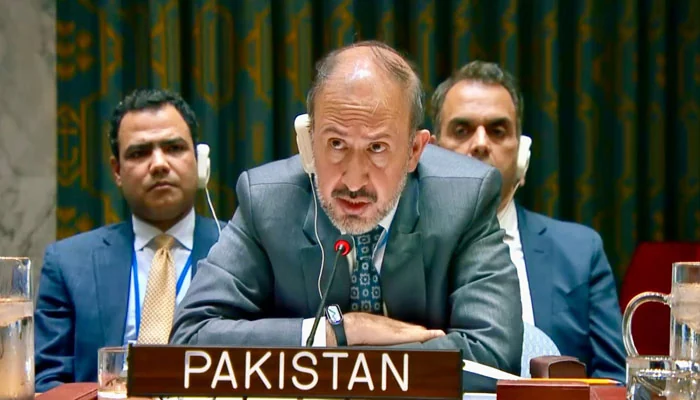
Syed Haider Shah, Pakistan’s permanent representative to the UN, said in his explanation of vote: “Pakistan condemns in the strongest terms the continued Houthi terrorist attacks against the Kingdom of Saudi Arabia. We stand in full and unwavering solidarity with the leadership, government and brotherly people of Saudi Arabia.”
He added: “Consistent with the United Nations Charter and international law, we support its legitimate right to defend its territory and protect its citizens and residents. We demand an immediate and unconditional cessation of these reprehensible Houthi attacks.”
The council demanded that the Houthis halt their military offensive in Yemen, stop attacking Saudi Arabia and end threats to commercial shipping.
The text also targets the group’s growing ability to build weapons locally from commercially available parts and precursor chemicals. UN monitors have found that the Houthis sustain their arsenal through smuggling and the diversion of civilian-use equipment, gradually reducing their reliance on outside supplies. Council members have until 11 January to decide what measures to take against the acquisition of specified items, drawn from a list the expert panel will prepare.
The panel’s remit has been widened to cover revenue the Houthis raise by controlling key economic sectors, with recommendations to be made on stopping that money reaching military activities. A further provision says the arbitrary detention of UN, diplomatic and humanitarian staff could be grounds for additional sanctions.
That clause follows the death in Houthi custody of Mohammad El-Shami, a Yemeni employee of the UN Human Rights Office who had been held since 6 June 2024. His family was told only recently that he had died more than a month earlier.
Consensus came after a difficult negotiation. Britain, the penholder on the text, had sought to restore language describing the Houthis as a terrorist group, wording used in sanctions resolutions since 2022, but dropped the effort after Russia objected that it could undermine political talks. Bahrain, backed by the United States, also tried to reintroduce the term, but its proposal was not taken up. China, supported by Russia, objected to the proposed list of dual-use items and to the expansion of the panel’s mandate.
Yemen’s ambassador, Abdullah Al-Saadi, welcomed the condemnation of the Houthis but regretted that the council “was not able to agree on naming things with their names”. He said the lack of stronger wording did not absolve the group’s backers of responsibility. He also accused the Houthis of using starvation as a weapon of war and called for an end to their long siege of Taiz.
Shah said Pakistan supported firmer international action but insisted that the conflict needed a political settlement that respected Yemen’s sovereignty, independence, unity and territorial integrity. “An inclusive political process that is Yemeni-owned and Yemeni-led” was essential to peace, he said. He added that the Panel of Experts must work strictly within its mandate, with “professionalism, impartiality and consistency”, to protect its credibility. Pakistan also thanked Britain for its role in the negotiations.
Pakistan’s mission to the UN set out the same positions in a statement on Friday.
The vote came on the day the Houthis claimed attacks on a pumping station on Saudi Arabia’s East-West oil pipeline, an oil facility at the Red Sea city of Yanbu and an Aramco building in Riyadh. The Saudi-led coalition said it had intercepted and destroyed two Houthi drones, one over the Riyadh region and the other over the kingdom’s oil-rich Eastern Province. Forces of Yemen’s internationally recognised government said they carried out 703 strikes on Houthi targets on Thursday, killing or wounding about 200 fighters.
The Houthis seized the capital, Sanaa, in 2014, and Saudi Arabia intervened militarily the following year to back the government. A UN-brokered truce in 2022 largely froze the war, but fighting resumed in July.
The Houthis have since taken the port of Mocha and islands in and around the Bab el-Mandeb Strait, a key shipping route that has gained importance as an alternative to the Strait of Hormuz. An attack on Riyadh’s airport in October killed 13 people and closed it, and the US ordered non-essential embassy staff and their families out of Saudi Arabia, citing the Houthi threat. By late September the UN said more than 700 people had been killed in the latest fighting and nearly 130,000 displaced inside Yemen.
Houthi health officials said Saudi air strikes on a village near Sanaa on 7 November killed at least 33 people. Saudi Arabia said it was investigating. Two days later, Yemen’s government urged Iran to stop arming the Houthis and withdraw its military experts. The claims have not been independently verified.
Pakistan and Saudi Arabia signed a bilateral defence agreement in September 2025. In August this year they were joined by Turkey in the Makkah Joint Defence Agreement, under which an attack on any one of the three is to be treated as an attack on all. Turkey and Pakistan have since agreed to rapidly deploy forces and capabilities to Saudi Arabia under the pact, according to Al Jazeera.
Copyright © 2021 Independent Pakistan | All rights reserved