By Staff Reporter
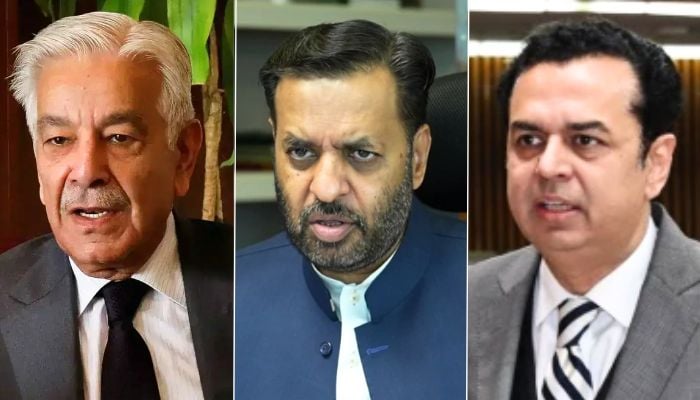
ISLAMABAD: Defence Minister Khawaja Asif on Wednesday asked Bilawal Bhutto-Zardari whether his own hands were clean, a day after the Pakistan Peoples Party chairman warned that dividing Sindh by force would bring bloodshed.
Asif’s rebuke, posted on X, was the sharpest of a series of attacks by federal ministers on Bhutto-Zardari. It exposed deep fractures in the governing coalition over a proposed referendum on creating new provinces, and over whether Karachi, Pakistan’s largest city, would stay in Sindh.
“He who claims equity must come with clean hands. This is a centuries-old legal maxim. Are your own hands clean? Do you have the right to lecture others or issue threats?” Asif wrote.
Bhutto-Zardari, whose party governs Sindh and supports Prime Minister Shehbaz Sharif’s government in Islamabad, made his remarks on Tuesday at the Karachi Press Club. He called for a “political reset” to restore public confidence in state institutions, and urged the government to revive dialogue with opposition parties, including Imran Khan’s Pakistan Tehreek-e-Insaf (PTI), and to end political victimisation. He said the system had not collapsed but had been deliberately destroyed, and that any reset had to be political rather than non-political.
He also rejected proposals for a referendum on new provinces, questioning the intent behind them. “If the province is divided by force, society will be divided, it will lead to enmity, ordinary people will take up arms, and the bloodshed will not be limited to a single death,” he said.
Asif, a senior figure in Sharif’s Pakistan Muslim League-Nawaz (PML-N), turned the PPP’s record in office against its chairman. The party has run Sindh for 18 years.
“Mr Bilawal, you have had the government in Sindh for 18 years. Sindh has become a paradise. The condition of Karachi city is something the world looks upon with envy,” he said sarcastically.
He also reminded the PPP that it has shared power with the PML-N in Islamabad since 2022. “The profit is yours, while the loss belongs to the PML-N or Pakistan,” he said.
Asif described the speech as “certainly very fiery and focused on criticism”, but said politicians should not call turning to the people a “backdoor”. He did not reject debate in parliament. He argued that it should run alongside a public vote.
“Our foundation as politicians is public opinion. There is no restriction on parliamentary debate and discussion alongside a public referendum,” he said. “If the opinion of the people is also sought alongside parliament, then, in my view, that would be the pinnacle of legitimacy.”
He added: “Governance is not anyone’s monopoly. This right has been bestowed by Allah upon 250 million people.”
“Why have you started fearing the vote?”
Talal Chaudhry, the minister of state for interior, went after the bloodshed warning directly at a press conference.
“The question is: does casting a vote lead to bloodshed, or does it prevent bloodshed? You have always maintained that decisions should be made through the ballot, not the bullet. So why have you started fearing the vote?” he said.
He accused Bhutto-Zardari of wanting to keep control of provincial resources for his party rather than for the people living there. “In seventeen years of your rule, your governance has drained the blood of Sindhis and the people of Sindh. First, look at whether there is any blood left in them at all,” he said.
Chaudhry also challenged the PPP chairman’s claim that votes on the 27th Constitutional Amendment were cast under pressure. He recalled that Bhutto-Zardari had spoken in favour of it in the National Assembly, calling a constitutional court Quaid-e-Azam’s dream and a legacy of his late mother, Benazir Bhutto.
“And then you said, ‘This is our legacy. By carrying our legacy forward, we have accomplished today what we had been trying to do for the past fifty years.’ In other words, this was something the Pakistan Peoples Party had been trying to accomplish, but it had not happened. And you took credit for this entire amendment. Today, you say that the vote was cast through coercion and force,” he said.
“Democracy is not just about delivering speeches, interpreting the articles of the Constitution, or explaining what the rights of the people are under those articles,” he added. “Democracy is also about performance. Democracy is also about governance.”
Rana Sanaullah, an adviser to the prime minister, said the claim about pressure could provide grounds for Mr Bhutto-Zardari’s disqualification as a lawmaker. He noted that the PPP had taken part in every stage of the coalition’s legislative work, including the 26th and 27th amendments. He asked whether Mr Bhutto-Zardari meant that he had voted under someone’s influence rather than of his own free will. Mr Sanaullah also said parliament would decide on any referendum, and advised the PPP chairman not to attach too much importance to statements by Asif and Interior Minister Mohsin Naqvi.
Information Minister Attaullah Tarar defended the referendum as a constitutional and legal way to gauge public opinion on new provinces. He said political parties that had held power for decades could not distance themselves from the weaknesses of the system. He also criticised parties that enjoy government positions while presenting themselves as opposition.
Karachi at the centre of the dispute
The fiercest claims came from Mustafa Kamal, the federal health minister and a leader of the Muttahida Qaumi Movement-Pakistan (MQM-P), a coalition partner. His party wants a nationwide referendum before the end of the year, and he argues that Karachi should be part of a new province.
“If even a single drop of blood is shed, the entire responsibility will lie with Bilawal Bhutto-Zardari,” Kamal said.
“Look at the records in Karachi. People from all communities, Sindhis, Pashtuns, Baloch, Punjabis and Saraikis, are now supporting the idea that Karachi should become an administrative unit and part of a new province,” he said in televised remarks. He called a referendum the best way to decide the issue and said the prime minister had the authority to hold one.
Kamal said the PPP should account for its 18 years in Sindh. He alleged that despite receiving Rs22,000 billion over 17 to 18 years, Karachi remained difficult to live in. He accused the party of weakening local government through the 26th Amendment and said Karachi had been divided into seven districts under its rule. He also claimed that the Muhajir community, which he said makes up 38 percent of Sindh’s population, had been undercounted by 7.3 million people and denied its share of development funds. These claims were his own and were not independently verified.
He urged the state to decide whether it wanted to protect a political party or Pakistan, warning that delay could let what he called “evil forces” enter the issue.
Malik Ahmad Khan, the PML-N speaker of the Punjab Assembly, asked why the PPP had backed a resolution on dividing Punjab but opposed dividing Sindh. Speaking in Lahore, he said President Asif Ali Zardari, the PPP co-chairman and Mr Bhutto-Zardari’s father, was willing to listen and that the issue could be settled through dialogue.
Opposition divided
The opposition reaction was mixed. The Jamiat Ulema-e-Islam-Fazl said Bhutto-Zardari had endorsed its view that a referendum was unnecessary where the Constitution already provides a mechanism. The Tehreek-e-Tahafuz-e-Ain Pakistan welcomed his comments in principle but urged him to turn words into action.
PTI chairman Barrister Gohar said he did not know the motives behind the speech but was glad the party’s political position was finally being recognised. Another PTI spokesman, Sheikh Waqas Akram, said the PPP could not escape responsibility for the country’s economic and political state while it remained in the ruling coalition. He demanded that it help secure the return of PTI’s reserved seats if it was serious about democratic representation.
The exchange followed reports that the president and prime minister had themselves discussed the issue. Sources said Zardari and Sharif agreed over the weekend that any change to provincial boundaries must follow the Constitution, and that a referendum would first need parliamentary approval. Neither the Presidency nor the Prime Minister’s Office confirmed this, and the Presidency said a meeting between Zardari and Naqvi had dealt with national security and regional matters.
Naqvi revived the debate in July with a call for more administrative units, and last week proposed putting the question to voters. Reports have pointed to a possible plan for 12 provinces under a 28th Amendment, with Punjab split into four, Khyber Pakhtunkhwa and Balochistan into three each, and Sindh into two. No draft has been presented.
A nationwide vote would not itself change any boundary. The Constitution lets the prime minister put a question of national importance to voters after approval by a joint sitting of parliament. Carving a new province out of Sindh would still require a constitutional amendment backed by two-thirds of the total membership of each house and two-thirds of the Sindh Assembly. The Assembly passed a resolution on 3 September rejecting any division of the province. That gives the PPP effective control over whether any such plan can proceed.
Copyright © 2021 Independent Pakistan | All rights reserved